











 Secure payments
Standard refund policy
Trade Assurance
Secure payments
Standard refund policy
Trade Assurance
| Brand | Samsung |
|---|---|
| Model | SM951 |
| Capacity | 256GB |
| Usage Class | Client |
| Host Interface | NVMe |
|---|---|
| Total Interface Bandwidth | 32 Gb/s |
| Form Factor | M.2 2280 |
|---|
| NAND Flash | MLC |
|---|---|
| Drive Writes Per Day | 0.3 |
| Total Bytes Written | 150 TBW |
| Sequential Read | 2150 MB/s |
|---|---|
| Sequential Write | 1200 MB/s |
| Random Read IOPS | 300000 |
| Random Write IOPS | 100000 |
| Average Latency | 50 μs |
| Mean Time Between Failures | 1.5 Million Hours |
|---|---|
| Uncorrectable Bit Error Rate | 1.0×10⁻¹⁷ |
| Power Loss Protection | No |
| MPN | MZ-HPU256HCGM |
|---|
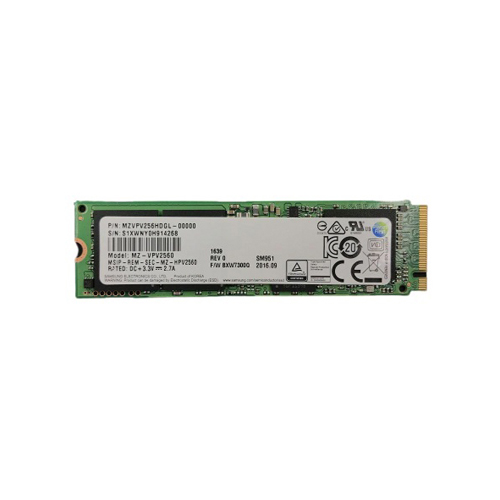
The Samsung SM951 (MZ-VPV2560) stands out in the 256GB client-performance tier by combining NVMe with MLC NAND to deliver up to 2150/1200 MB/s and 300K/100K IOPS, making it a strong fit for latency-sensitive boot drives, engineering workstations, and high-speed application scratch space. Compared with the previous-generation MZ-HPU256HCGM, it advances to an NVMe architecture for markedly lower protocol overhead and better parallel queue handling, while sustaining solid endurance at 150 TBW / 0.3 DWPD for more write-intensive daily use.
With an endurance rating of 150 TBW, this 256GB SSD can sustain about 41GB of host writes per day for 10 years, which is more than enough for typical OS, office, and application-drive workloads. Its 0.3 DWPD rating confirms it is a solid fit for boot and system-disk use in standard client or light-duty business environments, rather than heavy write-intensive server workloads. For reliability, the UBER specification of 1.0E-15 indicates a very low probability of unrecoverable read errors, supporting dependable day-to-day data integrity in normal operation. This model does not include power-loss protection (PLP), so while it is suitable for systems with stable power, it is not the best choice for applications where sudden power interruption during writes must be fully safeguarded.
1. The NVMe interface paired with 2150 MB/s sequential read throughput accelerates boot volumes, database scans, and large file staging in latency-sensitive enterprise servers.
2. With 300,000 K IOPS random read performance, the drive can sustain dense VM farms and high-concurrency OLTP workloads with faster access to small-block data.
3. A 0.3 DWPD endurance profile makes it a practical fit for read-centric enterprise use cases such as content delivery, reference datasets, and analytics cache tiers.
4. MLC NAND provides a stronger balance of consistency, write tolerance, and data integrity than cost-optimized flash, which is valuable for business-critical infrastructure.
5. The 50 µs typical latency helps applications respond more predictably, reducing storage wait time in transactional systems and real-time service environments.
Lower capacity reference: 128GB Higher capacity reference: 512GB In this series, the 256GB MZ-VPV2560 sits at the practical sweet spot. Compared with the 128GB model, it gives meaningfully better space flexibility for OS images, swap, logs, and application overhead, reducing the risk of early capacity pressure while keeping performance at a similar enterprise level. Compared with the 512GB option, it delivers a better balance of acquisition cost and usable capacity without overprovisioning the budget. It is best suited for small-to-medium virtualization clusters, such as hosting boot and utility volumes for about 25 to 40 virtual machines.
Q: Is MZ-VPV2560 suitable for a write-heavy database server?
A: Not ideally. With 0.3 DWPD and 150 TBW, MZ-VPV2560 is better suited for read-intensive or mixed workloads rather than sustained write-heavy database server environments.
Q: How many full drive writes per day can it actually endure over its warranty period?
A: It is rated for 0.3 DWPD, meaning about 30% of the 256GB capacity can be written daily over the warranty period, equivalent to roughly 76.8GB per day.
Q: Does it include power loss protection (PLP) and why is that critical?
A: No, it does not include PLP. This is critical in enterprise or database use because sudden power loss can risk in-flight data loss and metadata corruption.
Q: What RAID level is recommended for this SSD?
A: For this SSD, RAID 1 is commonly recommended for data redundancy, while RAID 10 is preferred when you need both improved performance and stronger fault tolerance.