











 Secure payments
Standard refund policy
Trade Assurance
Secure payments
Standard refund policy
Trade Assurance
| Brand | Samsung |
|---|---|
| Model | PM1743 |
| Capacity | 3.84 TB |
| Usage Class | Read Intensive |
| Host Interface | PCIe Gen5 x4 |
|---|---|
| Total Interface Bandwidth | 128 Gb/s |
| Form Factor | E3.S |
|---|
| NAND Flash | Samsung V-NAND 6th-Gen 128-layer 3D TLC |
|---|---|
| Drive Writes Per Day | 1 |
| Total Bytes Written | 7008 TBW |
| Sequential Read | 14000 MB/s |
|---|---|
| Sequential Write | 7100 MB/s |
| Random Read IOPS | 2500000 |
| Random Write IOPS | 250000 |
| Average Latency | 75 μs |
| Mean Time Between Failures | 2.5 Million Hours |
|---|---|
| Uncorrectable Bit Error Rate | 1.0×10⁻¹⁷ |
| Power Loss Protection | Yes |
| MPN | MZWLO3T8HBLS-00A07 |
|---|
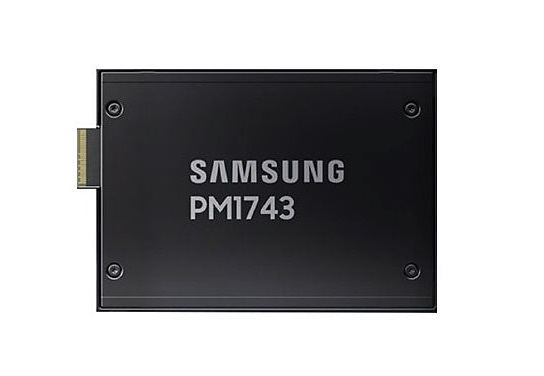
The Samsung PM1743 MZ3LO3T8HCJR-00A07 is a strong upgrade from the previous-generation MZWLO3T8HBLS-00A07, moving to PCIe Gen5 x4 and delivering up to 14,000/7,100 MB/s sequential throughput with 2,500,000/250,000 IOPS for substantially higher host-side bandwidth and transaction density. With 3.84 TB of 6th-Gen 128-layer V-NAND TLC, 1 DWPD endurance, and 7,008 TBW, it is especially well suited for latency-sensitive database, virtualization, and high-throughput analytics servers that need next-generation performance without stepping up to a higher-write-endurance class.
With an endurance rating of 7008 TBW and 1 DWPD, the MZ3LO3T8HCJR-00A07 is designed to handle writing its full capacity once per day across the warranty period, which is more than sufficient for typical enterprise boot, system, and mixed-read workloads. In practical terms, for common OS, application, and infrastructure use cases, this level of endurance supports long-term deployment with ample write headroom and low concern about wear-related replacement cycles. For enterprise reliability, built-in power loss protection (PLP) helps preserve in-flight data and protect metadata integrity during unexpected power interruptions, reducing the risk of corruption or unplanned downtime. Its UBER of 1.0E-17 and MTBF of 2.5 million hours indicate a very low probability of unrecoverable bit errors and strong long-run operational reliability, making it a dependable choice for business-critical environments.
1. The PCIe Gen5 x4 interface provides the bandwidth headroom needed to keep modern GPU servers, high-core-count CPUs, and composable storage platforms fed without creating a bus bottleneck.
2. Its sequential read performance shortens large dataset ingestion, checkpoint loading, and backup restore windows, helping analytics and AI clusters reach productive runtime faster.
3. Its random read capability sustains extremely high transaction concurrency, making it well suited for virtualization, scale-out databases, and latency-sensitive cloud services.
4. The endurance profile supports full-capacity rewrites every day across the warranty period, giving enterprises a practical balance of write tolerance, usable life, and storage cost for mixed workloads.
5. Built on Samsung’s mature multi-layer TLC V-NAND, the drive delivers low typical latency and stable QoS, which translates into faster application response and more predictable service-level performance under load.
Lower capacity reference: 1.92 TB Higher capacity reference: 7.68 TB In this series, 3.84 TB is the practical sweet spot between the 1.92 TB and 7.68 TB options. Compared with 1.92 TB, it gives much better headroom for data growth, overprovisioning, and mixed workload consolidation, reducing the need for early drive expansion. Compared with 7.68 TB, it typically delivers the best balance of acquisition cost, usable capacity, and enterprise-grade performance consistency without overcommitting budget to space that may remain idle. It is well suited for a mid-scale virtualization cluster, such as hosting boot and application volumes for about 40 to 60 virtual machines.
Q: Is MZ3LO3T8HCJR-00A07 suitable for a write-heavy database server?
A: It can support mixed or moderate write-intensive database workloads, but with 1 DWPD, it is not the best choice for extremely write-heavy servers requiring higher endurance over long-term operation.
Q: How many full drive writes per day can it actually endure over its warranty period?
A: This model is rated for 1 DWPD, meaning it can handle one full 3.84 TB drive write per day throughout its warranty period, aligned with its 7008 TBW endurance rating.
Q: Does it include power loss protection (PLP) and why is that critical?
A: Yes, it includes power loss protection. PLP is critical because it helps preserve in-flight data and metadata during sudden power failure, reducing corruption risk in enterprise environments.
Q: What RAID level is recommended for this SSD?
A: RAID 10 is generally recommended for this SSD when performance and redundancy are both important. For capacity-focused deployments, RAID 5 or RAID 6 may also be considered.