











 Secure payments
Standard refund policy
Trade Assurance
Secure payments
Standard refund policy
Trade Assurance
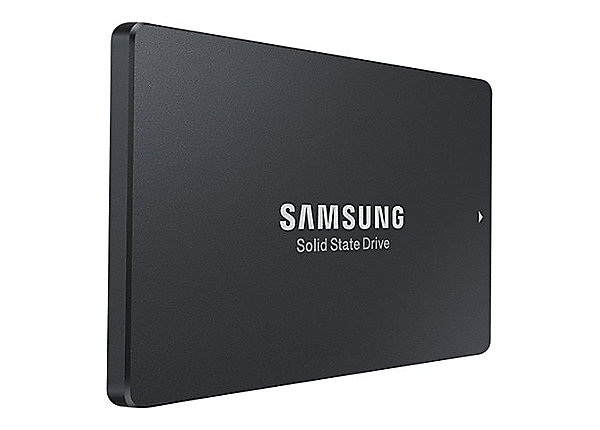
| Brand | Samsung |
|---|---|
| Model | SM863 |
| Capacity | 1.92TB |
| Usage Class | Mixed Use |
| Host Interface | SATA 6Gbps |
|---|---|
| Total Interface Bandwidth | 6 Gb/s |
| Form Factor | 2.5 |
|---|
| NAND Flash | V-NAND MLC (32-layer) |
|---|---|
| Drive Writes Per Day | 3.6 |
| Total Bytes Written | 12320 TBW |
| Sequential Read | 520 MB/s |
|---|---|
| Sequential Write | 485 MB/s |
| Random Read IOPS | 97000 |
| Random Write IOPS | 28000 |
| Average Latency | 100 μs |
| Mean Time Between Failures | 2 Million Hours |
|---|---|
| Uncorrectable Bit Error Rate | 1.0×10⁻¹⁷ |
| Power Loss Protection | Yes |
| MPN | MZ7KM1T9HAJM-00005 |
|---|
As the newer revision of the SM863 versus MZ7KM1T9HAJM-00005, the MZ7KM1T9HAJM-000NU stands out by pairing enterprise SATA simplicity with 3.6 DWPD endurance and 12,320 TBW at 1.92TB—substantially stronger write durability than typical read-focused SATA SSDs in the same class. For always-on virtualization, OLTP, and database log workloads that do not require SAS, its 32-layer V-NAND MLC, 97,000/28,000 IOPS, and 520/485 MB/s performance deliver a more robust and write-resilient platform than mainstream TLC-based alternatives.
With an endurance rating of 12,320 TBW and 3.6 DWPD, the MZ7KM1T9HAJM-000NU is built to handle sustained write-intensive enterprise workloads over its service life. In typical server use, this level of endurance means the drive can comfortably support long-term operation as a reliable system, boot, or application drive with substantial write headroom. For enterprise reliability, the drive includes Power Loss Protection (PLP), which helps preserve in-flight data and protects metadata integrity if power is unexpectedly interrupted. Its ultra-low UBER of 1.0E-17, together with a 2 million hour MTBF, indicates a very high standard of data integrity and operational reliability expected in data center environments.
1. The SATA interface ensures broad compatibility with mainstream enterprise servers and storage arrays, enabling straightforward drop-in upgrades without changing existing backplane infrastructure.
2. Its sustained sequential read performance accelerates large-block workloads such as database backup, media streaming, and VM image loading, helping reduce wait time in data-intensive operations.
3. Strong random read capability makes it well suited for latency-sensitive applications like OLTP databases, VDI boot storms, and heavily virtualized environments where many small requests arrive at once.
4. With an enterprise-grade write endurance profile backed by MLC V-NAND, this drive is built to handle frequent daily overwrite cycles in caching, logging, and mixed-workload deployments while maintaining long service life.
5. The combination of layered V-NAND architecture and very low typical latency supports consistently fast response times, improving application QoS and helping mission-critical services stay responsive under load.
Lower capacity reference: 960GB Higher capacity reference: 3.84TB In this series, the 1.92TB model is the sweet-spot capacity. Compared with the 960GB option, it gives much better headroom for OS images, logs, databases, and steady data growth, reducing early capacity pressure in enterprise nodes. Compared with the 3.84TB model, it usually delivers the best balance of acquisition cost, usable capacity, and enterprise-grade performance consistency. It is well suited for mid-scale deployments, such as a 2U virtualization host cluster, VDI pools, or mixed application servers requiring solid endurance without overprovisioning storage budget.
Q: Is MZ7KM1T9HAJM-000NU suitable for a write-heavy database server?
A: Yes. With 3.6 DWPD, 12,320 TBW, V-NAND MLC, and 100 µs typical latency, this 1.92TB SATA SSD is well suited for write-intensive database and enterprise server workloads.
Q: How many full drive writes per day can it actually endure over its warranty period?
A: It is rated for 3.6 full drive writes per day. For a 1.92TB SSD, that equals about 6.9TB of writes daily across the specified warranty period.
Q: Does it include power loss protection (PLP) and why is that critical?
A: Yes, it includes power loss protection. PLP helps preserve in-flight data and metadata during sudden outages, reducing corruption risk and improving reliability in enterprise applications and RAID environments.
Q: What RAID level is recommended for this SSD?
A: RAID 10 is generally recommended for high-write, performance-sensitive workloads, offering both redundancy and speed. For capacity-focused deployments, RAID 5 or RAID 6 may also be considered if write penalty is acceptable.