











 Secure payments
Standard refund policy
Trade Assurance
Secure payments
Standard refund policy
Trade Assurance
| Brand | Samsung |
|---|---|
| Model | SM863 |
| Capacity | 960 GB |
| Usage Class | Write Intensive |
| Host Interface | SATA 6.0 Gbps |
|---|---|
| Total Interface Bandwidth | 6 Gb/s |
| Form Factor | 2.5" |
|---|
| NAND Flash | Samsung V-NAND 2-bit MLC |
|---|---|
| Drive Writes Per Day | 3.6 |
| Total Bytes Written | 6160 TBW |
| Sequential Read | 520 MB/s |
|---|---|
| Sequential Write | 485 MB/s |
| Random Read IOPS | 97000 |
| Random Write IOPS | 29000 |
| Average Latency | 95 μs |
| Mean Time Between Failures | 2 Million Hours |
|---|---|
| Uncorrectable Bit Error Rate | 1.0×10⁻¹⁷ |
| Power Loss Protection | Yes |
| MPN | MZ-77E500BW |
|---|
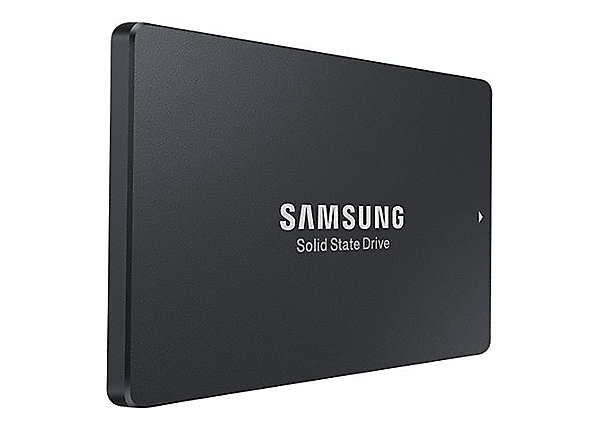
The Samsung SM863 MZ7KM960HAHP-00005 brings a clear generational step up from the MZ-77E500BW, moving to enterprise-class 3.6 DWPD endurance and 6,160 TBW with Samsung V-NAND 2-bit MLC for far stronger write longevity and sustained QoS under mixed workloads. At 960 GB, it pairs near-SATA-limit 520/485 MB/s throughput with up to 97,000/29,000 IOPS, making it a stronger choice than its predecessor for read-intensive virtualization, OLTP, and always-on server boot or caching tiers where consistency matters more than peak interface speed.
With an endurance rating of 6,160 TBW and 3.6 DWPD, this 960GB SSD is designed for sustained enterprise write activity and can comfortably handle typical OS, boot, application, and logging workloads with substantial headroom. In practical terms, for common system-disk or mixed-read environments, this level of endurance supports long-term deployment and can deliver many years of worry-free operation under normal data center usage. For enterprise reliability, built-in Power Loss Protection (PLP) helps preserve in-flight data and protects metadata integrity if power is unexpectedly interrupted, reducing the risk of corruption during outages. Its 1.0E-17 UBER and 2 million-hour MTBF indicate a very low uncorrectable bit error rate and strong long-term operational reliability, which is exactly what procurement teams look for in business-critical storage.
1. The SATA 6.0 Gbps interface ensures broad compatibility with existing enterprise servers and storage arrays, enabling cost-efficient upgrades without changing the backplane or controller stack.
2. With 520 MB/s sequential read performance, the drive accelerates backup restores, VM image loading, and large dataset access in read-heavy infrastructure.
3. Delivering 97,000 K IOPS in random reads, it helps databases and virtualized workloads respond faster under highly fragmented, concurrent access patterns.
4. Rated for 3.6 DWPD, this SSD is built for sustained write-intensive enterprise use, supporting demanding applications such as OLTP, logging, and mixed-workload caching with predictable lifespan.
5. Samsung V-NAND 2-bit MLC paired with a typical latency of 95 µs provides enterprise-grade flash consistency, helping latency-sensitive applications maintain stable QoS during continuous operation.
In this series, the next lower capacity is 480 GB and the next higher capacity is 1.92 TB. The 960 GB model is the practical sweet spot: compared with 480 GB, it offers much better headroom for OS growth, application logs, patching, and mixed workload bursts, reducing early capacity pressure. Compared with 1.92 TB, it keeps acquisition cost and $/IO efficiency more balanced while delivering essentially the same enterprise-class sequential and random performance profile. It is well suited for mid-sized virtualization clusters, such as hosting boot and core application volumes for around 40 to 60 general-purpose virtual machines.
Q: Is MZ7KM960HAHP-00005 suitable for a write-heavy database server?
A: Yes. With 3.6 DWPD, 6160 TBW, and Samsung V-NAND 2-bit MLC, this 960GB SATA SSD is well suited for write-intensive database workloads requiring strong endurance and low latency.
Q: How many full drive writes per day can it actually endure over its warranty period?
A: It is rated for 3.6 full drive writes per day. For a 960GB capacity, that equals about 3.46TB of writes daily across the defined warranty period.
Q: Does it include power loss protection (PLP) and why is that critical?
A: Yes, it includes power loss protection. PLP helps preserve in-flight data and metadata during sudden outages, reducing corruption risk and improving reliability in enterprise and transactional environments.
Q: What RAID level is recommended for this SSD?
A: The best RAID level depends on workload and fault-tolerance goals. RAID 10 is commonly recommended for databases, while RAID 1 or RAID 5 may suit lighter capacity-focused deployments.