

 Secure payments
Standard refund policy
Trade Assurance
Secure payments
Standard refund policy
Trade Assurance
| Brand | Samsung |
|---|---|
| Model | PM893 |
| Capacity | 1.92 TB |
| Usage Class | Enterprise/Read-Intensive |
| Host Interface | SATA 3.0 6Gb/s |
|---|---|
| Total Interface Bandwidth | 6 Gb/s |
| Form Factor | 2.5 inch 7mm |
|---|
| NAND Flash | Samsung V6 (128L) TLC |
|---|---|
| Drive Writes Per Day | 1 |
| Total Bytes Written | 3504 TBW |
| Sequential Read | 550 MB/s |
|---|---|
| Sequential Write | 520 MB/s |
| Random Read IOPS | 98000 |
| Random Write IOPS | 30000 |
| Average Latency | 100 μs |
| Mean Time Between Failures | 2 Million Hours |
|---|---|
| Uncorrectable Bit Error Rate | 1.0×10⁻¹⁷ |
| Power Loss Protection | Yes |
| MPN | MZ7L31T9HBLT-00007 |
|---|
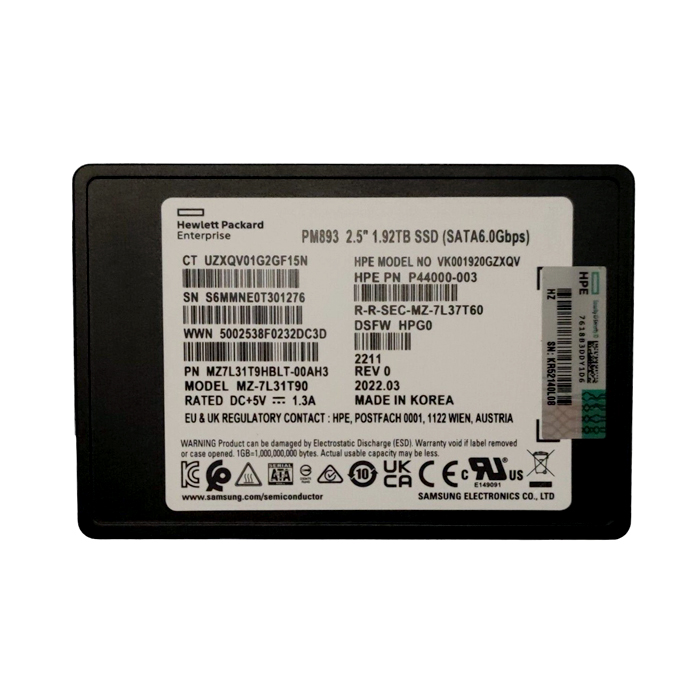
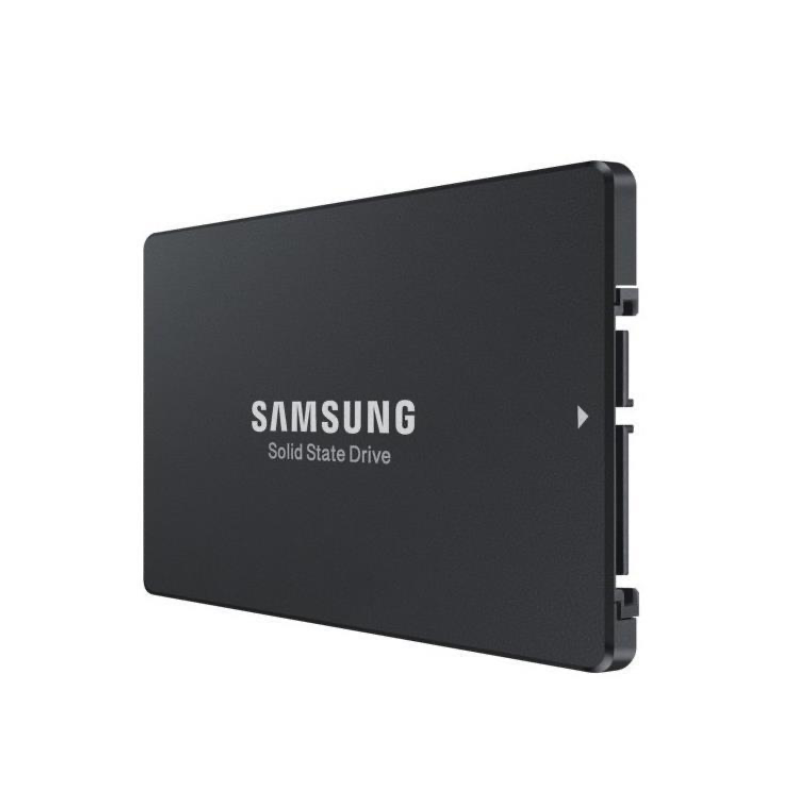
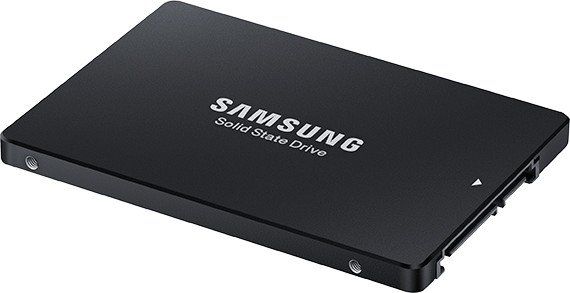
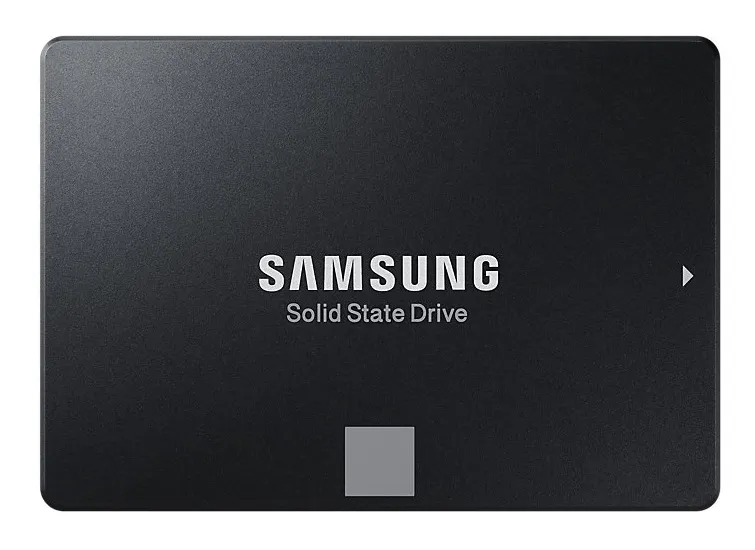
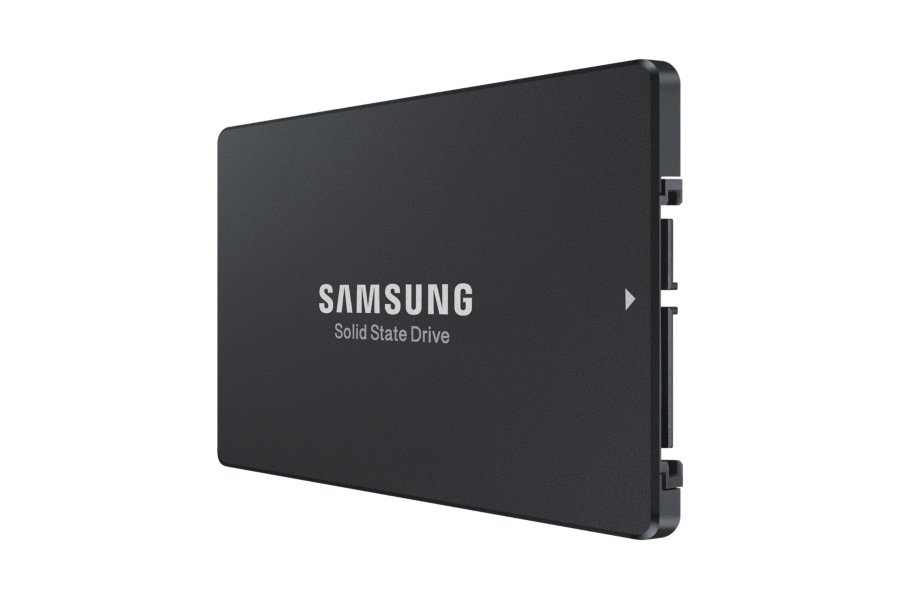
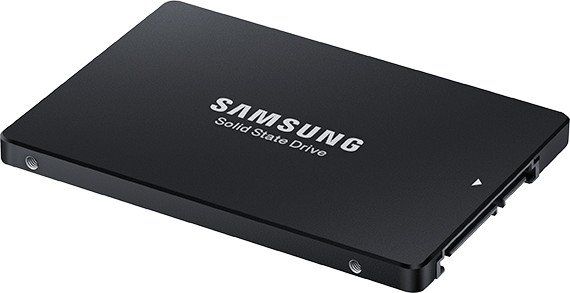
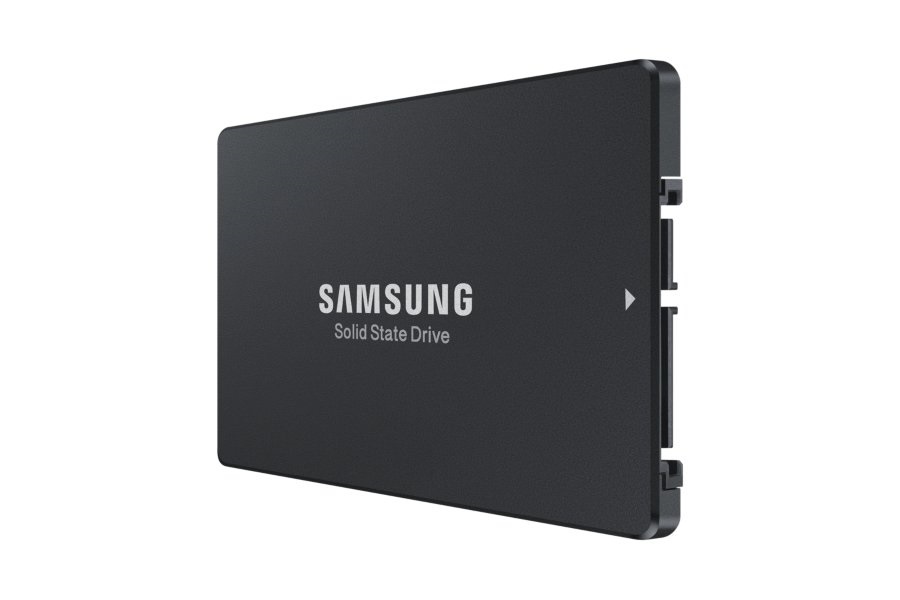
The Samsung PM893 1.92TB (MZ7L31T9HBLT-00AH3) is a strong choice for read-intensive and mixed-use enterprise SATA deployments, combining near–interface-limit 550/520 MB/s performance with 98K/30K IOPS and 1 DWPD endurance rated at 3504 TBW. Compared with the earlier MZ7L31T9HBLT-00007, this revision leverages newer Samsung V6 128-layer TLC NAND to deliver a more current-generation platform with stronger endurance-per-drive and better long-term value for server boot, virtualization, and scale-out storage refreshes.
With an endurance rating of 3504 TBW and 1 DWPD, this SSD can sustain very heavy write activity and still remain comfortably within its design limits. In typical boot-drive, application, or mixed enterprise workloads, that level of endurance is far more than most systems will consume over many years, so procurement teams can treat it as a low-risk choice for long-term deployment. Its power-loss protection (PLP) helps preserve in-flight data and critical metadata during an unexpected outage, reducing the risk of corruption and improving service continuity. The enterprise-class UBER of 1.0E-17, together with a 2 million hour MTBF, indicates a very low probability of unrecoverable read errors and strong overall reliability for business-critical environments.
1. The SATA 3.0 6Gb/s interface, paired with top-end sequential read performance, fully utilizes existing SATA server backplanes to speed up large file scans, backup restores, and VM image loading without requiring a platform upgrade.
2. With up to 98,000 random read IOPS, this SSD helps databases, virtual desktop pools, and read-heavy cloud workloads respond faster under high concurrency.
3. A 1 DWPD endurance rating makes it a practical fit for always-on enterprise environments where the drive is rewritten regularly but cost efficiency still matters.
4. Samsung V6 128-layer TLC NAND delivers a strong balance of capacity, power efficiency, and predictable reliability for mainstream data center deployments.
5. The typical 100 µs latency supports snappier transaction handling and more consistent application performance, especially in latency-sensitive server workloads.
Reference capacities in the same series for MZ7L31T9HBLT-00AH3 (1.92 TB): Lower capacity: 960 GB Typical performance: up to 550 MB/s sequential read, up to 520 MB/s sequential write, up to 98K random read IOPS, up to 30K random write IOPS Higher capacity: 3.84 TB Typical performance: up to 550 MB/s sequential read, up to 520 MB/s sequential write, up to 98K random read IOPS, up to 30K random write IOPS Capacity positioning analysis: The 1.92 TB point is the sweet spot in this SSD family. Compared with the 960 GB model, it gives much better headroom for OS images, logs, patch growth, and application data, reducing early capacity pressure. Compared with the 3.84 TB option, it keeps acquisition cost and fleet-level replacement budgets under tighter control while delivering essentially the same enterprise SATA performance. It is well suited for mid-scale virtualization clusters, such as hosting boot and middleware volumes for around 40 to 60 business application instances.
Q: Is MZ7L31T9HBLT-00AH3 suitable for a write-heavy database server?
A: Yes, it can support database workloads, but with 1 DWPD and 3504 TBW, it is better suited for mixed-use or moderate write-intensive environments rather than extremely heavy write workloads.
Q: How many full drive writes per day can it actually endure over its warranty period?
A: This model is rated at 1 DWPD, meaning it can handle one full 1.92 TB drive write per day across its warranty period within the specified endurance limits.
Q: Does it include power loss protection (PLP) and why is that critical?
A: Yes, it includes PLP. This is critical because it helps protect in-flight data and metadata during unexpected power failures, reducing corruption risk and improving storage reliability.
Q: What RAID level is recommended for this SSD?
A: RAID 1, RAID 10, or RAID 5/6 may be selected depending on performance, redundancy, and capacity goals. For database and business-critical workloads, RAID 10 is commonly recommended.