











 Secure payments
Standard refund policy
Trade Assurance
Secure payments
Standard refund policy
Trade Assurance
| Brand | Samsung |
|---|---|
| Model | PM893 |
| Capacity | 240GB |
| Usage Class | Enterprise |
| Host Interface | SATA 6.0 Gb/s |
|---|---|
| Total Interface Bandwidth | 6 Gb/s |
| Form Factor | 2.5 inch |
|---|
| NAND Flash | Samsung V-NAND 3-bit MLC (TLC) |
|---|---|
| Drive Writes Per Day | 1.3 |
| Total Bytes Written | 438 TBW |
| Sequential Read | 550 MB/s |
|---|---|
| Sequential Write | 380 MB/s |
| Random Read IOPS | 98000 |
| Random Write IOPS | 14000 |
| Average Latency | 140 μs |
| Mean Time Between Failures | 2 Million Hours |
|---|---|
| Uncorrectable Bit Error Rate | 1.0×10⁻¹⁷ |
| Power Loss Protection | Yes |
| MPN | MZ7LH240HAHQ |
|---|
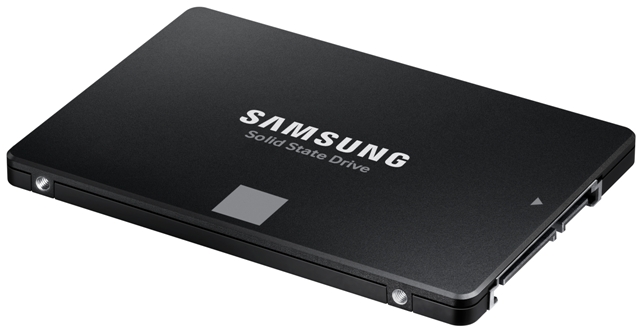
Compared with the previous-generation MZ7LH240HAHQ, the Samsung PM893 240GB (MZ7L3240HCHQ-00B7C) delivers a newer SATA platform with stronger endurance at 1.3 DWPD and 438 TBW, making it a better fit for write-intensive boot, logging, and edge server duties. Its 550/380 MB/s sequential performance and up to 98,000 random-read IOPS also give it a clear advantage for latency-sensitive read-heavy enterprise workloads where SATA compatibility, predictable QoS, and long-life V-NAND reliability matter most.
With an endurance rating of 438 TBW and 1.3 DWPD, this SSD is designed to handle sustained daily writes comfortably within its specified usage profile. In typical system-drive, boot-drive, or read-dominant enterprise workloads, that level of endurance is generally more than sufficient for many years of stable operation and should exceed the write demands of a normal hardware refresh cycle. Its built-in power loss protection (PLP) helps preserve in-flight data and metadata during an unexpected power interruption, reducing the risk of corruption and improving operational confidence. An UBER of 1.0E-17 indicates an extremely low probability of uncorrectable read errors, which is a key enterprise-grade reliability characteristic for maintaining data integrity over time.
1. The SATA interface makes this drive a drop-in upgrade for mainstream enterprise servers and storage arrays, while its top-end sequential read performance helps accelerate boot volumes, backups, and large-file ingest without requiring a platform refresh.
2. Its strong random-read capability keeps virtual machines, databases, and metadata-heavy applications responsive even when many users and processes are hitting the drive at once.
3. The endurance rating is suited to environments that rewrite substantial amounts of data every day, making it a practical fit for virtualization, logging, and read-optimized analytics tiers.
4. Samsung V-NAND TLC enables a cost-efficient enterprise capacity profile with better power and space efficiency, helping data centers scale storage density without sacrificing operational stability.
5. The low typical latency supports faster transaction acknowledgement and more predictable application behavior, which is especially valuable for OLTP, VDI, and latency-sensitive service workloads.
Lower capacity reference: 120GB Higher capacity reference: 480GB Within this enterprise SSD family, the 240GB model sits at a practical sweet spot. Compared with the 120GB version, it offers much better headroom for OS growth, logs, patches, and swap activity, reducing the risk of early capacity pressure. Compared with the 480GB option, it preserves nearly the same enterprise-class sequential and random I/O behavior while delivering a more efficient cost-per-node balance. This makes 240GB especially well suited for medium-scale server fleets, such as boot drives for 30-50 virtualization hosts or compact database and application nodes.
Q: Is MZ7L3240HCHQ-00B7C suitable for a write-heavy database server?
A: Yes, it can support moderate write-intensive database workloads thanks to its 1.3 DWPD endurance, low 140 µs latency, and PLP. For extremely heavy write environments, a higher-endurance model may be preferable.
Q: How many full drive writes per day can it actually endure over its warranty period?
A: This SSD is rated for 1.3 DWPD, meaning it is designed to handle about 1.3 full-capacity writes per day throughout its warranty period under normal enterprise operating conditions.
Q: Does it include power loss protection (PLP) and why is that critical?
A: Yes, it includes power loss protection. PLP helps preserve in-flight data and metadata during unexpected outages, which is critical for preventing corruption and maintaining consistency in enterprise systems.
Q: What RAID level is recommended for this SSD?
A: For database or virtualization use, RAID 1 or RAID 10 is typically recommended for stronger redundancy and better write performance. RAID 5/6 is more suitable for capacity-focused, read-heavy environments.