











 Secure payments
Standard refund policy
Trade Assurance
Secure payments
Standard refund policy
Trade Assurance
| Brand | Samsung |
|---|---|
| Model | PM893 |
| Capacity | 3.84 TB |
| Usage Class | Read Intensive |
| Host Interface | SATA 6.0 Gbps |
|---|---|
| Total Interface Bandwidth | 6 Gb/s |
| Form Factor | 2.5" |
|---|
| NAND Flash | Samsung V-NAND 6th-Gen 128-layer 3D TLC |
|---|---|
| Drive Writes Per Day | 1 |
| Total Bytes Written | 7008 TBW |
| Sequential Read | 550 MB/s |
|---|---|
| Sequential Write | 530 MB/s |
| Random Read IOPS | 98000 |
| Random Write IOPS | 30000 |
| Average Latency | 140 μs |
| Mean Time Between Failures | 2 Million Hours |
|---|---|
| Uncorrectable Bit Error Rate | 1.0×10⁻¹⁷ |
| Power Loss Protection | Yes |
| MPN | MZ7LH3T8HMLT |
|---|
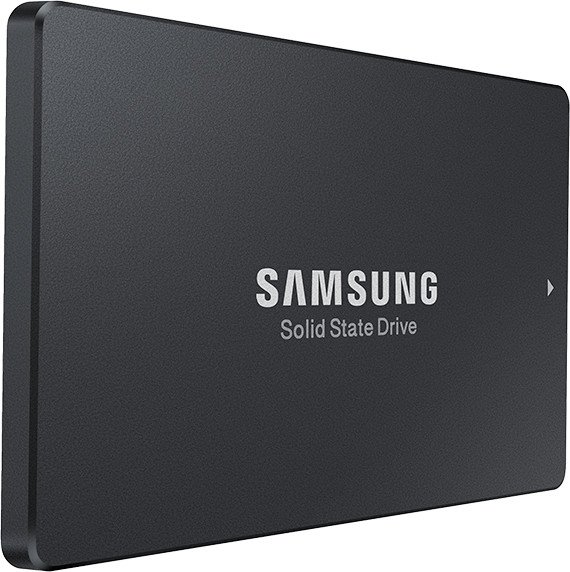
The Samsung PM893 3.84TB (MZ7L33T8HBLT) is a strong SATA refresh over the previous-generation MZ7LH3T8HMLT, using 6th-Gen 128-layer V-NAND to deliver better power efficiency, improved endurance management, and more consistent mixed-workload latency while sustaining up to 550/530 MB/s and 98K/30K IOPS. For read-centric to balanced enterprise workloads such as boot pools, virtualization storage, and scale-out server tiers, its 1 DWPD rating and 7008 TBW give it a clear lifecycle and reliability advantage over older SATA SSDs in the same capacity class.
With an endurance rating of 7008 TBW and 1 DWPD, the MZ7L33T8HBLT is designed to support writing its full capacity once per day across the warranty life, which is more than sufficient for typical enterprise operating system, boot, and general application workloads. In practical terms, under normal mixed-use conditions, this level of endurance provides long-term write headroom and can serve reliably as a system or infrastructure drive for many years without endurance concern. For enterprise reliability, built-in Power Loss Protection (PLP) helps preserve in-flight data and protects metadata integrity if power is interrupted unexpectedly, reducing the risk of corruption and downtime. Its UBER of 1.0E-17 and 2 million hour MTBF indicate an enterprise-class design focused on extremely low uncorrectable error rates and strong long-term operational stability, helping procurement teams buy with confidence.
1. The SATA interface ensures broad compatibility with mainstream enterprise servers and storage arrays, enabling simple drop-in upgrades without changing the existing backplane or controller ecosystem.
2. Its sustained sequential read performance accelerates full-dataset scans, backup restores, and large file retrieval, helping analytics and content delivery workloads finish faster.
3. Strong random read capability keeps latency-sensitive applications such as virtualization, OLTP databases, and boot storms responsive even under heavy parallel access.
4. This endurance profile supports consistent day-after-day write activity in mixed-use enterprise environments, giving operators a practical balance between lifespan, cost efficiency, and predictable maintenance planning.
5. Built on Samsung’s advanced V-NAND, the drive combines high density, mature TLC economics, and stable low-latency behavior, making it well suited for always-on data center deployments.
Lower capacity reference: 1.92 TB Higher capacity reference: 7.68 TB At 3.84 TB, the MZ7L33T8HBLT sits in the sweet spot of this series. Compared with the 1.92 TB model, it provides much better headroom for OS images, application stacks, logs, and moderate data growth, reducing early capacity pressure. Compared with the 7.68 TB model, it delivers essentially the same enterprise-class sequential and random performance while keeping acquisition cost and per-drive exposure more manageable. This makes it especially well suited for mid-scale virtualization clusters, database replicas, or roughly 40 to 60 general-purpose business application VMs.
Q: Is MZ7L33T8HBLT suitable for a write-heavy database server?
A: It can support moderate write-intensive database workloads, but with 1 DWPD it is better suited for mixed-use or read-focused enterprise servers rather than extremely write-heavy transactional environments.
Q: How many full drive writes per day can it actually endure over its warranty period?
A: This model is rated for 1 DWPD, meaning it can sustain one full 3.84 TB drive write per day across its warranty period, consistent with the 7008 TBW endurance specification.
Q: Does it include power loss protection (PLP) and why is that critical?
A: Yes, it includes power loss protection. PLP helps preserve in-flight data and metadata during unexpected outages, which is essential for maintaining data integrity and reducing corruption risk in enterprise systems.
Q: What RAID level is recommended for this SSD?
A: RAID 10 is generally recommended for enterprise SSD deployments requiring strong performance and redundancy. For capacity-focused environments, RAID 5 or RAID 6 may also be considered depending on workload priorities.