











 Secure payments
Standard refund policy
Trade Assurance
Secure payments
Standard refund policy
Trade Assurance
| Brand | Samsung |
|---|---|
| Model | PM883 |
| Capacity | 3.84TB |
| Usage Class | Enterprise |
| Host Interface | SATA 6Gb/s |
|---|---|
| Total Interface Bandwidth | 6 Gb/s |
| Form Factor | 2.5 |
|---|
| NAND Flash | Samsung V-NAND 3bit MLC |
|---|---|
| Drive Writes Per Day | 1.3 |
| Total Bytes Written | 5466 TBW |
| Sequential Read | 550 MB/s |
|---|---|
| Sequential Write | 520 MB/s |
| Random Read IOPS | 98000 |
| Random Write IOPS | 28000 |
| Average Latency | 145 μs |
| Mean Time Between Failures | 2 Million Hours |
|---|---|
| Uncorrectable Bit Error Rate | 1.0×10⁻¹⁷ |
| Power Loss Protection | Yes |
| MPN | MZ7LM3T8HMLP |
|---|
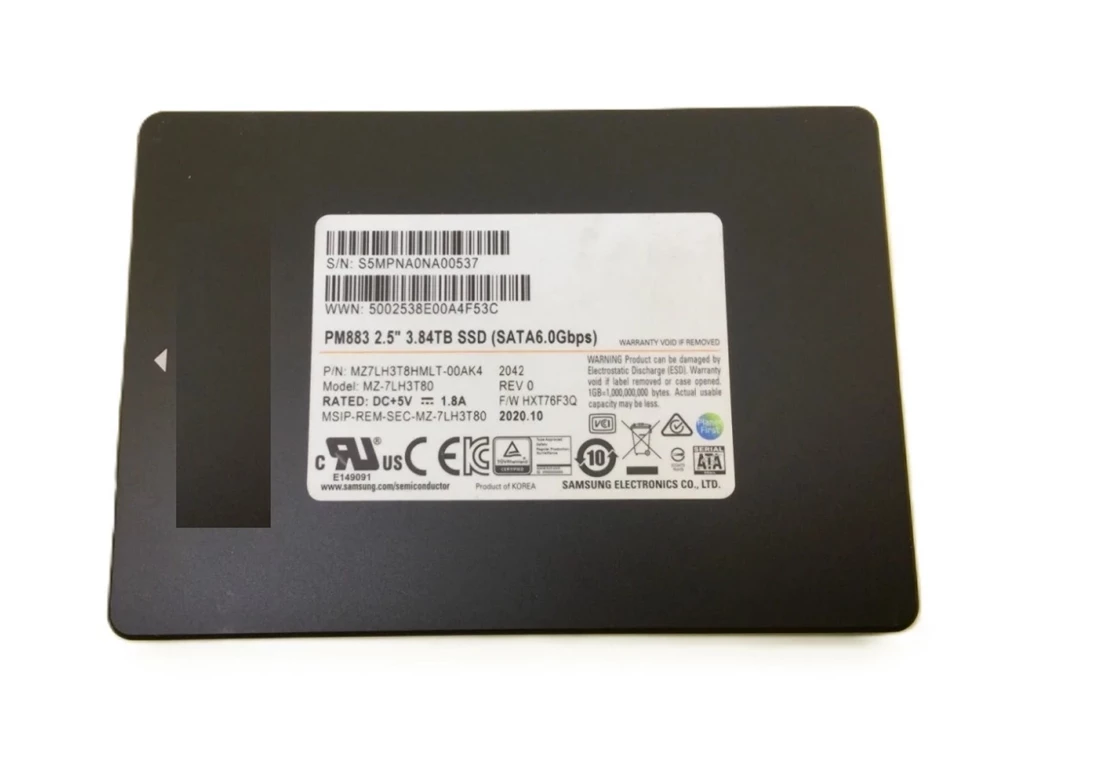
The Samsung PM883 MZ7LH3T8HMLT-00AK4 stands out as a high-density enterprise SATA SSD, combining 3.84TB of Samsung V-NAND 3bit MLC with 1.3 DWPD / 5,466 TBW, 550/520 MB/s sequential performance, and up to 98,000/28,000 IOPS for read-heavy virtualization, boot, and scale-out server tiers. Compared with the previous-generation MZ7LM3T8HMLP, this PM883 variant brings a newer V-NAND generation and a stronger balance of capacity density, sustained SATA-limit throughput, and enterprise endurance, making it the better choice for extending the life of existing 6Gb/s infrastructures without moving to SAS or NVMe.
With an endurance rating of 5,466 TBW and 1.3 DWPD, the MZ7LH3T8HMLT-00AK4 is designed to handle sustained enterprise write workloads over its service life. In practical terms, this level of endurance is more than sufficient for typical server boot, system, and mixed business application workloads, providing long-term operational confidence without concern over normal daily write activity. For enterprise reliability, the drive includes Power Loss Protection (PLP), which helps preserve in-flight data and metadata during unexpected power interruption, reducing the risk of corruption or incomplete writes. Its UBER of 1.0E-17 indicates an extremely low uncorrectable bit error rate, supporting high data integrity expectations in business-critical environments.
1. The SATA 6Gb/s interface enables drop-in compatibility with mainstream enterprise backplanes and servers, making it ideal for cost-efficient storage refreshes without platform changes.
2. Its sustained sequential read performance accelerates large-file access, helping analytics, backup, and content delivery workloads move data quickly with predictable throughput.
3. Strong random read capability supports high-concurrency databases and virtualized environments by reducing storage bottlenecks during bursty lookup-heavy operations.
4. A 1.3 DWPD endurance rating provides the write tolerance needed for mixed-use enterprise workloads, balancing longevity, reliability, and total cost of ownership.
5. Samsung V-NAND 3bit MLC paired with low typical latency helps deliver consistent response times and dependable QoS for business-critical applications such as OLTP and cloud hosting.
Lower capacity reference: 1.92TB Higher capacity reference: 7.68TB In this series, the 3.84TB model sits at the practical sweet spot. Compared with the 1.92TB version, it gives much better headroom for data growth, higher VM density, and fewer capacity-driven drive swaps over the platform lifecycle. Compared with the 7.68TB option, it usually delivers a more attractive cost-to-usable-space balance while keeping essentially the same enterprise-class sequential and random performance profile. It is especially well suited for mid-scale virtualization clusters, such as hosting boot and application volumes for roughly 150 to 250 business workloads.
Q: Is MZ7LH3T8HMLT-00AK4 suitable for a write-heavy database server?
A: Yes. With 1.3 DWPD, 5466 TBW, low 145 µs typical latency, and enterprise Samsung V-NAND, this 3.84TB SATA SSD is suitable for moderately write-heavy database server workloads.
Q: How many full drive writes per day can it actually endure over its warranty period?
A: It is rated for 1.3 full drive writes per day. For a 3.84TB capacity, that equals about 4.99TB of writes daily across the official warranty period.
Q: Does it include power loss protection (PLP) and why is that critical?
A: Yes, it includes power loss protection. PLP helps preserve in-flight data and metadata during sudden outages, reducing corruption risk and improving reliability for databases, virtualization, and transactional systems.
Q: What RAID level is recommended for this SSD?
A: RAID 10 is typically recommended for this SSD in performance-sensitive and write-intensive environments, because it balances speed, redundancy, and rebuild efficiency better than RAID 5 or RAID 6.