











 Secure payments
Standard refund policy
Trade Assurance
Secure payments
Standard refund policy
Trade Assurance
| Brand | Samsung |
|---|---|
| Model | PM883 |
| Capacity | 3.84 TB |
| Usage Class | Enterprise/Read-Intensive (OEM Dell) |
| Host Interface | SATA 3.0 6Gb/s |
|---|---|
| Total Interface Bandwidth | 6 Gb/s |
| Form Factor | 2.5 inch 7mm |
|---|
| NAND Flash | Samsung V4 (64L) TLC |
|---|---|
| Drive Writes Per Day | 1.3 |
| Total Bytes Written | 5460 TBW |
| Sequential Read | 550 MB/s |
|---|---|
| Sequential Write | 520 MB/s |
| Random Read IOPS | 98000 |
| Random Write IOPS | 28000 |
| Average Latency | 145 μs |
| Mean Time Between Failures | 2 Million Hours |
|---|---|
| Uncorrectable Bit Error Rate | 1.0×10⁻¹⁷ |
| Power Loss Protection | Yes |
| MPN | MZ7KM3T8HMLP |
|---|
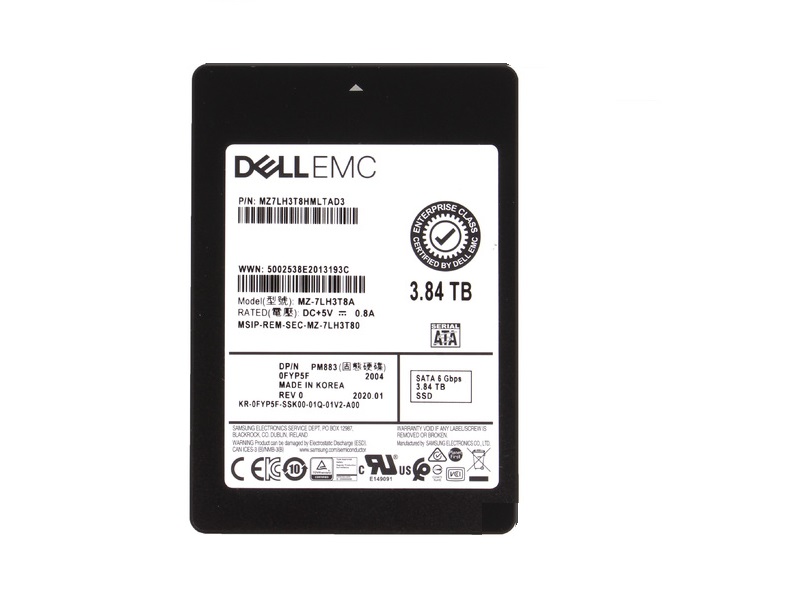
Compared with the previous-generation MZ7KM3T8HMLP, the Samsung PM883 3.84TB (MZ7LH3T8HMLT0D3) moves to Samsung V4 64-layer TLC NAND, delivering better power-and-density efficiency and more consistent enterprise SATA performance at up to 550/520 MB/s and 98K/28K IOPS. Its standout value is combining near-SATA-interface-limit throughput with 1.3 DWPD and 5,460 TBW, making it a stronger fit than the older generation for read-centric virtualization, scale-out storage, and mixed enterprise workloads that need higher usable capacity without moving to SAS or NVMe.
With an endurance rating of 5,460 TBW and 1.3 DWPD, the MZ7LH3T8HMLT0D3 is built to handle sustained enterprise write workloads with ample margin for typical server and storage use. In practical terms, for common OS boot, application, and mixed-read environments, this level of endurance is more than sufficient for many years of stable operation, giving procurement teams confidence in long-term deployment. Its enterprise reliability is further strengthened by Power Loss Protection (PLP), which helps preserve in-flight data and protects metadata integrity during unexpected power interruptions. In addition, the ultra-low UBER of 1.0E-17 means an extremely low probability of uncorrectable bit errors, supporting dependable data integrity, while the 2 million hour MTBF reflects a design intended for continuous business-critical operation.
1. The SATA 3.0 6Gb/s interface, paired with 550 MB/s sequential read speed, offers a drop-in upgrade for legacy enterprise servers, accelerating OS boot, bulk file access, and routine data movement without requiring a platform refresh.
2. With 98,000 K IOPS in random reads, this drive helps databases, virtual desktop pools, and heavily indexed applications respond faster under mixed-user workloads and peak transaction bursts.
3. A 1.3 DWPD endurance rating makes it well suited for always-on business environments where steady daily writes, consistent service levels, and predictable replacement cycles matter.
4. Samsung V4 (64L) TLC NAND balances flash density, power efficiency, and cost control, giving enterprises a practical way to scale capacity while maintaining solid performance consistency.
5. The 145 µs typical latency supports quicker access to hot data, helping reduce application wait states and improve responsiveness in read-intensive infrastructure.
Lower capacity reference: 1.92 TB Higher capacity reference: 7.68 TB Capacity positioning analysis: In this series, the 3.84 TB model sits at the sweet spot. Compared with the 1.92 TB version, it gives much better headroom for data growth, longer refresh cycles, and more flexible workload placement without increasing drive count too quickly. Compared with the 7.68 TB option, it usually delivers the best balance between acquisition cost, usable capacity, and enterprise-grade performance consistency. It is well suited for mid-scale virtualization clusters, such as hosting boot and application volumes for about 60 to 80 general-purpose virtual machines.
Q: Is MZ7LH3T8HMLT0D3 suitable for a write-heavy database server?
A: Yes, it can support moderately write-intensive database workloads. With 1.3 DWPD, 5460 TBW, TLC NAND, and 145 µs typical latency, it is better suited for enterprise mixed-use rather than extreme write-heavy environments.
Q: How many full drive writes per day can it actually endure over its warranty period?
A: This model is rated for 1.3 full drive writes per day. For a 3.84 TB drive, that equals about 4.99 TB of writes daily across the specified warranty period.
Q: Does it include power loss protection (PLP) and why is that critical?
A: Yes, it includes power loss protection. PLP helps preserve in-flight data and metadata during unexpected outages, reducing corruption risk and improving reliability for enterprise servers, storage arrays, and transactional workloads.
Q: What RAID level is recommended for this SSD?
A: Recommended RAID level depends on the workload. RAID 10 is typically preferred for databases due to stronger performance and redundancy, while RAID 5 or 6 may suit capacity-focused applications.