











 Secure payments
Standard refund policy
Trade Assurance
Secure payments
Standard refund policy
Trade Assurance
| Brand | Samsung |
|---|---|
| Model | PM883 |
| Capacity | 7.68 TB |
| Usage Class | Read Intensive |
| Host Interface | SATA 6.0 Gbps |
|---|---|
| Total Interface Bandwidth | 6 Gb/s |
| Form Factor | 2.5" |
|---|
| NAND Flash | Samsung V-NAND 4th-Gen 64-layer 3D TLC |
|---|---|
| Drive Writes Per Day | 1.3 |
| Total Bytes Written | 10935 TBW |
| Sequential Read | 550 MB/s |
|---|---|
| Sequential Write | 520 MB/s |
| Random Read IOPS | 98000 |
| Random Write IOPS | 28000 |
| Average Latency | 95 μs |
| Mean Time Between Failures | 2 Million Hours |
|---|---|
| Uncorrectable Bit Error Rate | 1.0×10⁻¹⁷ |
| Power Loss Protection | Yes |
| MPN | MZ7LH7T6HMLA-00007 |
|---|
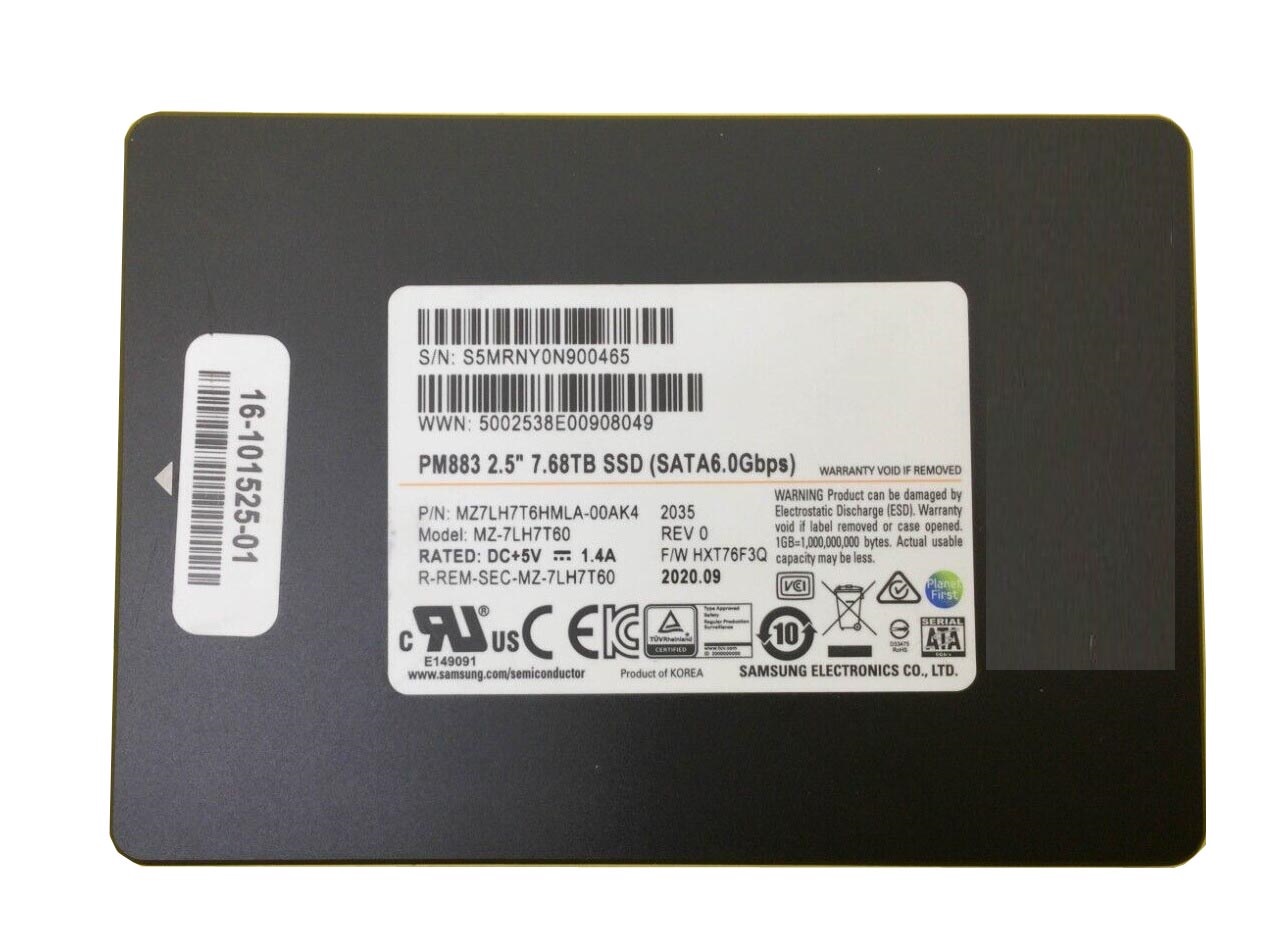
The Samsung PM883 7.68TB (MZ7LH7T6HMLA-00AK4) is a strong fit for read-heavy virtualization, content delivery, and scale-out storage nodes that need SATA compatibility, combining 550/520 MB/s throughput, up to 98K/28K IOPS, and 1.3 DWPD with a substantial 10,935 TBW endurance budget. Compared with the earlier MZ7LH7T6HMLA-00007, this revision advances the platform with Samsung 4th-Gen 64-layer V-NAND, delivering a more current enterprise TLC foundation for higher-capacity, long-life deployments without changing the proven SATA 6.0 Gbps infrastructure.
With an endurance rating of 10,935 TBW and 1.3 DWPD, the MZ7LH7T6HMLA-00AK4 is built to handle sustained write-intensive enterprise use over its service life. In typical server or system-boot workloads, this level of endurance means the drive can comfortably support long-term deployment, including many years of daily operation without endurance becoming a practical concern. For enterprise reliability, the drive includes Power Loss Protection (PLP), which helps preserve in-flight data and protect metadata integrity during unexpected power interruptions. Its ultra-low UBER of 1.0E-17, combined with a 2 million hour MTBF, indicates a highly dependable platform designed to minimize unrecoverable read errors and support stable operation in business-critical environments.
1. The SATA 6.0 Gbps interface gives this drive broad compatibility with mainstream enterprise backplanes and servers, making it an easy drop-in upgrade for legacy infrastructure without changing the storage stack.
2. Its 550 MB/s sequential read performance helps accelerate large-file access, reducing wait time for boot images, backups, media archives, and analytics datasets.
3. With up to 98,000 random-read IOPS, the drive can serve dense small-block workloads efficiently, improving responsiveness for virtual machines, metadata access, and read-heavy databases.
4. The 1.3 DWPD endurance rating supports sustained daily write activity over the service life of the SSD, giving enterprise teams more confidence in always-on transactional and mixed-use environments.
5. Samsung 4th-Gen 64-layer 3D TLC V-NAND, paired with a typical latency of 95 µs, delivers a balanced mix of flash density, predictable QoS, and low response time for latency-sensitive business applications.
Lower capacity reference: 3.84 TB Higher capacity reference: N/A — 7.68 TB is the highest standard capacity in the exact Samsung PM883 (MZ7LH) series. The 7.68 TB model is the sweet spot of the PM883 family. Compared with the 3.84 TB version, it provides much better capacity headroom for virtual machines, boot volumes, logs, and steady growth, while reducing drive count and simplifying slot planning. As the top-capacity PM883 SKU, it also avoids the cost jump and platform refresh typically associated with moving to a denser next-generation SSD class. In practice, it is a strong fit for a mid-sized virtualization cluster supporting about 120 to 180 mixed application VMs.
Q: Is MZ7LH7T6HMLA-00AK4 suitable for a write-heavy database server?
A: Yes. With 1.3 DWPD, 10,935 TBW, low 95 µs typical latency, and enterprise Samsung 64-layer V-NAND TLC, it is suitable for mixed and moderately write-heavy database workloads.
Q: How many full drive writes per day can it actually endure over its warranty period?
A: This model is rated for 1.3 full drive writes per day. For a 7.68 TB SSD, that equals about 9.98 TB of writes daily within warranty conditions.
Q: Does it include power loss protection (PLP) and why is that critical?
A: Yes, it includes power loss protection. PLP helps preserve in-flight data and metadata during sudden outages, reducing corruption risk and improving reliability for enterprise storage environments.
Q: What RAID level is recommended for this SSD?
A: RAID 10 is commonly recommended for database and virtualization workloads requiring strong performance and redundancy. RAID 1 suits smaller deployments, while RAID 5/6 fits capacity-focused environments.