











 Secure payments
Standard refund policy
Trade Assurance
Secure payments
Standard refund policy
Trade Assurance
| Brand | Samsung |
|---|---|
| Model | 840 PRO |
| Capacity | 256GB |
| Usage Class | Client |
| Host Interface | SATA |
|---|---|
| Total Interface Bandwidth | 6 Gb/s |
| Form Factor | 2.5 |
|---|
| NAND Flash | MLC |
|---|---|
| Drive Writes Per Day | 0.16 |
| Total Bytes Written | 73 TBW |
| Sequential Read | 540 MB/s |
|---|---|
| Sequential Write | 520 MB/s |
| Random Read IOPS | 100000 |
| Random Write IOPS | 90000 |
| Average Latency | 50 μs |
| Mean Time Between Failures | 1.5 Million Hours |
|---|---|
| Uncorrectable Bit Error Rate | 1.0×10⁻¹⁷ |
| Power Loss Protection | No |
| MPN | MZ7PC256HAFV |
|---|
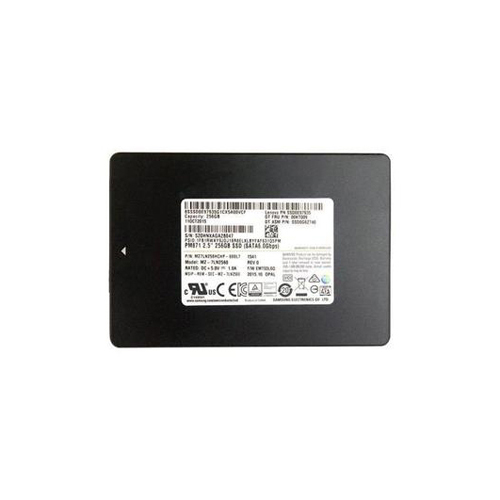
The Samsung 840 PRO 256GB (MZ7PD256HCGM-000H7) stands out in the SATA class by combining MLC NAND with 540/520 MB/s sequential throughput and up to 100,000/90,000 IOPS, making it a strong fit for high-response workstations, OS/app acceleration, and read-heavy database or VM boot workloads. Compared with the previous-generation MZ7PC256HAFV, it delivers a clear generational uplift in write performance and random I/O capability, giving engineers lower latency under mixed workloads without moving beyond the SATA interface.
With an endurance rating of 73 TBW and 0.16 DWPD, this SSD is well suited for read-focused and typical OS/application workloads, where daily write volumes are relatively modest. In practical terms, for use as a boot or system drive, it can comfortably support many years of normal business operation and is a sensible choice for stable, light-to-moderate write environments. From a reliability perspective, the specified UBER of 1.0E-15 indicates a very low unrecoverable bit error rate, helping ensure strong data integrity during normal enterprise data reads. This model does not include power loss protection, so while it is appropriate for non-write-critical roles, systems that require protection against sudden power interruption during in-flight writes should use platform-level safeguards such as UPS or journaling/file-system protection.
1. The SATA interface, paired with throughput that nearly saturates the bus, makes this drive a practical drop-in upgrade for legacy enterprise servers and storage arrays without requiring platform changes.
2. Its strong random-read capability helps VDI, web hosting, and database lookup workloads stay responsive under heavy concurrent access.
3. The modest write endurance is best aligned with read-centric enterprise roles such as boot drives, content delivery, reference datasets, and analytics caches rather than write-intensive logging or transactional workloads.
4. MLC NAND provides a balanced mix of reliability, consistency, and lifecycle stability that enterprise operators value over lower-cost flash in always-on environments.
5. The very low typical latency supports faster application response times and more predictable QoS for latency-sensitive infrastructure such as metadata services and read-optimized virtualized workloads.
Reference capacities in the same series for MPN MZ7PD256HCGM-000H7: Lower capacity: 128GB Approx. performance: up to 520 MB/s read, 400 MB/s write, up to 95K random read IOPS, up to 14K random write IOPS Current model: 256GB Approx. performance: up to 520 MB/s read, 400 MB/s write, up to 95K random read IOPS, up to 14K random write IOPS Higher capacity: 512GB Approx. performance: up to 520 MB/s read, 400 MB/s write, up to 95K random read IOPS, up to 14K random write IOPS Capacity positioning analysis: The 256GB version sits at the sweet spot in this series. Compared with the 128GB model, it gives much better space headroom for OS images, logs, patch growth, and overprovisioning, reducing the risk of early capacity pressure. Compared with the 512GB option, it usually delivers the most practical balance between acquisition cost and enterprise-grade performance consistency. This makes it a strong fit for mid-density deployments, such as boot storage for about 30 to 50 virtualization nodes or a compact VDI pilot environment.
Q: Is MZ7PD256HCGM-000H7 suitable for a write-heavy database server?
A: No. With 0.16 DWPD, 73 TBW, SATA interface, and no PLP, this model is better suited for read-intensive or light mixed workloads rather than write-heavy database server environments.
Q: How many full drive writes per day can it actually endure over its warranty period?
A: It is rated for 0.16 DWPD, meaning about 0.16 full drive writes per day over the warranty period. For 256GB capacity, that equals roughly 41GB of writes daily.
Q: Does it include power loss protection (PLP) and why is that critical?
A: No, it does not include power loss protection. PLP is critical because it helps preserve in-flight data and metadata during sudden outages, reducing corruption risk in transactional systems.
Q: What RAID level is recommended for this SSD?
A: For business use, RAID 1 or RAID 10 is generally recommended to improve redundancy and availability. RAID 0 is not advised, especially since this SSD does not provide PLP.