











 Secure payments
Standard refund policy
Trade Assurance
Secure payments
Standard refund policy
Trade Assurance
| Brand | Samsung |
|---|---|
| Model | PM863 |
| Capacity | 480 GB |
| Usage Class | Read Intensive |
| Host Interface | SATA 6.0 Gbps |
|---|---|
| Total Interface Bandwidth | 6 Gb/s |
| Form Factor | 2.5" |
|---|
| NAND Flash | Samsung V-NAND 3D TLC |
|---|---|
| Drive Writes Per Day | 1.3 |
| Total Bytes Written | 700 TBW |
| Sequential Read | 525 MB/s |
|---|---|
| Sequential Write | 460 MB/s |
| Random Read IOPS | 99000 |
| Random Write IOPS | 16000 |
| Average Latency | 95 μs |
| Mean Time Between Failures | 2 Million Hours |
|---|---|
| Uncorrectable Bit Error Rate | 1.0×10⁻¹⁷ |
| Power Loss Protection | Yes |
| MPN | MZ-77E1T0B/AM |
|---|
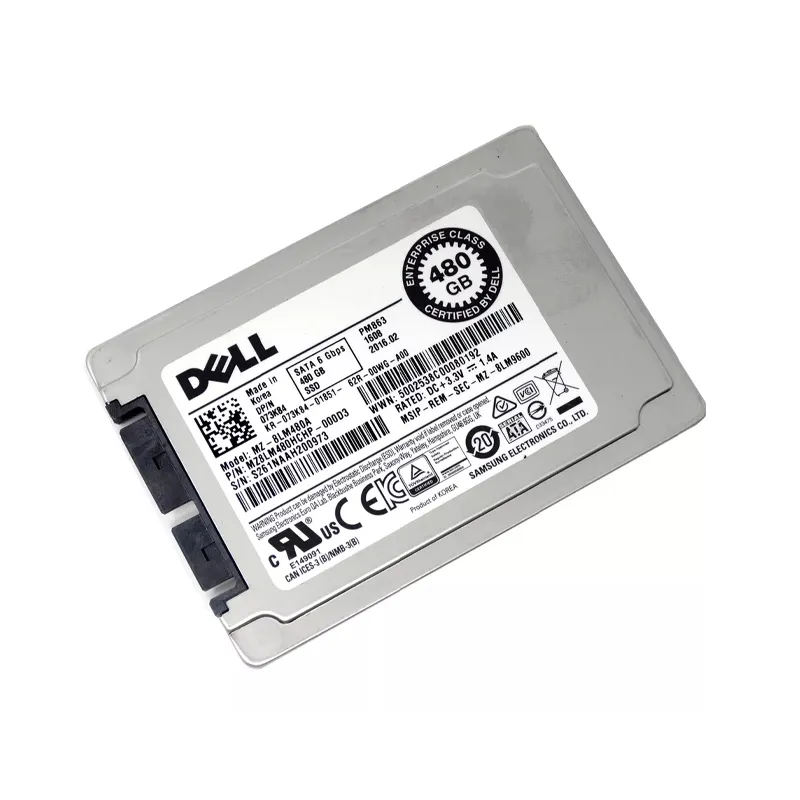
Compared with the predecessor MZ-77E1T0B/AM, the PM863 MZ8LM480HCHP-000D3 delivers a major generational endurance uplift with 700 TBW and 1.3 DWPD—about 4.7× higher write life than the earlier drive’s 150 TBW rating. For SATA-based servers and storage nodes, it pairs Samsung V-NAND 3D TLC with 525/460 MB/s throughput and 99,000/16,000 IOPS to provide a more durable, enterprise-tuned platform for read-centric virtualization, boot, and content-serving workloads.
With an endurance rating of 700 TBW and 1.3 DWPD, the MZ8LM480HCHP-000D3 is well suited for typical server and system-drive workloads, including frequent OS updates, logging, and everyday application activity. In practical terms, this level of endurance provides ample write headroom for long-term stable use, giving buyers confidence that it can serve reliably as a system or boot drive for many years under normal enterprise conditions. For enterprise reliability, this SSD includes power-loss protection (PLP), which helps preserve in-flight data and protects mapping tables if power is interrupted unexpectedly. Its UBER of 1.0E-17, together with a 2 million hour MTBF, indicates a very low probability of unrecoverable bit errors and supports dependable operation in business-critical environments.
1. The SATA 6.0 Gbps interface, paired with near-bus-limit sequential read performance, makes this drive an easy drop-in upgrade for existing enterprise servers while accelerating OS boot, patching, and bulk data retrieval.
2. Its 99,000 K IOPS random-read capability helps virtualized workloads, metadata-heavy applications, and read-intensive databases stay responsive under highly fragmented access patterns.
3. A 1.3 DWPD endurance rating gives IT teams the confidence to run steady daily overwrite cycles in caching, logging, and mixed-use server environments without premature wear concerns.
4. Samsung V-NAND 3D TLC enables a strong balance of capacity, power efficiency, and long-term reliability, making it well suited for enterprise deployments that need cost-effective flash at scale.
5. With a typical latency of 95 µs, the drive supports predictable application response times, which is critical for transactional systems and multi-tenant infrastructure where tail latency impacts service quality.
Reference capacities in the same series: Lower capacity: 240 GB Higher capacity: 960 GB Capacity positioning analysis: In this series, the 480 GB model sits at the practical sweet spot. Compared with the 240 GB version, it gives much more headroom for OS images, application growth, logs, and overprovisioning, reducing early capacity pressure in always-on enterprise workloads. Compared with the 960 GB option, it usually delivers a better balance of acquisition cost, usable capacity, and essentially similar mainstream enterprise SATA performance. It is well suited for mid-scale deployments, such as boot and application storage for about 40 to 60 virtualized business service instances.
Q: Is MZ8LM480HCHP-000D3 suitable for a write-heavy database server?
A: Yes, it can support moderate write-intensive database workloads. With 1.3 DWPD, 700 TBW, low 95 µs latency, and enterprise features, it fits transactional servers better than light consumer SSDs.
Q: How many full drive writes per day can it actually endure over its warranty period?
A: This model is rated at 1.3 DWPD, meaning it can handle about 1.3 full 480 GB drive writes per day throughout its warranty period, within the specified endurance limits.
Q: Does it include power loss protection (PLP) and why is that critical?
A: Yes, it includes power loss protection. PLP helps preserve in-flight data and mapping tables during sudden outages, which is critical for preventing corruption and maintaining enterprise data integrity.
Q: What RAID level is recommended for this SSD?
A: For most server deployments, RAID 1 or RAID 10 is recommended for better redundancy and performance. RAID 5 may work, but write-heavy environments usually benefit more from RAID 10.