











 Secure payments
Standard refund policy
Trade Assurance
Secure payments
Standard refund policy
Trade Assurance
| Brand | Samsung |
|---|---|
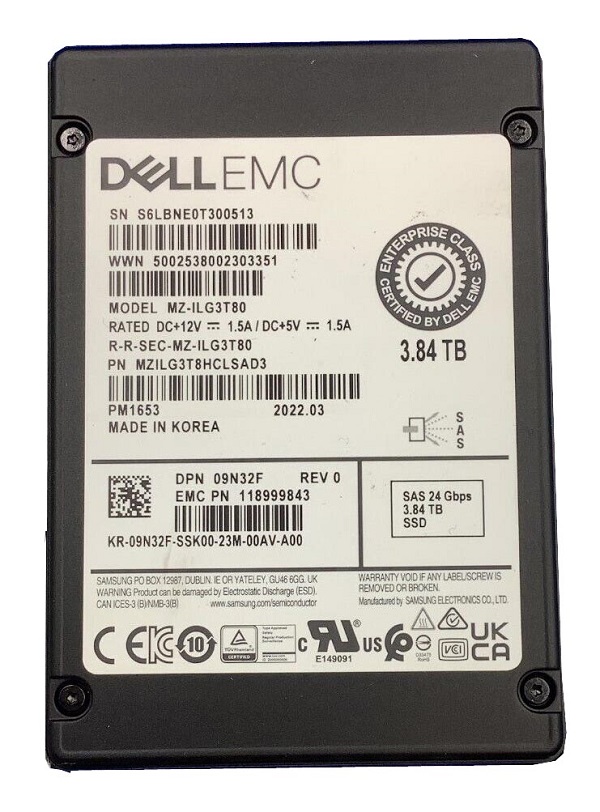
| Model | PM1653 |
| Capacity | 3.84 TB |
| Usage Class | Enterprise/Mixed-Use |
| Host Interface | SAS 24Gb/s |
|---|---|
| Total Interface Bandwidth | 24 Gb/s |
| Form Factor | 2.5 inch 15mm |
|---|
| NAND Flash | Samsung V6 (128L) TLC |
|---|---|
| Drive Writes Per Day | 3 |
| Total Bytes Written | 21024 TBW |
| Sequential Read | 4300 MB/s |
|---|---|
| Sequential Write | 3800 MB/s |
| Random Read IOPS | 800000 |
| Random Write IOPS | 270000 |
| Average Latency | 95 μs |
| Mean Time Between Failures | 2.5 Million Hours |
|---|---|
| Uncorrectable Bit Error Rate | 1.0×10⁻¹⁷ |
| Power Loss Protection | Yes |
| MPN | MZILG3T8HCLS-00AD3 |
|---|
Compared with the earlier MZILG3T8HCLS-00AD3, the MZILG3T8HCLSAD3 gives you a newer PM1653 build centered on the 24Gb/s SAS generation, delivering up to 4.3/3.8 GB/s and 800K/270K IOPS to remove the throughput ceiling common in 12Gb/s-class enterprise SAS deployments. With 3 DWPD, 21,024 TBW, and Samsung V6 128-layer TLC, it is a strong fit for latency-sensitive OLTP databases, virtualized clusters, and mixed read/write enterprise workloads that need both high endurance and top-tier SAS performance.
With an endurance rating of 21,024 TBW and 3 DWPD, the MZILG3T8HCLSAD3 is built for sustained enterprise write workloads and can support writing its full capacity three times per day throughout its rated service life. In typical server or storage applications, this level of endurance provides a very large operating margin, making it a dependable choice for long-term use such as OS, virtualization, database, and mixed-read/write workloads. For enterprise reliability, the drive includes Power Loss Protection (PLP), which helps preserve in-flight data and protects metadata integrity during unexpected power interruptions. Its UBER rating of 1.0E-17 and 2.5 million-hour MTBF indicate a very low probability of unrecoverable bit errors and strong overall hardware reliability, giving procurement teams added confidence in data integrity and stable operation.
1. The SAS twenty-four-gigabit interface provides dual-port enterprise connectivity and broad compatibility with mission-critical storage arrays, enabling higher bandwidth with seamless failover in always-on environments.
2. This level of sequential read performance accelerates large-block workloads such as backup restore, media streaming, and data warehouse scans, helping reduce job completion time across shared infrastructure.
3. Its strong random read capability is well suited for virtualization, OLTP databases, and metadata-heavy applications, sustaining fast response under highly concurrent access patterns.
4. With an endurance profile built for multiple full-drive rewrites per day, the drive can confidently handle write-intensive enterprise workloads such as logging, caching, and mixed transactional storage over its service life.
5. Samsung’s V6 one-hundred-twenty-eight-layer TLC NAND balances capacity, power efficiency, and reliability, giving data centers a cost-effective flash platform for consistent enterprise performance.
Lower capacity reference: 1.92 TB Higher capacity reference: 7.68 TB At 3.84 TB, this model sits at the sweet spot of the series. Compared with the 1.92 TB option, it offers much better capacity headroom for data growth, denser VM placement, and longer refresh cycles without changing the platform. Compared with the 7.68 TB version, it usually delivers a more attractive cost profile while keeping enterprise-class sequential throughput and random IOPS at a very similar level. This makes 3.84 TB especially well suited for mid-scale virtualization clusters, mixed database workloads, and read-intensive application nodes.
Q: Is MZILG3T8HCLSAD3 suitable for a write-heavy database server?
A: Yes. With 3 DWPD endurance, 21,024 TBW, 24Gb/s SAS, and 95 µs typical latency, MZILG3T8HCLSAD3 is well suited for write-intensive database and enterprise transactional workloads.
Q: How many full drive writes per day can it actually endure over its warranty period?
A: It is rated for 3 full drive writes per day. For a 3.84 TB SSD, that equals about 11.52 TB of writes daily across the standard warranty period.
Q: Does it include power loss protection (PLP) and why is that critical?
A: Yes, it includes PLP. This is critical because it helps protect in-flight data and metadata during sudden power loss, reducing corruption risk and improving reliability in enterprise environments.
Q: What RAID level is recommended for this SSD?
A: RAID 10 is typically recommended for performance-sensitive database workloads, offering strong redundancy and low latency. For capacity-focused deployments, RAID 5 or RAID 6 may also be considered.