











 Secure payments
Standard refund policy
Trade Assurance
Secure payments
Standard refund policy
Trade Assurance
| Brand | Samsung |
|---|---|
| Model | PM1643a |
| Capacity | 3.84TB |
| Usage Class | Read Intensive |
| Host Interface | SAS 12G |
|---|---|
| Total Interface Bandwidth | 12 Gb/s |
| Form Factor | 2.5-inch |
|---|
| NAND Flash | Samsung V-NAND TLC |
|---|---|
| Drive Writes Per Day | 1 |
| Total Bytes Written | 7008 TBW |
| Sequential Read | 2100 MB/s |
|---|---|
| Sequential Write | 2000 MB/s |
| Random Read IOPS | 400000 |
| Random Write IOPS | 50000 |
| Average Latency | 100 μs |
| Mean Time Between Failures | 2 Million Hours |
|---|---|
| Uncorrectable Bit Error Rate | 1.0×10⁻¹⁷ |
| Power Loss Protection | Yes |
| MPN | MZILT3T8HBLT |
|---|
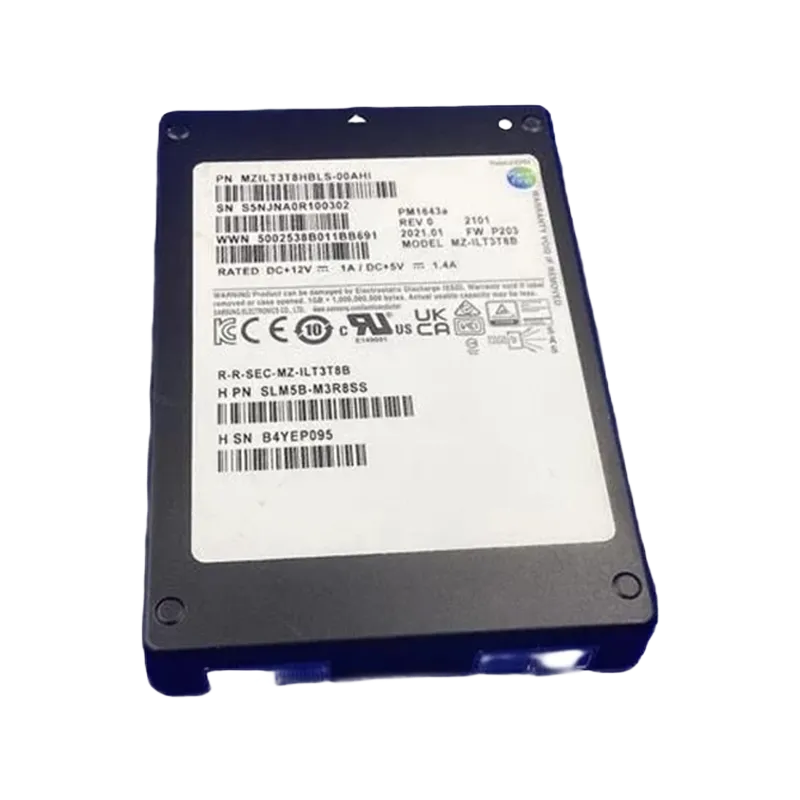
Compared with the earlier MZILT3T8HBLT, the Samsung PM1643a MZILT3T8HBLS-00AHI represents a later-generation 3.84TB SAS 12G refresh that preserves a strong 2100/2000 MB/s and 400K/50K IOPS profile while adding the reliability and platform maturity expected from Samsung’s updated PM1643a revision. For enterprise architects standardizing on SAS, its 1 DWPD and 7008 TBW with Samsung V-NAND TLC make it a stronger fit than typical read-centric peers for mixed database, virtualization, and business-critical server workloads that need balanced endurance and consistent latency.
With 7,008 TBW and a 1 DWPD rating, this SSD is designed to handle writing its full usable capacity every day across a standard enterprise service life, which is more than sufficient for typical server, virtualization, and system-boot workloads. In practical terms, if used as an OS or application drive with normal daily write activity, its endurance headroom is ample for long-term, worry-free operation. This model also includes power-loss protection (PLP), which helps preserve in-flight data and prevents metadata corruption if power is unexpectedly interrupted, an essential safeguard in enterprise environments. Its UBER of 1.0E-17 indicates an extremely low probability of uncorrectable bit errors, supporting high data integrity, while the 2 million hour MTBF further reflects strong overall reliability for continuous business use.
1. The SAS 12G interface provides proven dual-port enterprise connectivity, enabling highly available storage paths and seamless integration into mission-critical server and SAN environments.
2. Its strong sequential read performance accelerates backup restores, data warehousing scans, and large-file streaming workloads, helping reduce time-to-data in enterprise operations.
3. High random read capability supports dense virtualization, transactional databases, and metadata-heavy applications by sustaining fast response under heavily concurrent access patterns.
4. A 1 DWPD endurance profile makes it well suited for read-centric enterprise workloads that need predictable service life, controlled replacement cycles, and lower storage TCO.
5. Samsung V-NAND TLC, paired with low typical latency, delivers a balanced mix of capacity efficiency, consistent responsiveness, and enterprise-grade reliability for always-on business systems.
Lower capacity reference: 1.92TB Higher capacity reference: 7.68TB At 3.84TB, this SSD sits in the sweet spot of the family. Compared with 1.92TB, it gives much better headroom for data growth, denser VM placement, and longer refresh cycles without changing the familiar enterprise read/write and IOPS profile. Compared with 7.68TB, it typically delivers a more efficient balance of acquisition cost, usable capacity, and performance consistency, making it easier to standardize across mixed workloads. It is especially well suited for mid-scale virtualization clusters, database nodes, and hyperconverged platforms hosting roughly 40 to 70 business applications or service instances.
Q: Is MZILT3T8HBLS-00AHI suitable for a write-heavy database server?
A: Yes, it can support database workloads, but with 1 DWPD it is better suited for mixed-use rather than extremely write-heavy environments. For sustained intensive writes, a higher-endurance enterprise SSD is recommended.
Q: How many full drive writes per day can it actually endure over its warranty period?
A: This model is rated at 1 DWPD, meaning it can sustain one full 3.84TB drive write per day during its warranty period, aligning with its total endurance rating of 7008TBW.
Q: Does it include power loss protection (PLP) and why is that critical?
A: Yes, it includes power loss protection. PLP helps preserve in-flight data and metadata during unexpected power failure, which is essential for maintaining data integrity and reducing corruption risk in enterprise systems.
Q: What RAID level is recommended for this SSD?
A: For most enterprise deployments, RAID 10 is recommended for the best balance of performance, redundancy, and latency. RAID 5 or RAID 6 may be considered when usable capacity is a higher priority.