











 Secure payments
Standard refund policy
Trade Assurance
Secure payments
Standard refund policy
Trade Assurance
| Brand | Samsung |
|---|---|
| Model | PM1643a |
| Capacity | 7.68 TB |
| Usage Class | Enterprise / Data Center Read Intensive |
| Host Interface | SAS 12Gb/s |
|---|---|
| Total Interface Bandwidth | 12 Gb/s |
| Form Factor | 2.5 |
|---|
| NAND Flash | Samsung V-NAND TLC |
|---|---|
| Drive Writes Per Day | 1 |
| Total Bytes Written | 14016 TBW |
| Sequential Read | 2100 MB/s |
|---|---|
| Sequential Write | 2000 MB/s |
| Random Read IOPS | 400000 |
| Random Write IOPS | 50000 |
| Average Latency | 110 μs |
| Mean Time Between Failures | 2 Million Hours |
|---|---|
| Uncorrectable Bit Error Rate | 1.0×10⁻¹⁷ |
| Power Loss Protection | Yes |
| MPN | MZILT7T6HMLA |
|---|
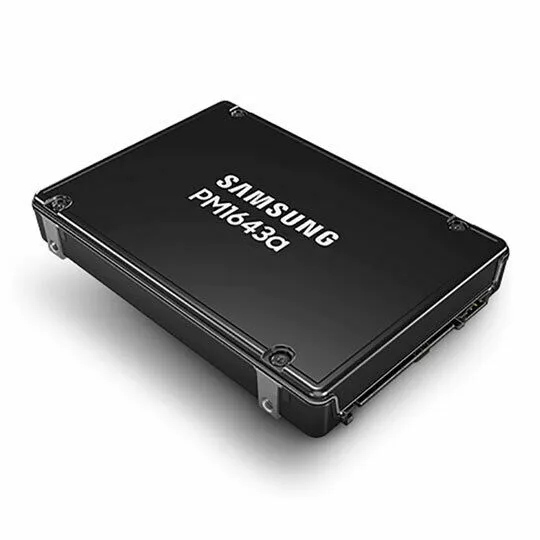
Compared with MZILT7T6HMLA, the PM1643a (MZILT7T6HALA) delivers a clear generational upgrade in endurance and workload handling, with 14,016 TBW, 400K/50K random IOPS, and 2,100/2,000 MB/s throughput in a 7.68 TB SAS 12Gb/s form factor. It is a strong choice for enterprise storage tiers that need higher write endurance and denser mixed-workload performance than the prior generation without moving beyond the SAS ecosystem.
With an endurance rating of 14,016 TBW and 1 DWPD, the MZILT7T6HALA is designed to sustain writing its full capacity once per day throughout its rated service life, which is more than sufficient for typical enterprise read-intensive and mixed-use deployments. In practical terms, for common workloads such as OS boot, virtualization, application hosting, and general server storage, this level of endurance provides long-term, worry-free operation over many years. The drive also includes enterprise-class reliability features such as power loss protection (PLP), which helps preserve in-flight data and protect metadata integrity during an unexpected power interruption. Its ultra-low UBER of 1.0E-17 means an extremely low probability of uncorrectable bit errors during reads, supporting high data integrity and dependable operation in business-critical environments.
1. The SAS 12Gb/s interface ensures seamless drop-in compatibility with mainstream dual-controller enterprise storage arrays, simplifying upgrades while maintaining high-availability data paths.
2. With 2100 MB/s sequential read performance, this drive accelerates large-block workloads such as backup restores, media streaming, and database snapshot access.
3. Delivering 400,000 random read IOPS, it sustains responsive performance for virtualization clusters, OLTP databases, and heavily indexed read-centric applications.
4. Rated at 1 DWPD, the drive is well suited for mixed-use enterprise deployments that need predictable endurance for daily rewrites without overprovisioning for extreme write workloads.
5. Built on Samsung V-NAND TLC and featuring a typical latency of 110 µs, it balances cost-efficient flash density with the fast, consistent response times required for latency-sensitive business systems.
Lower capacity reference: 3.84 TB Higher capacity reference: 15.36 TB At 7.68 TB, this model sits in the sweet spot of the series. Compared with the 3.84 TB version, it offers much better headroom for data growth, denser VM placement, and longer refresh cycles without increasing drive count too quickly. Compared with the 15.36 TB option, it delivers a more balanced acquisition cost while keeping enterprise-class sequential throughput and random IOPS at a similar level. This makes 7.68 TB especially well suited for mid-scale virtualization clusters, database nodes, and all-flash arrays serving roughly 40 to 80 mixed enterprise workloads.
Q: Is MZILT7T6HALA suitable for a write-heavy database server?
A: Yes, it is suitable for mixed and moderately write-intensive database workloads. With 1 DWPD endurance, 14,016 TBW, low 110 µs latency, and SAS reliability, it fits enterprise server use well.
Q: How many full drive writes per day can it actually endure over its warranty period?
A: This model is rated at 1 DWPD, meaning it can sustain one full 7.68 TB drive write per day throughout its warranty period, aligning with its 14,016 TB total endurance rating.
Q: Does it include power loss protection (PLP) and why is that critical?
A: Yes, it includes power loss protection. PLP helps preserve in-flight data and metadata during sudden outages, reducing corruption risk and improving data integrity for enterprise databases and transactional applications.
Q: What RAID level is recommended for this SSD?
A: RAID 10 is commonly recommended for this SSD in performance-sensitive database environments, as it offers strong redundancy and fast write performance. RAID 5 or 6 may suit more capacity-focused deployments.