











 Secure payments
Standard refund policy
Trade Assurance
Secure payments
Standard refund policy
Trade Assurance
| Brand | Samsung |
|---|---|
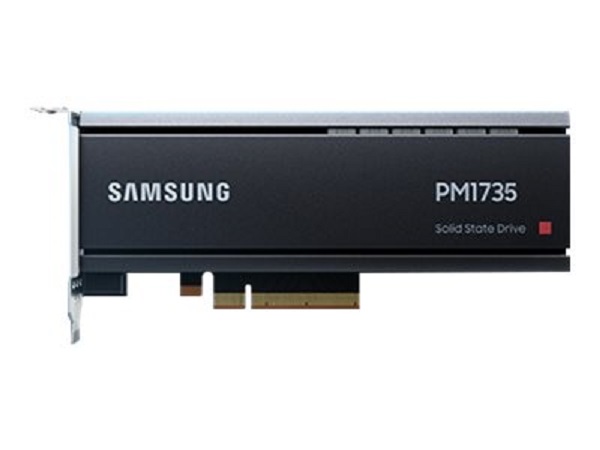
| Model | PM1735 |
| Capacity | 6.4 TB |
| Usage Class | Enterprise/Mixed-Use |
| Host Interface | PCIe 4.0 x8, NVMe 1.3 |
|---|---|
| Total Interface Bandwidth | 128 Gb/s |
| Form Factor | HHHL (Add-in Card) |
|---|
| NAND Flash | Samsung V5 (9xL) TLC |
|---|---|
| Drive Writes Per Day | 3 |
| Total Bytes Written | 35040 TBW |
| Sequential Read | 8000 MB/s |
|---|---|
| Sequential Write | 3800 MB/s |
| Random Read IOPS | 1500000 |
| Random Write IOPS | 250000 |
| Average Latency | 90 μs |
| Mean Time Between Failures | 2 Million Hours |
|---|---|
| Uncorrectable Bit Error Rate | 1.0×10⁻¹⁷ |
| Power Loss Protection | Yes |
| MPN | MZPLL6T4HMLA-00003 |
|---|
Compared with the previous-generation MZPLL6T4HMLA-00003, the PM1735 MZPLJ6T4HALA-00AH3 moves to PCIe 4.0 x8 and boosts peak performance to 8,000/3,800 MB/s with up to 1.5M/250K IOPS, giving latency-sensitive enterprise platforms a clear bandwidth and transaction-density upgrade. With 6.4 TB of Samsung V5 TLC and 3 DWPD endurance rated at 35,040 TBW, it is a strong fit for high-throughput virtualization, OLTP, and scale-out analytics nodes that need both sustained write durability and top-tier NVMe performance.
With an endurance rating of 35,040 TBW and 3 DWPD, the MZPLJ6T4HALA-00AH3 is built for sustained heavy write activity in enterprise environments, comfortably supporting demanding database, virtualization, and cache workloads over its service life. In practical terms, for typical mixed-read/write deployment as a boot drive or application drive, this level of endurance is far beyond normal usage and can be used with confidence for many years, including 24/7 operation. For enterprise reliability, the drive includes Power Loss Protection (PLP), which helps preserve in-flight data and protect mapping tables during unexpected power interruption, reducing the risk of corruption and unplanned recovery events. Its UBER of 1.0E-17, together with a 2 million hour MTBF, indicates a very low probability of unrecoverable read errors and strong long-term operational stability expected from data center-class SSDs.
1. The PCIe Gen4 x8 NVMe interface provides enough host-side bandwidth to keep virtualization clusters, GPU servers, and high-core-count compute nodes from being constrained by storage.
2. Its class-leading sequential read throughput shortens dataset staging, backup restore, and large-scale analytic scan times in bandwidth-heavy enterprise workflows.
3. The outstanding random read capability enables faster response for VDI, OLTP databases, and metadata-intensive cloud applications even under heavy parallel access.
4. This endurance rating is well suited for write-intensive enterprise duties such as caching, logging, and mixed transactional workloads throughout the drive’s planned service life.
5. Samsung V5 TLC NAND, combined with very low typical latency, delivers stable QoS and cost-efficient flash performance for latency-sensitive business applications.
Lower capacity reference: 3.2 TB Higher capacity reference: 12.8 TB Capacity positioning analysis: In this enterprise SSD family, 6.4 TB sits at the practical sweet spot. Compared with the 3.2 TB model, it offers much better headroom for data growth, longer refresh cycles, and more flexible workload placement without changing the expected enterprise-class read/write and random IOPS profile. Compared with the 12.8 TB option, it usually delivers the best balance of acquisition cost, usable capacity, and performance consistency. It is especially well suited for mid-scale virtualization clusters, such as hosting boot and application volumes for roughly 40 to 60 business service instances.
Q: Is MZPLJ6T4HALA-00AH3 suitable for a write-heavy database server?
A: Yes. With 3 DWPD endurance, 35,040 TBW, Samsung V5 TLC NAND, and low 90 µs typical latency, this 6.4 TB NVMe SSD is well suited for write-intensive database workloads.
Q: How many full drive writes per day can it actually endure over its warranty period?
A: This model is rated for 3 drive writes per day. For a 6.4 TB capacity, that equals about 19.2 TB of writes daily across the specified warranty period.
Q: Does it include power loss protection (PLP) and why is that critical?
A: Yes, it includes PLP. This is critical because it helps protect in-flight data and metadata during unexpected power failure, reducing corruption risk and improving enterprise storage reliability.
Q: What RAID level is recommended for this SSD?
A: RAID 10 is generally recommended for this SSD in performance-sensitive servers, as it balances redundancy and speed. RAID 1 or RAID 5 may also fit, depending on capacity priorities.