











 Secure payments
Standard refund policy
Trade Assurance
Secure payments
Standard refund policy
Trade Assurance
| Brand | Samsung |
|---|---|
| Model | PM9A3 |
| Capacity | 15.36 TB |
| Usage Class | Read Intensive |
| Host Interface | PCIe Gen4 x4 |
|---|---|
| Total Interface Bandwidth | 64 Gb/s |
| Form Factor | U.2 (2.5") |
|---|
| NAND Flash | Samsung V-NAND 6th-Gen 128-layer 3D TLC |
|---|---|
| Drive Writes Per Day | 1 |
| Total Bytes Written | 28032 TBW |
| Sequential Read | 6900 MB/s |
|---|---|
| Sequential Write | 4100 MB/s |
| Random Read IOPS | 1000000 |
| Random Write IOPS | 180000 |
| Average Latency | 85 μs |
| Mean Time Between Failures | 2 Million Hours |
|---|---|
| Uncorrectable Bit Error Rate | 1.0×10⁻¹⁷ |
| Power Loss Protection | Yes |
| MPN | MZQL215THBLA |
|---|
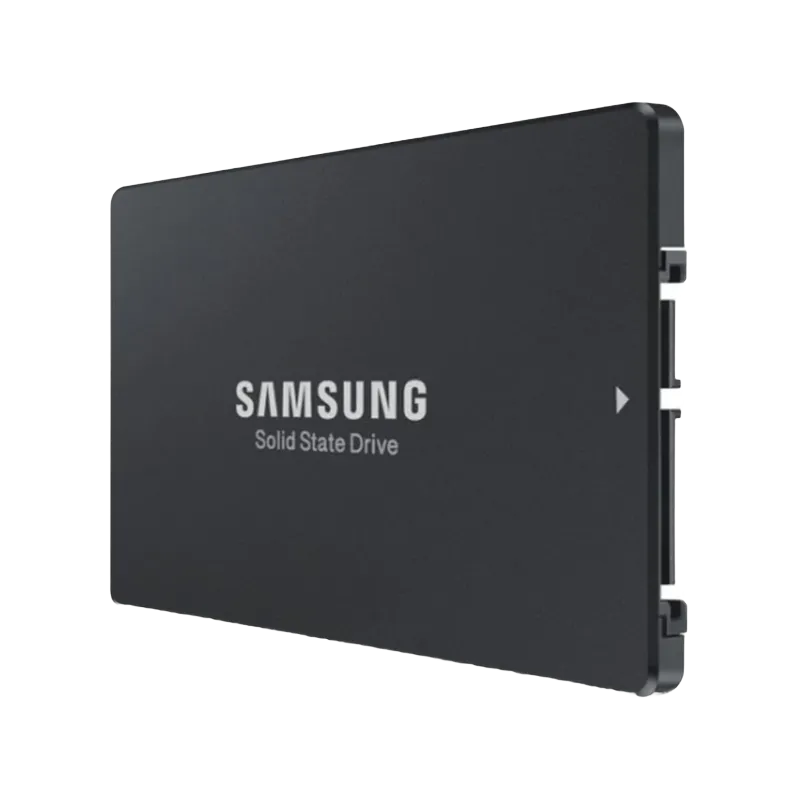
The Samsung PM9A3 MZQL215THBLA-00A07 is a strong fit for high-density virtualized infrastructure and read-intensive cloud databases, combining 15.36 TB of capacity with PCIe Gen4 x4 performance up to 6,900/4,100 MB/s and 1,000,000/180,000 IOPS on Samsung 6th-Gen 128-layer V-NAND TLC. Compared with the earlier MZQL215THBLA, this -00A07 revision offers a newer qualified build for deployment standardization while maintaining the PM9A3’s standout value: 28,032 TBW endurance and consistent Gen4-class throughput at scale in the 1 DWPD enterprise tier.
With an endurance rating of 28,032 TBW and 1 DWPD, the MZQL215THBLA-00A07 is designed to handle writing its full capacity once per day across the warranty life, which is more than sufficient for typical enterprise system-disk, boot, logging, and mixed-read workloads. In practical terms, under normal server usage it provides a very large write margin and can be deployed as a stable long-term storage device with strong confidence in daily operation. For enterprise reliability, this SSD includes Power Loss Protection (PLP), which helps preserve in-flight data and protects metadata integrity during unexpected power interruptions, reducing the risk of corruption and unplanned recovery events. Its UBER specification of 1.0E-17, together with a 2 million hour MTBF, indicates an enterprise-class reliability level with an extremely low probability of unrecoverable bit errors, supporting dependable operation in business-critical environments.
1. The PCIe Gen4 x4 host interface, paired with near-saturation sequential bandwidth, accelerates large dataset staging, VM boot storms, and analytics scan workloads by cutting storage transfer bottlenecks.
2. Its million-class random read capability is built for heavily consolidated databases and virtualization clusters, sustaining fast access to small-block data even under intense parallel demand.
3. A 1 DWPD endurance profile makes it a strong fit for mixed-read enterprise workloads that need predictable lifespan and warranty-aligned write tolerance without overpaying for unnecessary write headroom.
4. Samsung’s 6th-generation 128-layer 3D TLC V-NAND balances density, power efficiency, and cost, enabling higher usable capacity per server while maintaining enterprise-grade consistency and reliability.
5. Typical latency in the tens of microseconds helps reduce tail-response time for transaction processing, metadata lookups, and latency-sensitive cloud applications where storage delay directly impacts QoS.
For MPN MZQL215THBLA-00A07 (15.36 TB), the closest lower capacity in the same series is 7.68 TB, and the next higher capacity is 30.72 TB. At 15.36 TB, this SSD sits in the sweet spot of the family. Compared with the 7.68 TB model, it gives substantially more headroom for data growth, denser server consolidation, and longer refresh cycles without changing the expected enterprise-class throughput profile. Compared with the 30.72 TB version, it usually delivers the best balance of usable capacity, cost efficiency, and predictable performance. It is especially well suited for mid-scale virtualization clusters, mixed database nodes, or compact all-flash storage pools in 1U/2U servers.
Q: Is MZQL215THBLA-00A07 suitable for a write-heavy database server?
A: It can support database workloads, but with 1 DWPD it is better suited to mixed-use rather than extremely write-intensive environments. For sustained heavy writes, a higher-endurance enterprise SSD would be safer.
Q: How many full drive writes per day can it actually endure over its warranty period?
A: This model is rated for 1 DWPD, meaning it can sustain one full 15.36 TB drive write per day during its warranty period, aligned with its 28,032 TBW endurance rating.
Q: Does it include power loss protection (PLP) and why is that critical?
A: Yes, it includes power loss protection. PLP helps preserve in-flight data and metadata during unexpected outages, which is critical for maintaining data integrity and reducing corruption risk in enterprise systems.
Q: What RAID level is recommended for this SSD?
A: RAID choice depends on your priority. RAID 10 is commonly recommended for enterprise SSDs when you need strong performance, redundancy, and faster rebuild behavior than parity-based RAID configurations.