











 Secure payments
Standard refund policy
Trade Assurance
Secure payments
Standard refund policy
Trade Assurance
| Brand | Samsung |
|---|---|
| Model | PM983 |
| Capacity | 7.68TB |
| Usage Class | Enterprise |
| Host Interface | NVMe PCIe Gen3 x4 |
|---|---|
| Total Interface Bandwidth | 32 Gb/s |
| Form Factor | 2.5 |
|---|
| NAND Flash | Samsung V-NAND 3-bit MLC |
|---|---|
| Drive Writes Per Day | 1.3 |
| Total Bytes Written | 10932 TBW |
| Sequential Read | 3100 MB/s |
|---|---|
| Sequential Write | 2000 MB/s |
| Random Read IOPS | 540000 |
| Random Write IOPS | 50000 |
| Average Latency | 85 μs |
| Mean Time Between Failures | 2 Million Hours |
|---|---|
| Uncorrectable Bit Error Rate | 1.0×10⁻¹⁷ |
| Power Loss Protection | Yes |
| MPN | MZQLW7T6HMLA |
|---|
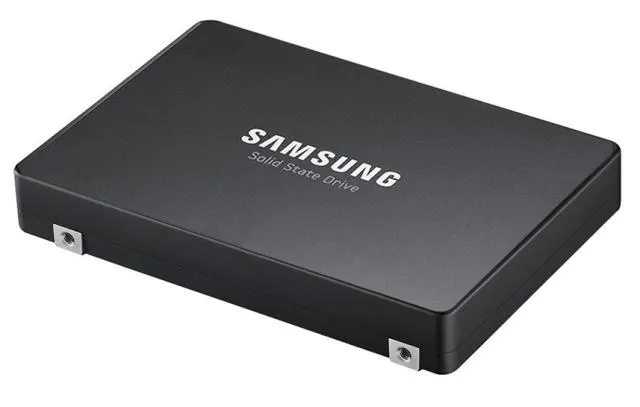
Samsung PM983 MZQLB7T6HMLA stands out as a high-capacity read-optimized NVMe drive, pairing 7.68TB of Samsung V-NAND 3-bit MLC with 3,100/2,000 MB/s throughput and 540K/50K IOPS to support dense virtualization, scale-out storage, and content-serving tiers without sacrificing enterprise endurance at 1.3 DWPD and 10,932 TBW. Compared with the previous-generation MZQLW7T6HMLA, this MPN delivers a stronger balance of usable capacity, sustained write durability, and PCIe Gen3 x4 performance, making it the better fit for operators seeking higher rack-level efficiency and longer service life in mixed read/write datacenter deployments.
With an endurance rating of 10,932 TBW and 1.3 DWPD, the MZQLB7T6HMLA is built to sustain heavy daily write activity over its service life, making it well suited for read/write-intensive enterprise workloads. In typical server or system-disk use, this level of endurance provides ample headroom for many years of operation without endurance becoming a practical concern. The drive also includes enterprise-grade power loss protection (PLP), which helps preserve in-flight data and metadata if power is unexpectedly interrupted, reducing the risk of corruption and improving operational stability. Its UBER specification of 1.0E-17, together with a 2 million hour MTBF, indicates an extremely low probability of unrecoverable bit errors and a high level of long-term reliability expected in data center environments.
1. The NVMe PCIe Gen3 x4 interface removes legacy storage bottlenecks, giving enterprise servers the parallel bandwidth needed to keep virtualized workloads and data-intensive applications consistently responsive.
2. Its strong sequential read performance accelerates large-block data movement, reducing wait time for analytics pipelines, media streaming, backup restores, and database loading operations.
3. High random read capability enables the drive to sustain massive numbers of small, concurrent transactions, which is especially valuable for OLTP databases, VDI boot storms, and heavily consolidated cloud environments.
4. With an endurance rating designed for steady daily rewriting, this SSD is well suited for mixed-use enterprise deployments that need dependable lifespan under continuous application churn rather than just burst performance.
5. Samsung V-NAND 3-bit MLC combined with very low typical latency delivers an effective balance of density, reliability, and fast response time, helping latency-sensitive services meet tighter SLA targets.
Lower capacity reference: 3.84TB Higher capacity reference: 15.36TB In this SSD family, 7.68TB sits at the practical sweet spot. Compared with the 3.84TB model, it gives much better headroom for data growth, denser consolidation, and longer refresh cycles without changing the familiar enterprise-class read, write, and random IOPS profile. Compared with the 15.36TB option, it usually delivers a more attractive cost-per-deployment balance while avoiding unnecessary overprovisioning in mainstream clusters. It is especially well suited for mid-size virtualization, mixed database workloads, or a 12 to 16 node hyper-converged infrastructure rollout.
Q: Is MZQLB7T6HMLA suitable for a write-heavy database server?
A: Yes. With 1.3 DWPD, 10,932 TBW endurance, low 85 µs typical latency, and Samsung V-NAND 3-bit MLC, MZQLB7T6HMLA is well suited for mixed to write-intensive database workloads.
Q: How many full drive writes per day can it actually endure over its warranty period?
A: This model is rated for 1.3 full drive writes per day. For the 7.68TB capacity, that equals about 9.98TB of writes daily across the warranty period.
Q: Does it include power loss protection (PLP) and why is that critical?
A: Yes, it includes power loss protection. PLP helps preserve in-flight data and metadata during unexpected outages, reducing corruption risk and improving reliability in enterprise and database environments.
Q: What RAID level is recommended for this SSD?
A: RAID recommendation depends on workload goals. RAID 1 or RAID 10 is typically preferred for databases requiring strong redundancy and performance, while RAID 5 or 6 suits capacity-focused deployments.