











 Secure payments
Standard refund policy
Trade Assurance
Secure payments
Standard refund policy
Trade Assurance
| Brand | Samsung |
|---|---|
| Model | SM961 |
| Capacity | 512GB |
| Usage Class | Client |
| Host Interface | NVMe |
|---|---|
| Total Interface Bandwidth | 32 Gb/s |
| Form Factor | M.2 2280 |
|---|
| NAND Flash | MLC V-NAND |
|---|---|
| Drive Writes Per Day | 0.35 |
| Total Bytes Written | 320 TBW |
| Sequential Read | 3200 MB/s |
|---|---|
| Sequential Write | 1700 MB/s |
| Random Read IOPS | 330000 |
| Random Write IOPS | 300000 |
| Average Latency | 50 μs |
| Mean Time Between Failures | 1.5 Million Hours |
|---|---|
| Uncorrectable Bit Error Rate | 1.0×10⁻¹⁷ |
| Power Loss Protection | No |
| MPN | MZVPV512HDGL |
|---|
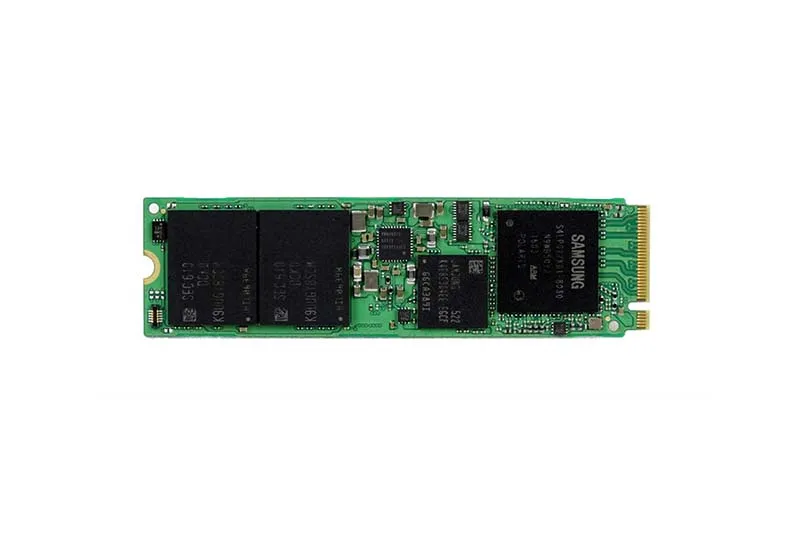
The Samsung SM961 512GB (MZVKW512HMJP) is a strong upgrade over the previous-generation MZVPV512HDGL, delivering a clear generational uplift in NVMe performance with up to 3200/1700 MB/s sequential read/write and 330,000/300,000 IOPS for latency-sensitive client workstations and high-throughput boot drives. Its MLC V-NAND also gives it a durability advantage over many same-class TLC-based alternatives, pairing 320 TBW and 0.35 DWPD with more consistent sustained write behavior for professional content creation and heavy mixed-I/O usage.
With a rated endurance of 320 TBW, this 512GB SSD can sustain about 88GB of host writes per day for 10 years, which is comfortably above the write volume of most OS, office, and general business workloads. In practical terms, it is a solid choice for a system or boot drive and for read-heavy business applications, where it can operate for many years without endurance concerns. Its UBER rating of 1.0E-15 indicates a very low probability of unrecoverable read errors, supporting strong data integrity in normal enterprise use, while the 1.5 million-hour MTBF further reflects mature, stable hardware reliability. This model does not include power-loss protection, so it is best deployed in systems with stable power or UPS support rather than in write-critical applications where in-flight data must be preserved during an unexpected outage.
1. The NVMe interface, paired with high sequential read bandwidth, accelerates large-block data movement so database snapshots, VM boots, and analytics jobs complete noticeably faster.
2. Strong random read performance enables the drive to sustain heavy mixed-user and metadata-intensive workloads, helping enterprise applications stay responsive even under peak concurrency.
3. Its endurance rating is best suited to read-centric deployments, giving operators a cost-efficient option for content delivery, boot storage, and scale-out read-heavy infrastructure.
4. MLC V-NAND provides a balanced combination of consistency, retention, and write resilience, making it a dependable choice for business-critical environments that value predictable behavior over time.
5. Very low typical latency helps reduce storage wait time at the application layer, improving transaction responsiveness and delivering smoother QoS for latency-sensitive services.
Lower capacity reference: 256GB Higher capacity reference: 1TB Within this series, the 512GB MZVKW512HMJP sits at the sweet spot. Compared with the 256GB model, it gives noticeably better space headroom for OS images, application stacks, logs, and growth over time, reducing early capacity pressure. Compared with the 1TB option, it keeps acquisition cost and fleet-level budget under tighter control while delivering essentially the same enterprise-class sequential throughput and random IOPS profile. In practice, 512GB is a strong fit for mid-sized virtualization clusters, such as hosting boot and utility volumes for around 40 to 60 business application instances.
Q: Is MZVKW512HMJP suitable for a write-heavy database server?
A: MZVKW512HMJP is not ideal for a write-heavy database server. With 0.35 DWPD, 320 TBW, and no PLP, it is better suited for read-focused or mixed mainstream workloads.
Q: How many full drive writes per day can it actually endure over its warranty period?
A: This SSD is rated at 0.35 DWPD, meaning about 35% of its 512GB capacity can be written daily over the warranty period, equivalent to roughly 179GB of writes per day.
Q: Does it include power loss protection (PLP) and why is that critical?
A: No, it does not include power loss protection. PLP is critical because it helps prevent in-flight data loss and metadata corruption during sudden power failure, especially in enterprise write operations.
Q: What RAID level is recommended for this SSD?
A: For this SSD, RAID 1 or RAID 10 is generally recommended for better redundancy and performance balance. RAID choice should still depend on workload pattern, capacity targets, and uptime requirements.