











 Secure payments
Standard refund policy
Trade Assurance
Secure payments
Standard refund policy
Trade Assurance
| Brand | Samsung |
|---|---|
| Model | PM9A1 |
| Capacity | 256GB |
| Usage Class | Client |
| Host Interface | NVMe |
|---|---|
| Total Interface Bandwidth | 64 Gb/s |
| Form Factor | M.2 2280 |
|---|
| NAND Flash | TLC V-NAND |
|---|---|
| Drive Writes Per Day | 0.33 |
| Total Bytes Written | 150 TBW |
| Sequential Read | 6400 MB/s |
|---|---|
| Sequential Write | 2700 MB/s |
| Random Read IOPS | 500000 |
| Random Write IOPS | 600000 |
| Average Latency | 50 μs |
| Mean Time Between Failures | 1.5 Million Hours |
|---|---|
| Uncorrectable Bit Error Rate | 1.0×10⁻¹⁷ |
| Power Loss Protection | No |
| MPN | MZVLB256HBHQ |
|---|
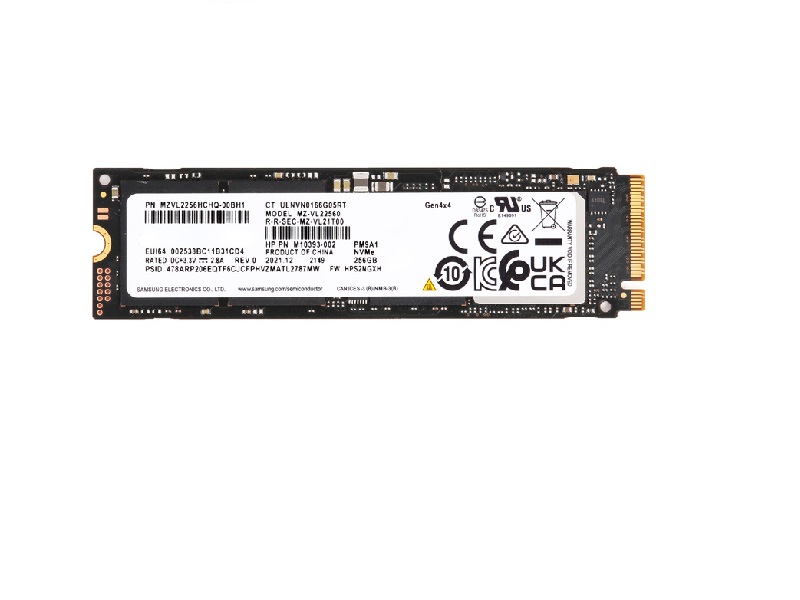
Compared with the previous-generation MZVLB256HBHQ, the Samsung PM9A1 MZVL2256HCHQ-00BH1 delivers a clear generational step up with PCIe NVMe bandwidth reaching 6400/2700 MB/s and random performance up to 500K/600K IOPS, giving 256GB client and embedded platforms much faster boot, load, and scratch-disk responsiveness. Its TLC V-NAND design, 150 TB TBW, and 0.33 DWPD make it a stronger choice than the prior model for read-heavy workstation, edge appliance, and OEM system-drive deployments where higher throughput and better sustained reliability are required within the same capacity class.
With an endurance rating of 150 TBW and 0.33 DWPD, the MZVL2256HCHQ-00BH1 is well suited for typical OS, office, and general-purpose business workloads where daily writes are modest. In practical terms, 150 TBW equals about 41 GB of writes per day over 10 years, making it a dependable choice as a boot or system drive under normal usage patterns. For reliability, its UBER of 1.0E-15 indicates a very low unrecoverable bit error rate, supporting strong data integrity in everyday operation, while the 1.5 million-hour MTBF reflects solid long-term component reliability. This model does not include power-loss protection, so it is best deployed in environments with stable power or UPS support rather than write-critical applications that require in-flight data protection during sudden outages.
1. The NVMe interface cuts protocol overhead and unlocks deeper parallelism, helping cloud, virtualization, and scale-out application servers respond faster under heavy concurrency.
2. Its strong sequential read performance accelerates large-block data movement, reducing wait time for analytics scans, backup restores, and AI model or dataset loading.
3. The high random read capability is well suited to metadata-heavy databases, virtual desktop environments, and read-intensive web platforms that depend on sustained small-block responsiveness at scale.
4. This endurance profile fits read-dominant enterprise deployments such as boot volumes, content repositories, and general-purpose server storage where capacity efficiency matters more than constant heavy rewriting.
5. TLC V-NAND provides an effective balance of density, cost, and reliability, while the microsecond-class typical latency helps keep transaction paths, cache lookups, and latency-sensitive services consistently snappy.
Lower capacity reference: 128GB Higher capacity reference: 512GB Capacity positioning analysis: Within this enterprise SSD family, 256GB is the sweet-spot capacity. Compared with 128GB, it provides noticeably better space headroom for OS images, logs, patches, and application growth, reducing the risk of early capacity pressure while keeping the same class of sequential throughput and random IOPS. Compared with 512GB, it reaches a better balance between acquisition cost and usable capacity, avoiding overprovisioning for lighter workloads. It is especially well suited for small to mid-sized virtualization clusters, such as hosting boot volumes for around 25 to 40 business application VMs.
Q: Is MZVL2256HCHQ-00BH1 suitable for a write-heavy database server?
A: No. With 0.33 DWPD, 150 TBW, TLC V-NAND, and no PLP, this 256GB NVMe SSD is better suited for client or light mixed workloads than write-intensive database servers.
Q: How many full drive writes per day can it actually endure over its warranty period?
A: It is rated for 0.33 DWPD, meaning about one-third of the 256GB capacity can be written daily over the warranty period, equivalent to roughly 84GB of writes per day.
Q: Does it include power loss protection (PLP) and why is that critical?
A: No, it does not include PLP. This matters because sudden power loss can leave in-flight data unwritten, increasing the risk of data inconsistency or corruption in transactional workloads.
Q: What RAID level is recommended for this SSD?
A: For general use, RAID 1 is recommended for redundancy, while RAID 10 is preferable for better performance and fault tolerance. Avoid parity-heavy RAID for sustained write-intensive applications.