











 Secure payments
Standard refund policy
Trade Assurance
Secure payments
Standard refund policy
Trade Assurance
| Brand | Samsung |
|---|---|
| Model | PM981a |
| Capacity | 512GB |
| Usage Class | Client / OEM |
| Host Interface | NVMe PCIe Gen3 x4 |
|---|---|
| Total Interface Bandwidth | 8 Gb/s |
| Form Factor | M.2 (2280) |
|---|
| NAND Flash | Samsung V-NAND 3-bit MLC (TLC) |
|---|---|
| Drive Writes Per Day | 0.3 |
| Total Bytes Written | 300 TBW |
| Sequential Read | 3500 MB/s |
|---|---|
| Sequential Write | 2900 MB/s |
| Random Read IOPS | 460000 |
| Random Write IOPS | 500000 |
| Average Latency | 50 μs |
| Mean Time Between Failures | 1.5 Million Hours |
|---|---|
| Uncorrectable Bit Error Rate | 1.0×10⁻¹⁷ |
| Power Loss Protection | No |
| MPN | MZVLB512HAJQ |
|---|
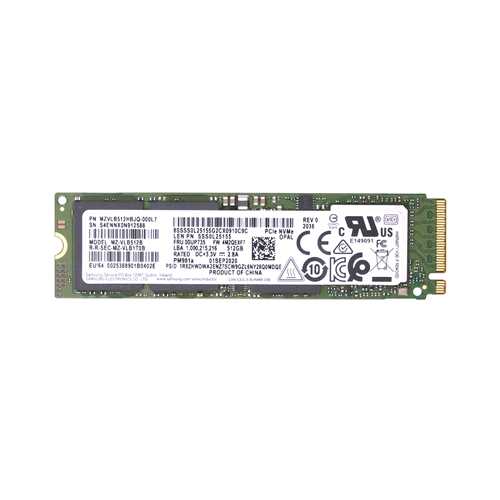
The Samsung PM981a MZVLB512HBJQ-000L7 delivers a strong 512GB PCIe Gen3 x4 profile with up to 3,500/2,900 MB/s sequential performance, 460K/500K IOPS, and 300 TBW endurance, making it especially well suited for premium notebooks, mobile workstations, and high-response OEM boot drives. Compared with the earlier MZVLB512HAJQ, this revision offers a more balanced next-generation tuning of throughput, random I/O, and endurance in the same class, giving system designers better real-world responsiveness and longer service life without changing platform interface.
With an endurance rating of 300 TBW, this 512GB SSD can sustain approximately 80GB of host writes per day for 10 years, or about 150GB per day for more than 5 years. In typical business PC, laptop, and OS-boot-drive workloads, that is comfortably above normal daily write activity, making it a low-risk choice for long-term system use. Power Loss Protection (PLP) is not included, which means the drive is not designed to preserve in-flight write data during an unexpected power interruption; for procurement, this is generally acceptable for client and office systems operating with stable power or UPS support. Its UBER rating of 1.0E-15 indicates a very low unrecoverable read error rate, and together with the 1.5 million hour MTBF, it supports dependable day-to-day operation in standard commercial environments.
1. The NVMe over PCIe Gen3 x4 design provides a low-overhead, high-bandwidth data path that helps enterprise servers accelerate storage access and reduce application wait time compared with legacy SAS or SATA SSDs.
2. With strong sequential read throughput, this drive is well suited for streaming large datasets, speeding up VM boot storms, backup restores, and analytics jobs that depend on moving big files quickly.
3. Its high random read capability enables responsive performance for metadata-heavy workloads such as virtualization, online transaction processing, and read-intensive databases serving many concurrent users.
4. The endurance rating is optimized for read-centric enterprise deployments, making it a practical fit for content delivery, boot storage, log analytics, and scale-out infrastructure where write pressure is moderate.
5. Built with Samsung V-NAND TLC and featuring very low typical latency, the SSD balances flash density with predictable responsiveness, helping improve rack-level efficiency while keeping application response times tight.
For the same series, the next lower capacity reference is 256GB, and the next higher capacity reference is 1TB. Their sequential read/write performance and random IOPS are generally in the same class as the 512GB model, which is typical for enterprise-oriented deployment planning. The 512GB point is the sweet spot in this family. Compared with 256GB, it gives much better headroom for OS images, logs, patch growth, and application data, reducing near-term capacity pressure. Compared with 1TB, it keeps acquisition cost and power budget more controlled while still delivering essentially the same day-to-day performance profile. This makes it a strong fit for mid-scale deployments, such as hosting boot and application volumes for about 30 to 50 general-purpose virtual server instances.
Q: Is MZVLB512HBJQ-000L7 suitable for a write-heavy database server?
A: No. With 0.3 DWPD, 300 TBW, TLC V-NAND, and no PLP, this model is better suited for client, read-focused, or mixed workloads rather than write-heavy database server use.
Q: How many full drive writes per day can it actually endure over its warranty period?
A: It is rated for 0.3 DWPD, meaning about 0.3 full writes of the 512GB capacity per day during the warranty period, equivalent to roughly 154GB of writes daily.
Q: Does it include power loss protection (PLP) and why is that critical?
A: No, it does not include PLP. This matters because sudden power loss can leave in-flight data unwritten, increasing the risk of corruption or inconsistency in transactional or enterprise workloads.
Q: What RAID level is recommended for this SSD?
A: For business use, RAID 1 or RAID 10 is generally recommended to improve redundancy and availability. RAID 0 is not advised for important data, especially without power loss protection.