











 Secure payments
Standard refund policy
Trade Assurance
Secure payments
Standard refund policy
Trade Assurance
| Brand | Samsung |
|---|---|
| Model | PM9D3a |
| Capacity | 15.36 TB |
| Usage Class | Enterprise / Data Center Read Intensive |
| Host Interface | PCIe Gen5 x4, NVMe 2.0 |
|---|---|
| Total Interface Bandwidth | 128 Gb/s |
| Form Factor | 2.5 |
|---|
| NAND Flash | Samsung V8 (236-layer) TLC |
|---|---|
| Drive Writes Per Day | 1 |
| Total Bytes Written | 28032 TBW |
| Sequential Read | 12000 MB/s |
|---|---|
| Sequential Write | 6800 MB/s |
| Random Read IOPS | 2000000 |
| Random Write IOPS | 250000 |
| Average Latency | 65 μs |
| Mean Time Between Failures | 2.5 Million Hours |
|---|---|
| Uncorrectable Bit Error Rate | 1.0×10⁻¹⁷ |
| Power Loss Protection | Yes |
| MPN | MZQL215THBLA-00A07 |
|---|
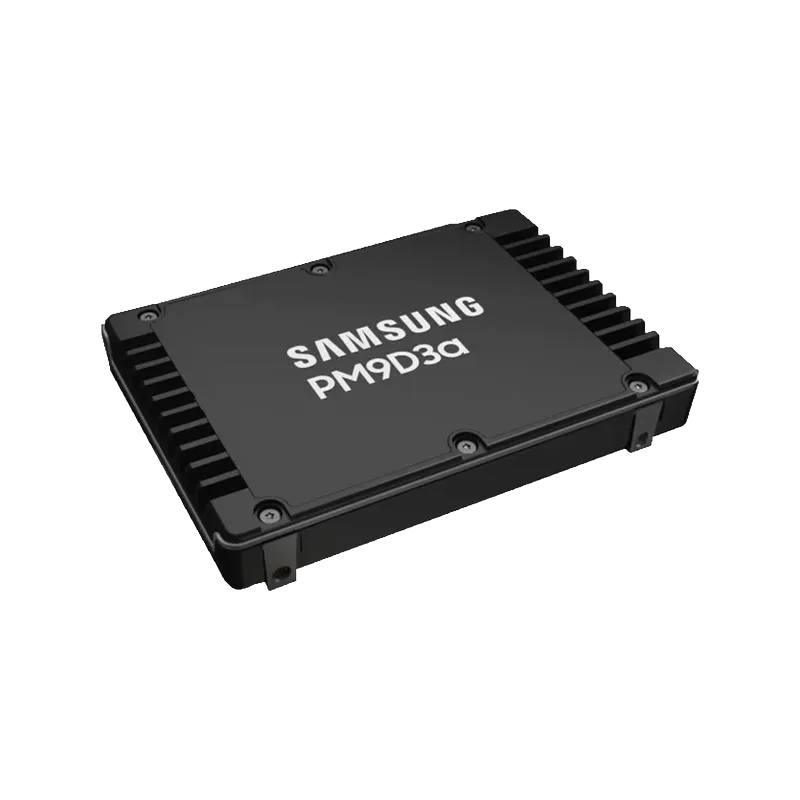
The MZWL615THBLF-00BW7 (PM9D3a) is a strong generational step over MZQL215THBLA-00A07, moving to PCIe Gen5 x4 and NVMe 2.0 to deliver up to 12,000 MB/s sequential read, 6,800 MB/s write, and 2.0M random read IOPS for substantially higher throughput headroom in next-generation servers. With 15.36 TB of Samsung V8 236-layer TLC and enterprise endurance of 1 DWPD / 28,032 TBW, it offers a compelling balance of density, durability, and performance for virtualization clusters, high-speed analytics tiers, and AI data staging workloads.
With an endurance rating of 28,032 TBW and 1 DWPD, this SSD is designed to support writing its full capacity once every day over a typical enterprise service life, making it well suited for sustained data-center workloads. For lighter write scenarios such as use as a boot or system drive, actual write consumption is usually far below this level, so from an endurance perspective it can deliver many years of dependable operation. Its enterprise reliability features further reduce operational risk: built-in power loss protection (PLP) helps preserve in-flight data and metadata during unexpected power outages, minimizing the chance of corruption or incomplete writes. An UBER of 1.0E-17 means the drive is engineered for an extremely low unrecoverable read error rate, supporting high data integrity for business-critical storage environments.
1. The PCIe Gen5 x4 interface with NVMe 2.0 unlocks next-generation host bandwidth, accelerating data-intensive workloads such as AI model staging, large-scale analytics, and high-speed storage virtualization.
2. Its class-leading sequential read performance shortens backup restore windows, speeds up database scans, and reduces asset loading time for content-rich enterprise applications.
3. Extremely high random read capability enables faster response for metadata-heavy environments like OLTP databases, cloud platforms, and large virtual desktop deployments under heavy concurrency.
4. A 1 DWPD endurance profile provides a balanced fit for mixed-read enterprise workloads, delivering predictable lifespan and lower replacement risk in always-on data center operation.
5. Samsung V8 236-layer TLC NAND combined with very low typical latency helps sustain consistent QoS, faster transaction turnaround, and better rack-level efficiency in latency-sensitive services.
Lower capacity reference: 7.68 TB Higher capacity reference: 30.72 TB Capacity positioning analysis: Within this enterprise SSD family, 15.36 TB sits at the sweet spot. Compared with 7.68 TB, it gives much better headroom for data growth, denser consolidation, and longer refresh cycles without changing the performance profile in any meaningful way. Compared with 30.72 TB, it typically delivers a more attractive cost-per-deployment while avoiding overprovisioning in environments that do not need maximum density. This makes 15.36 TB a balanced choice for mid-scale virtualization clusters, database nodes, or all-flash storage pools serving roughly 40 to 80 mixed enterprise workloads.
Q: Is MZWL615THBLF-00BW7 suitable for a write-heavy database server?
A: Yes, it is suitable for mixed and moderately write-heavy database workloads. With 1 DWPD, 28,032 TBW, low 65 µs latency, and PCIe Gen5 NVMe performance, it supports enterprise database environments reliably.
Q: How many full drive writes per day can it actually endure over its warranty period?
A: This model is rated for 1 DWPD, meaning it can sustain one full 15.36 TB drive write per day across its warranty period, aligned with its total endurance rating of 28,032 TBW.
Q: Does it include power loss protection (PLP) and why is that critical?
A: Yes, it includes power loss protection. PLP is critical because it helps preserve in-flight data and metadata during unexpected power failure, reducing corruption risk and improving storage reliability.
Q: What RAID level is recommended for this SSD?
A: For enterprise deployments, RAID 10 is commonly recommended when performance and redundancy are priorities. If usable capacity is more important, RAID 5 or RAID 6 may also be considered.