











 Secure payments
Standard refund policy
Trade Assurance
Secure payments
Standard refund policy
Trade Assurance
| Brand | Samsung |
|---|---|
| Model | PM1733 Series |
| Capacity | 7.68TB |
| Usage Class | Enterprise Data Center / Read Intensive |
| Host Interface | PCIe Gen 4.0 x4, NVMe |
|---|---|
| Total Interface Bandwidth | 16 Gb/s |
| Form Factor | 2.5 (U.2) 15mm |
|---|
| NAND Flash | Samsung V5 (9x-layer) 3D V-NAND TLC |
|---|---|
| Drive Writes Per Day | 1 |
| Total Bytes Written | 14016 TBW |
| Sequential Read | 7000 MB/s |
|---|---|
| Sequential Write | 3800 MB/s |
| Random Read IOPS | 1450000 |
| Random Write IOPS | 115000 |
| Average Latency | 95 μs |
| Mean Time Between Failures | 2.0 Million Hours |
|---|---|
| Uncorrectable Bit Error Rate | 1.0×10⁻¹⁷ |
| Power Loss Protection | Yes |
| MPN | MZWLJ7T6HALA-00007 |
|---|
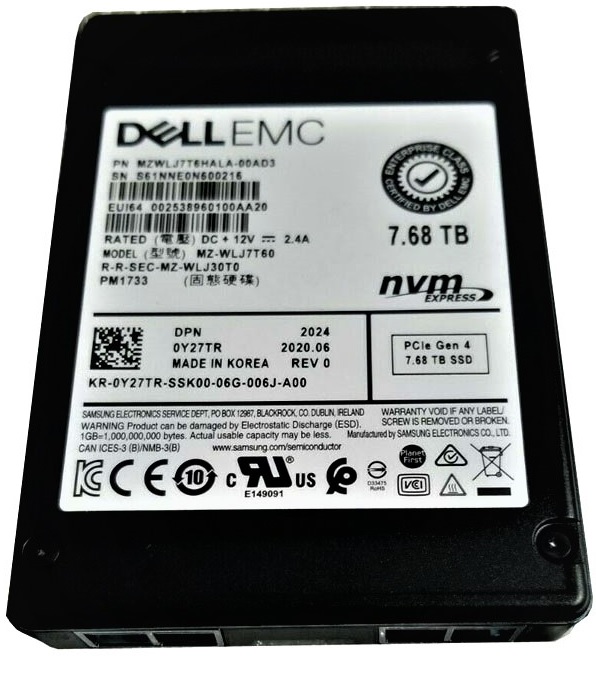
The MZWLJ7T6HALA-00AD3 in the PM1733 Series is a strong fit for read-intensive virtualization, scale-out database, and analytics tiers, combining 7.68TB of Samsung V5 3D TLC NAND with PCIe Gen4 x4 performance up to 7,000/3,800 MB/s and 1.45M/115K IOPS at a solid 1 DWPD and 14,016 TBW. Compared with the earlier MZWLJ7T6HALA-00007, this revision delivers a clear generational upgrade in host-interface bandwidth and flash platform capability, making it the better choice where higher transaction density and faster data ingest per U.2 slot are required.
With an endurance rating of 14,016 TBW and 1 DWPD, the MZWLJ7T6HALA-00AD3 is designed to handle heavy, sustained write activity across its service life, making it well suited for enterprise server and storage workloads. In typical OS, boot, and mixed application scenarios, this level of endurance is far beyond normal system-disk demand, so procurement teams can expect long-term, worry-free operation under standard enterprise use. Its enterprise reliability profile is further strengthened by power loss protection (PLP), which helps preserve in-flight data and metadata during unexpected power interruptions, reducing the risk of corruption and downtime. An UBER of 1.0E-17, together with a 2 million hour MTBF, reflects a very low probability of unrecoverable read errors and strong overall dependability for business-critical environments.
1. The PCIe Gen4 x4 NVMe architecture gives this drive the headroom to keep modern servers fed with data, reducing storage bottlenecks in virtualization, analytics, and AI pipelines.
2. Its class-leading sequential read capability accelerates large-block workloads such as database backup, media streaming, and model loading, helping systems reach usable state faster.
3. The combination of very high random-read throughput and sub-100-microsecond response time makes it especially effective for latency-sensitive applications like OLTP databases, metadata services, and high-concurrency cloud platforms.
4. The endurance profile is well suited to read-centric enterprise deployments, allowing predictable daily full-drive refreshes without overpaying for write endurance that many mixed workloads do not need.
5. Samsung’s advanced 3D TLC V-NAND provides a strong balance of density, power efficiency, and reliability, enabling enterprise capacity scaling without sacrificing consistent performance.
Lower capacity reference: 3.84TB Higher capacity reference: 15.36TB Capacity positioning analysis: In this SSD family, 7.68TB is the sweet-spot capacity. Compared with the 3.84TB model, it gives much better headroom for data growth, overprovisioning flexibility, and workload consolidation without changing the expected enterprise-class sequential throughput or random IOPS profile. Compared with the 15.36TB option, it usually delivers the best balance of usable capacity, acquisition cost, and performance efficiency, avoiding overinvestment for many deployments. It is especially well suited for mid-scale virtualization clusters, mixed OLTP application pools, or shared storage serving roughly 200 to 300 enterprise users.
Q: Is MZWLJ7T6HALA-00AD3 suitable for a write-heavy database server?
A: It can support mixed-use database workloads, but with 1 DWPD it is not ideal for extremely write-heavy environments. For sustained intensive writes, a higher-endurance enterprise SSD would be safer.
Q: How many full drive writes per day can it actually endure over its warranty period?
A: This model is rated for 1 DWPD, meaning it can handle one full 7.68TB drive write per day over its warranty period, aligned with its 14,016TB total endurance rating.
Q: Does it include power loss protection (PLP) and why is that critical?
A: Yes, it includes power loss protection. PLP helps preserve in-flight data and metadata during sudden outages, which is critical for preventing corruption and maintaining database or RAID consistency.
Q: What RAID level is recommended for this SSD?
A: RAID 10 is generally recommended for performance-sensitive database workloads, while RAID 5 or RAID 6 may suit capacity-focused deployments. The best choice depends on your performance, redundancy, and rebuild requirements.