











 Secure payments
Standard refund policy
Trade Assurance
Secure payments
Standard refund policy
Trade Assurance
| Brand | Samsung |
|---|---|
| Model | PM1743 Series |
| Capacity | 1.92TB |
| Usage Class | Enterprise Data Center / Read Intensive |
| Host Interface | PCIe Gen 5.0 x4, NVMe 2.0 |
|---|---|
| Total Interface Bandwidth | 32 Gb/s |
| Form Factor | 2.5 (U.2) 15mm |
|---|
| NAND Flash | Samsung V6 (128-layer) 3D V-NAND TLC |
|---|---|
| Drive Writes Per Day | 1 |
| Total Bytes Written | 3504 TBW |
| Sequential Read | 13000 MB/s |
|---|---|
| Sequential Write | 3500 MB/s |
| Random Read IOPS | 2500000 |
| Random Write IOPS | 250000 |
| Average Latency | 80 μs |
| Mean Time Between Failures | 2.5 Million Hours |
|---|---|
| Uncorrectable Bit Error Rate | 1.0×10⁻¹⁷ |
| Power Loss Protection | Yes |
| MPN | MZWLR1T9HCJR |
|---|
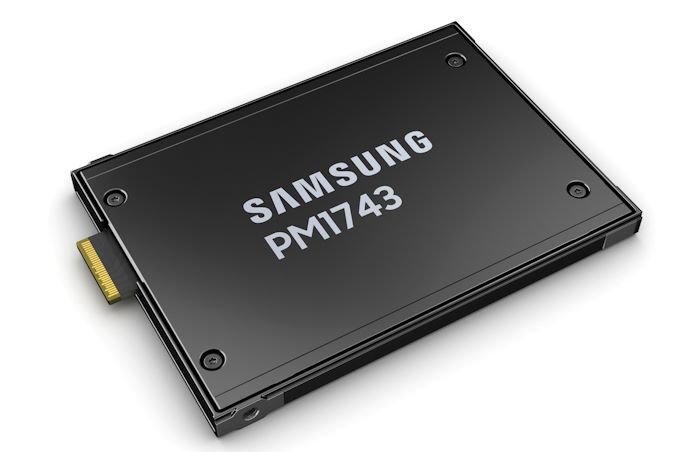
Compared with the previous-generation MZWLR1T9HCJR, the MZWLO1T9HCJR in the PM1743 Series advances to PCIe Gen 5.0 x4 and NVMe 2.0, delivering up to 13,000 MB/s sequential read and 2,500,000 random-read IOPS for a clear uplift in host throughput and read-side responsiveness. Its 1.92TB Samsung V6 128-layer 3D V-NAND TLC design, combined with 1 DWPD and 3,504 TBW endurance, makes it a strong fit for read-intensive virtualization, scale-out databases, and analytics nodes that need Gen5 performance without moving to a higher-endurance cost tier.
With an endurance rating of 3,504 TBW and 1 DWPD, the MZWLO1T9HCJR is designed to handle writing its full capacity every day throughout its rated service life, which is more than sufficient for typical enterprise boot, system, and mixed-read workloads. In practical terms, under normal server operating conditions, this level of endurance supports long-term deployment with strong write-life headroom rather than being a wear-out concern. For enterprise reliability, built-in Power Loss Protection (PLP) helps preserve in-flight data and protect metadata integrity during unexpected power interruptions, reducing the risk of corruption and unclean shutdown-related failures. Its UBER of 1.0E-17 and 2.5 million-hour MTBF indicate a very low uncorrectable bit error rate and strong long-term operational reliability, giving procurement teams added confidence for business-critical environments.
1. The PCIe Gen 5.0 x4 interface with NVMe 2.0 unlocks 13,000 MB/s sequential read performance, sharply reducing dataset staging, VM boot, and checkpoint load times in GPU-dense servers.
2. With 2,500,000 K random read IOPS, the drive sustains massive parallel access, helping large-scale databases and AI feature stores respond faster under heavy concurrency.
3. Rated at 1 DWPD, it is well suited for read-centric enterprise workloads that need predictable lifespan and lower replacement risk across a full service cycle.
4. Samsung V6 128-layer 3D V-NAND TLC provides a strong balance of density, power efficiency, and cost, enabling higher rack-level capacity without sacrificing enterprise-class reliability.
5. A typical latency of 80 µs helps keep QoS tight, minimizing tail-response delays for transactional systems, virtualized storage, and real-time inference pipelines.
For MPN MZWLO1T9HCJR (1.92TB), the adjacent capacities in the same enterprise SSD family are typically: Lower capacity: 960GB Higher capacity: 3.84TB Reference performance positioning: 960GB: broadly similar sequential read/write and random IOPS to the 1.92TB model 1.92TB: mainstream sweet-spot capacity with the same enterprise-class performance profile 3.84TB: also generally keeps similar sequential and random performance, with the main difference being usable capacity and cost per drive Capacity positioning analysis: The 1.92TB model sits at the practical sweet spot of the series. Compared with the 960GB version, it gives much more headroom for OS images, logs, hot data, and future growth without changing the performance class. Compared with the 3.84TB version, it usually delivers a better balance of acquisition cost, usable capacity, and predictable enterprise SSD behavior. It is especially well suited for mid-scale virtualization clusters, such as shared boot, database, or mixed application storage for roughly 40 to 70 business workloads.
Q: Is MZWLO1T9HCJR suitable for a write-heavy database server?
A: Yes, it can support database workloads well. With 1 DWPD, 3504 TBW, low 80 µs latency, and enterprise TLC NAND, it is suitable for moderate to heavy write environments.
Q: How many full drive writes per day can it actually endure over its warranty period?
A: This model is rated at 1 DWPD, meaning it can handle one full 1.92TB drive write per day throughout its warranty period, within the specified endurance limit.
Q: Does it include power loss protection (PLP) and why is that critical?
A: Yes, it includes PLP. This is critical because it helps protect in-flight data and metadata during sudden power failures, reducing corruption risk and improving storage reliability.
Q: What RAID level is recommended for this SSD?
A: RAID 1 or RAID 10 is generally recommended for enterprise use, especially for databases. These levels provide strong redundancy, good performance, and better protection against drive failure.