











 Secure payments
Standard refund policy
Trade Assurance
Secure payments
Standard refund policy
Trade Assurance
| Brand | Samsung |
|---|---|
| Model | PM1733A |
| Capacity | 3.84 TB |
| Usage Class | Read Intensive |
| Host Interface | PCIe Gen4 x4 |
|---|---|
| Total Interface Bandwidth | 64 Gb/s |
| Form Factor | 2.5" |
|---|
| NAND Flash | Samsung V-NAND 6th-Gen 128-layer 3D TLC |
|---|---|
| Drive Writes Per Day | 1 |
| Total Bytes Written | 7008 TBW |
| Sequential Read | 7000 MB/s |
|---|---|
| Sequential Write | 3800 MB/s |
| Random Read IOPS | 1450000 |
| Random Write IOPS | 115000 |
| Average Latency | 85 μs |
| Mean Time Between Failures | 2 Million Hours |
|---|---|
| Uncorrectable Bit Error Rate | 1.0×10⁻¹⁷ |
| Power Loss Protection | Yes |
| MPN | MZWLR3T8HBLS-00B07 |
|---|
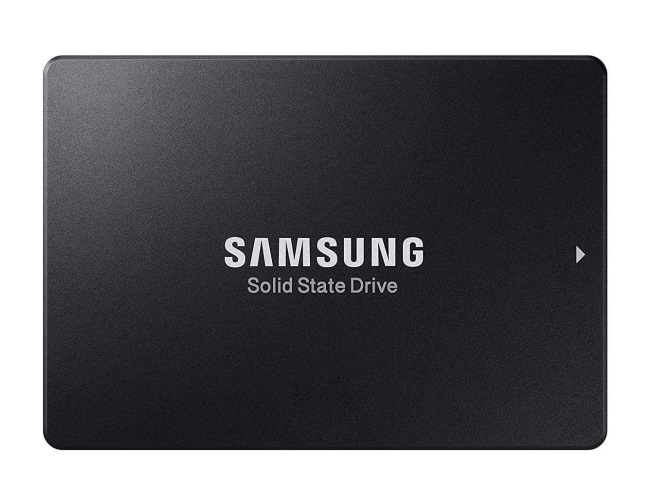
Compared with the previous MZWLR3T8HBLS-00B07, the MZWLR3T8HCLS-00B07 PM1733A advances to a PCIe Gen4 x4 platform with Samsung 6th-Gen 128-layer V-NAND, delivering up to 7,000/3,800 MB/s and 1,450,000/115,000 IOPS for a clear generational gain in bandwidth and transaction density. Its 3.84 TB capacity, 1 DWPD rating, and 7008 TBW endurance make it a stronger fit for read-intensive virtualization, scale-out databases, and high-throughput analytics nodes that need higher performance per drive without sacrificing enterprise endurance.
With an endurance rating of 7008 TBW and 1 DWPD, this SSD is designed to sustain one full drive write per day for about five years, which is a strong enterprise-class endurance level for a 3.84 TB drive. In typical server boot, OS, application, or read-heavy infrastructure workloads that write far less than a full drive per day, this translates into very comfortable long-term use and can realistically support system-disk deployment for well beyond 10 years from a write-endurance standpoint. Its built-in Power Loss Protection (PLP) helps preserve in-flight data and mapping information during an unexpected power interruption, reducing the risk of corruption and improving operational safety in enterprise environments. The 1.0E-17 UBER means an extremely low uncorrectable bit error rate, supporting high data integrity, while the 2 million-hour MTBF further reflects a robust reliability profile for business-critical procurement.
1. The PCIe Gen4 x4 interface provides the host bandwidth needed to keep virtualization clusters, analytics nodes, and GPU servers fed without the storage bus becoming a bottleneck.
2. Its class-leading sequential read performance sharply reduces large-file ingest, database restore, and AI model load times in data-intensive enterprise environments.
3. Exceptional random read capability, paired with ultra-low typical latency, accelerates mixed OLTP, metadata-heavy, and VDI workloads by delivering faster response under deep queue pressure.
4. The 1 DWPD endurance profile is well aligned with mainstream enterprise deployments that require dependable daily write capacity across the full warranty period without overprovisioning for heavier-duty media.
5. Samsung 6th-Gen 128-layer 3D TLC V-NAND combines mature high-density flash with enterprise-grade consistency, enabling a strong balance of capacity efficiency, sustained performance, and predictable reliability at scale.
Lower-capacity reference: 1.92 TB Higher-capacity reference: 7.68 TB Capacity positioning analysis: In this enterprise SSD family, 3.84 TB is the sweet-spot capacity. Versus 1.92 TB, it gives much better headroom for data growth, RAID efficiency, and longer refresh cycles, reducing the risk of early capacity bottlenecks. Versus 7.68 TB, it typically delivers a more attractive cost per deployment while keeping essentially the same mainstream enterprise read/write and random IOPS profile. That makes 3.84 TB the best balance of space, price, and predictable performance for mid-scale virtualization clusters, database nodes, or roughly 30 to 50 mixed-application servers in a standardized rollout.
Q: Is MZWLR3T8HCLS-00B07 suitable for a write-heavy database server?
A: It can support mixed-use database workloads, but for truly write-heavy servers, its 1 DWPD endurance may be limiting. We recommend validating daily write volume against the 7008 TBW rating.
Q: How many full drive writes per day can it actually endure over its warranty period?
A: This model is rated at 1 DWPD, meaning it can sustain one full 3.84 TB drive write per day across its warranty period, consistent with the specified 7008 TBW endurance.
Q: Does it include power loss protection (PLP) and why is that critical?
A: Yes, it includes power loss protection. PLP is critical because it helps preserve in-flight data and metadata during sudden outages, reducing corruption risk and improving enterprise storage reliability.
Q: What RAID level is recommended for this SSD?
A: The best RAID level depends on workload needs. RAID 1 or RAID 10 is typically recommended for databases requiring performance and redundancy, while RAID 5 or 6 suits capacity-focused environments.