











 Secure payments
Standard refund policy
Trade Assurance
Secure payments
Standard refund policy
Trade Assurance
| Brand | Samsung |
|---|---|
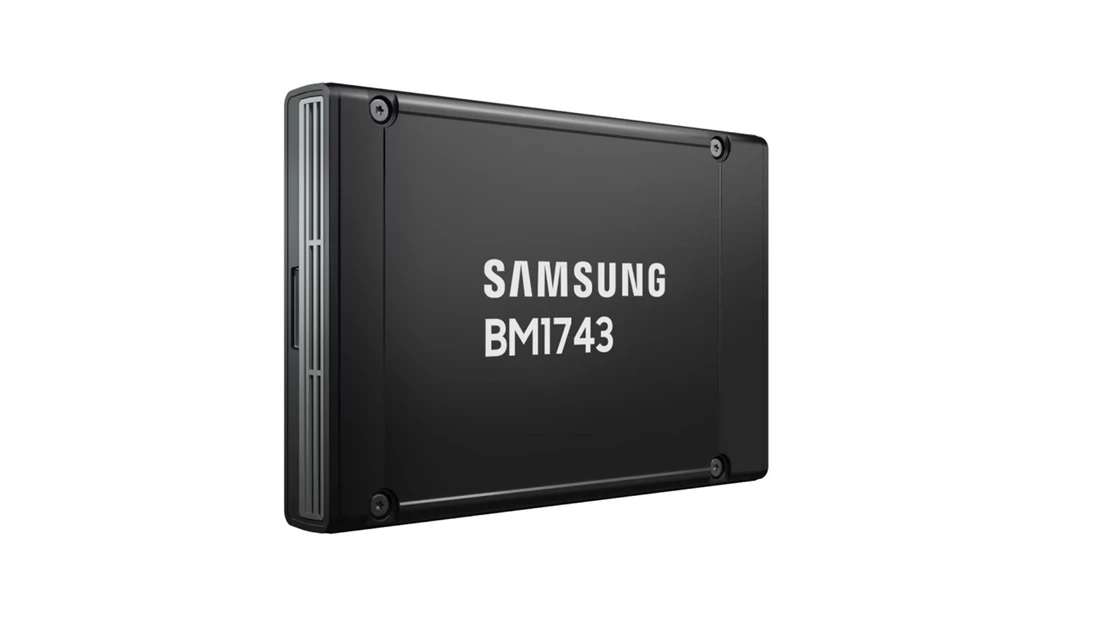
| Model | BM1743 |
| Capacity | 30.72 TB |
| Usage Class | Read Intensive |
| Host Interface | PCIe Gen5 x4 |
|---|---|
| Total Interface Bandwidth | 128 Gb/s |
| Form Factor | E3.S |
|---|
| NAND Flash | Samsung V-NAND 7th-Gen QLC |
|---|---|
| Drive Writes Per Day | 1 |
| Total Bytes Written | 56064 TBW |
| Sequential Read | 14000 MB/s |
|---|---|
| Sequential Write | 5000 MB/s |
| Random Read IOPS | 1600000 |
| Random Write IOPS | 110000 |
| Average Latency | 110 μs |
| Mean Time Between Failures | 2.5 Million Hours |
|---|---|
| Uncorrectable Bit Error Rate | 1.0×10⁻¹⁷ |
| Power Loss Protection | Yes |
| MPN | MZWLR15THALA-00007 |
|---|
Compared with MZWLR15THALA-00007, the BM1743 MZWMO30THCLF-00AW7 doubles usable capacity to 30.72 TB and moves to PCIe Gen5 x4, delivering up to 14,000 MB/s and 1.6M random-read IOPS for significantly higher throughput and density per slot. Its Samsung 7th-Gen QLC NAND, 1 DWPD endurance, and 56,064 TBW make it a strong upgrade for read-centric scale-out storage, AI data lakes, and high-density content platforms that need lower cost per TB without sacrificing enterprise-class reliability.
With an endurance rating of 56,064 TBW and 1 DWPD, the MZWMO30THCLF-00AW7 is built to sustain writing the equivalent of its full capacity every day throughout its designed service life, which is far beyond the needs of most typical server and enterprise system-disk workloads. In practical terms, for OS, boot, application, and general read-heavy infrastructure use, this level of endurance provides strong long-term headroom and supports worry-free operation over many years when deployed within the specified workload profile. For enterprise reliability, built-in Power Loss Protection (PLP) helps preserve in-flight data and protects metadata integrity during unexpected power interruptions, reducing the risk of corruption and unplanned recovery events. Its UBER of 1.0E-17 indicates an extremely low unrecoverable bit error rate, meaning the drive is designed for very high data integrity in business-critical environments where consistency, availability, and predictable performance matter.
1. The PCIe Gen5 x4 NVMe interface, paired with ultra-high sequential throughput, removes storage as a bottleneck for checkpoint loading, large-scale analytics scans, and backup ingest in modern enterprise servers.
2. Its massive random read capability keeps metadata-heavy databases, virtualized clusters, and AI feature stores highly responsive even under intense parallel access.
3. A one-drive-write-per-day endurance rating is well aligned with read-centric enterprise workloads, giving operators predictable lifespan planning for cloud storage, content delivery, and analytics serving.
4. Samsung’s seventh-generation QLC V-NAND enables higher usable capacity and better cost efficiency per rack, making it attractive for scale-out platforms that prioritize density and economics.
5. Typical latency in the low hundreds of microseconds helps reduce tail-response delays, improving SLA consistency for transactional services and other latency-sensitive enterprise applications.
Lower capacity reference: 15.36 TB Higher capacity reference: 61.44 TB At 30.72 TB, the MZWMO30THCLF-00AW7 sits in the sweet spot of the series. Compared with the 15.36 TB model, it gives much more headroom for data growth, longer refresh cycles, and better rack-level capacity efficiency without changing the expected enterprise-class sequential throughput or random IOPS profile. Compared with the 61.44 TB option, it usually delivers a more attractive cost-per-deployment and avoids overprovisioning capacity that many projects will not fully use. It is well suited for mid-scale virtualization clusters, large OLTP databases, or dense all-flash storage nodes for roughly 150–250 mixed business workloads.
Q: Is MZWMO30THCLF-00AW7 suitable for a write-heavy database server?
A: It can support mixed database workloads, but for strongly write-heavy servers, its 1 DWPD and QLC NAND make it less ideal than higher-endurance TLC enterprise SSDs.
Q: How many full drive writes per day can it actually endure over its warranty period?
A: This model is rated for 1 DWPD, meaning it can sustain one full 30.72 TB drive write per day across its warranty period, aligned with 56,064 TBW endurance.
Q: Does it include power loss protection (PLP) and why is that critical?
A: Yes, it includes power loss protection. PLP helps preserve in-flight data and metadata during sudden outages, which is critical for enterprise reliability, data integrity, and consistent recovery behavior.
Q: What RAID level is recommended for this SSD?
A: RAID 10 is commonly recommended for performance-sensitive enterprise workloads, while RAID 5 or 6 may suit capacity-focused environments. The best choice depends on performance, redundancy, and rebuild requirements.