











 Secure payments
Standard refund policy
Trade Assurance
Secure payments
Standard refund policy
Trade Assurance
| Brand | Samsung |
|---|---|
| Model | PM1735 |
| Capacity | 3.2 TB |
| Usage Class | Mixed Use |
| Host Interface | PCIe Gen4 x8 |
|---|---|
| Total Interface Bandwidth | 128 Gb/s |
| Form Factor | HHHL |
|---|
| NAND Flash | Samsung V-NAND 3D TLC |
|---|---|
| Drive Writes Per Day | 3 |
| Total Bytes Written | 17520 TBW |
| Sequential Read | 8000 MB/s |
|---|---|
| Sequential Write | 3800 MB/s |
| Random Read IOPS | 1500000 |
| Random Write IOPS | 250000 |
| Average Latency | 90 μs |
| Mean Time Between Failures | 2 Million Hours |
|---|---|
| Uncorrectable Bit Error Rate | 1.0×10⁻¹⁷ |
| Power Loss Protection | Yes |
| MPN | MZPLLI3T2HAJQ-00007 |
|---|
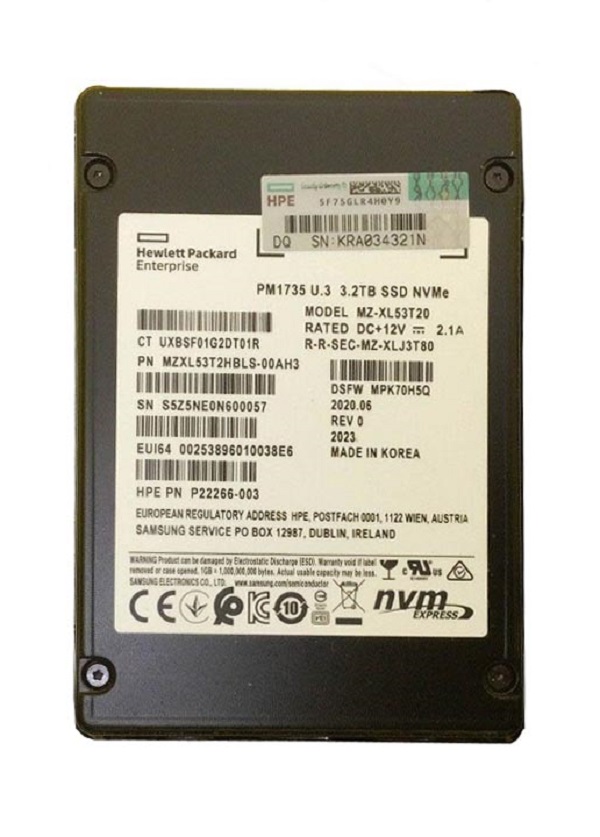
The Samsung PM1735 3.2TB (MZXL53T2HBLS-00AH3) is a strong generational upgrade over MZPLLI3T2HAJQ-00007, moving to a PCIe Gen4 x8 platform and delivering up to 8,000/3,800 MB/s sequential performance with 1.5M/250K random IOPS for materially higher throughput and VM or database consolidation density. Its 3 DWPD endurance, 17,520 TBW rating, and Samsung V-NAND 3D TLC make it a better fit for mixed read/write enterprise workloads that need both high sustained performance and stronger lifecycle durability than the prior-generation drive.
With an endurance rating of 17,520 TBW and 3 DWPD, the MZXL53T2HBLS-00AH3 is built to sustain very heavy write activity in demanding enterprise environments. In typical server and storage workloads, this level of endurance translates into long-term, worry-free operation, making it highly suitable for use as a system drive or mixed-use data drive over many years of continuous service. For enterprise reliability, the drive includes power loss protection (PLP), which helps preserve data integrity by safeguarding in-flight data and metadata during unexpected power interruptions. Its UBER specification of 1.0E-17, together with a 2 million hour MTBF, indicates an extremely low rate of uncorrectable bit errors and a design optimized for dependable operation in business-critical systems.
1. The PCIe Gen4 x8 host link provides ample lane bandwidth to keep modern dual-socket servers and storage nodes fully fed, reducing data-ingest bottlenecks in analytics, AI, and virtualization clusters.
2. Its multi-gigabyte-per-second sequential read capability accelerates large-block operations such as checkpoint loading, backup restore, media processing, and scale-out dataset scans.
3. The million-class random read performance is well suited for metadata-heavy databases, VM farms, and high-concurrency OLTP environments where massive parallel access must stay consistently responsive.
4. With enterprise-grade latency in the tens-of-microseconds range, the drive helps applications deliver faster transaction completion and tighter QoS under bursty mixed workloads.
5. The combination of a write-intensive endurance profile and Samsung V-NAND 3D TLC enables sustained daily overwrite cycles with a strong balance of reliability, capacity efficiency, and predictable lifecycle cost.
Lower capacity reference: 1.6 TB Higher capacity reference: 6.4 TB The 3.2 TB model sits at the sweet spot of this SSD family. Compared with the 1.6 TB version, it gives meaningfully better headroom for growth, reducing early capacity pressure in mixed enterprise workloads. Compared with the 6.4 TB version, it delivers a more attractive balance of acquisition cost, usable capacity, and broadly similar enterprise-class performance. This makes 3.2 TB a practical mainstream choice for mid-scale deployments, such as shared virtualization clusters, database nodes, or compact all-flash storage pools supporting about 40 to 60 business applications.
Q: Is MZXL53T2HBLS-00AH3 suitable for a write-heavy database server?
A: Yes. With 3 DWPD, 17,520 TBW, Samsung V-NAND 3D TLC, PCIe Gen4 x8, and 90 µs typical latency, this SSD is well suited for write-intensive database workloads.
Q: How many full drive writes per day can it actually endure over its warranty period?
A: It is rated for 3 full drive writes per day. For a 3.2 TB SSD, that equals 9.6 TB of writes daily, matching the 17,520 TBW endurance specification.
Q: Does it include power loss protection (PLP) and why is that critical?
A: Yes, it includes power loss protection. PLP helps preserve in-flight data and metadata during unexpected outages, which is critical for preventing corruption and maintaining consistency in enterprise environments.
Q: What RAID level is recommended for this SSD?
A: For most enterprise deployments, RAID 10 is recommended because it balances strong performance, low latency, and fault tolerance. RAID 1 is also suitable for smaller critical systems needing redundancy.