











 Secure payments
Standard refund policy
Trade Assurance
Secure payments
Standard refund policy
Trade Assurance
| Brand | Samsung |
|---|---|
| Model | PM883 |
| Capacity | 1.92 TB |
| Usage Class | Enterprise/Read-Intensive |
| Host Interface | SATA 3.0 6Gb/s |
|---|---|
| Total Interface Bandwidth | 6 Gb/s |
| Form Factor | 2.5 inch 7mm |
|---|
| NAND Flash | Samsung V4 (64L) TLC |
|---|---|
| Drive Writes Per Day | 1.3 |
| Total Bytes Written | 2733 TBW |
| Sequential Read | 550 MB/s |
|---|---|
| Sequential Write | 520 MB/s |
| Random Read IOPS | 98000 |
| Random Write IOPS | 28000 |
| Average Latency | 120 μs |
| Mean Time Between Failures | 2 Million Hours |
|---|---|
| Uncorrectable Bit Error Rate | 1.0×10⁻¹⁷ |
| Power Loss Protection | Yes |
| MPN | MZ7KM1T9HMJP |
|---|
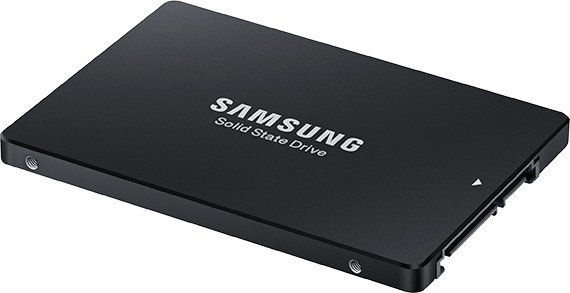
Compared with the earlier MZ7KM1T9HMJP generation, the Samsung PM883 MZ7LH1T9HMLT moves to 64-layer V4 TLC NAND and delivers a stronger 1.92 TB SATA enterprise profile with 550/520 MB/s throughput, 98K/28K IOPS, and 1.3 DWPD / 2,733 TBW endurance. Its unique value is combining near-SATA-limit performance with higher-capacity, read-optimized enterprise endurance, making it the better choice for dense virtualization, boot, and content-serving tiers that need a newer-generation replacement with improved endurance economics and performance consistency.
With an endurance rating of 2,733 TBW and 1.3 DWPD, the MZ7LH1T9HMLT is built to handle sustained daily writes in demanding business environments, not just light-duty use. In typical OS, boot, and general application workloads—where write volumes are usually much lower than the rated limit—this drive offers long service life and ample endurance headroom for years of stable operation. Its enterprise reliability is strengthened by power-loss protection (PLP), which helps preserve in-flight data and metadata if power is suddenly interrupted, reducing the risk of corruption or incomplete writes. An UBER of 1.0E-17 means the probability of an unrecoverable bit error is extremely low, supporting high data integrity expectations for enterprise storage deployments.
1. The SATA 3.0 6Gb/s interface, paired with top-end sequential read performance, lets this drive drop into mainstream enterprise servers and storage arrays while still accelerating boot, rebuild, and large-file delivery workloads.
2. Its 550 MB/s sequential read capability helps shorten backup restores, media streaming, and analytics dataset loading where steady throughput matters more than bursting.
3. With 98,000 random read IOPS, it can sustain high-concurrency access from virtual machines, web platforms, and database lookup traffic without quickly becoming the bottleneck.
4. Rated for 1.3 DWPD, this SSD offers the write endurance needed for mixed-use enterprise environments, supporting daily logging, transaction activity, and cache updates with predictable service life.
5. Built on Samsung V4 64-layer TLC NAND and delivering a typical latency of 120 µs, it balances cost-efficient flash density with responsive read behavior for consistently snappy application performance.
Lower capacity reference: 960 GB Higher capacity reference: 3.84 TB The 1.92 TB model sits at the sweet spot of the series. Compared with the 960 GB version, it gives much better headroom for OS images, application data, logs, and growth, reducing the risk of early capacity pressure. Compared with the 3.84 TB model, it usually delivers the best balance of acquisition cost, usable capacity, and enterprise-grade performance consistency. In practical deployment, it is well suited for medium-scale virtualization or database clusters, such as supporting boot and application storage for around 40 to 60 general-purpose virtual machines.
Q: Is MZ7LH1T9HMLT suitable for a write-heavy database server?
A: Yes, it is suitable for many write-intensive database workloads. With 1.3 DWPD, 2733 TBW endurance, TLC NAND, and 120 µs typical latency, it offers solid reliability and consistent enterprise performance.
Q: How many full drive writes per day can it actually endure over its warranty period?
A: This model is rated for 1.3 full drive writes per day over its warranty period. For a 1.92 TB SSD, that equals about 2.5 TB of writes per day.
Q: Does it include power loss protection (PLP) and why is that critical?
A: Yes, it includes power loss protection. PLP helps preserve in-flight data and metadata during unexpected outages, reducing corruption risk and improving data integrity in enterprise and database environments.
Q: What RAID level is recommended for this SSD?
A: The recommended RAID level depends on your priority. RAID 10 is typically preferred for database workloads, offering strong performance, redundancy, and faster rebuilds than parity-based RAID configurations.