











 Secure payments
Standard refund policy
Trade Assurance
Secure payments
Standard refund policy
Trade Assurance
| Brand | Samsung |
|---|---|
| Model | PM9A3 |
| Capacity | 7.68 TB |
| Usage Class | Enterprise / Data Center Read Intensive |
| Host Interface | PCIe Gen4 x4, NVMe 1.4 |
|---|---|
| Total Interface Bandwidth | 64 Gb/s |
| Form Factor | 2.5 |
|---|
| NAND Flash | Samsung V6 (128-layer) TLC |
|---|---|
| Drive Writes Per Day | 1 |
| Total Bytes Written | 14016 TBW |
| Sequential Read | 6900 MB/s |
|---|---|
| Sequential Write | 4100 MB/s |
| Random Read IOPS | 1100000 |
| Random Write IOPS | 200000 |
| Average Latency | 85 μs |
| Mean Time Between Failures | 2 Million Hours |
|---|---|
| Uncorrectable Bit Error Rate | 1.0×10⁻¹⁷ |
| Power Loss Protection | Yes |
| MPN | MZQL27T6HBLA-00A07 |
|---|
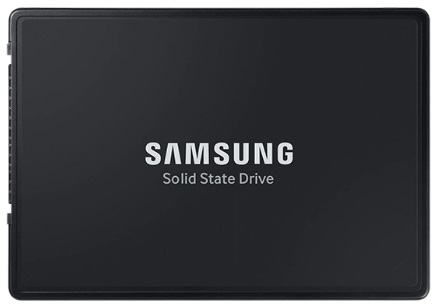
The Samsung PM9A3 7.68TB (MZQL27T6HBLA-00W07) is a strong fit for dense virtualized infrastructure, scale-out storage, and read-heavy database tiers, combining PCIe Gen4 x4 bandwidth with Samsung 128-layer V6 TLC to deliver up to 6,900/4,100 MB/s and 1.1M/200K IOPS at a data-center-ready 1 DWPD. Compared with the earlier MZQL27T6HBLA-00A07, this later revision offers a clear platform-generation advantage through a newer V6 NAND foundation and more mature PM9A3 tuning, giving architects better performance-per-slot and stronger long-life value at 14,016 TBW.
With an endurance rating of 14,016 TBW and 1 DWPD, the MZQL27T6HBLA-00W07 is designed to sustain a full drive write per day across its warranty life, which is more than sufficient for typical enterprise boot, system, and mixed-read workloads. In practical terms, under normal server operating conditions, this level of endurance supports long-term, worry-free deployment and provides substantial write headroom for many years of steady use. As an enterprise SSD, it includes power loss protection (PLP), which helps preserve in-flight data and protects metadata integrity during unexpected power interruptions, reducing the risk of corruption and unplanned recovery events. Its UBER rating of 1.0E-17, combined with a 2 million hour MTBF, indicates a very low probability of unrecoverable bit errors and strong overall reliability for business-critical infrastructure.
1. The PCIe Gen4 x4 interface with NVMe 1.4 provides a modern low-overhead data path that helps servers extract more usable bandwidth per drive and reduce storage bottlenecks in virtualized and scale-out environments.
2. Its class-leading sequential read performance accelerates large-block workloads such as database snapshots, analytics scans, backup restore, and AI model loading, cutting wait time for bulk data access.
3. The million-class random read capability makes it especially strong for latency-sensitive applications like OLTP databases, metadata-heavy cloud services, and high-concurrency VM farms.
4. A one-drive-write-per-day endurance rating fits mainstream enterprise duty cycles, giving operators predictable lifespan for read-heavy to mixed-use deployments without overpaying for unnecessary write endurance.
5. Samsung’s 128-layer TLC NAND, paired with typical latency in the tens of microseconds, delivers a strong balance of density, cost efficiency, and consistently fast response for always-on business workloads.
For MPN MZQL27T6HBLA-00W07 (7.68 TB), the nearest lower capacity in the same series is 3.84 TB, and the nearest higher capacity is 15.36 TB. As is typical for enterprise SSD families, sequential read/write performance and random IOPS are broadly similar across these three capacities. At 7.68 TB, this model sits in the sweet spot of the series. Compared with the 3.84 TB version, it gives much better headroom for dataset growth, VM density, and write burst absorption without forcing an early storage refresh. Compared with the 15.36 TB model, it usually offers a more efficient balance of acquisition cost, usable capacity, and steady enterprise performance. It is especially well suited for medium-scale virtualization clusters, mixed database nodes, or high-density application servers needing strong capacity without overprovisioning.
Q: Is MZQL27T6HBLA-00W07 suitable for a write-heavy database server?
A: It can support mixed or moderately write-intensive database workloads, but with 1 DWPD, it is not ideal for extremely write-heavy servers. Higher-endurance models are better for sustained heavy writes.
Q: How many full drive writes per day can it actually endure over its warranty period?
A: This SSD is rated at 1 DWPD, meaning it can handle one full 7.68 TB drive write per day during its warranty period, aligned with its 14,016 TBW endurance specification.
Q: Does it include power loss protection (PLP) and why is that critical?
A: Yes, it includes power loss protection. PLP helps preserve in-flight data and metadata during unexpected outages, reducing corruption risk and improving reliability in enterprise and database environments.
Q: What RAID level is recommended for this SSD?
A: For most enterprise deployments, RAID 1 or RAID 10 is recommended for strong redundancy and performance. RAID 5 or 6 may suit capacity-focused environments, depending on workload and rebuild tolerance.