











 Secure payments
Standard refund policy
Trade Assurance
Secure payments
Standard refund policy
Trade Assurance
| Brand | Intel |
|---|---|
| Model | D5-P5316 |
| Capacity | 30.72TB |
| Usage Class | Enterprise Data Center / Warm Storage |
| Host Interface | PCIe Gen 4.0 x4, NVMe 1.3c |
|---|---|
| Total Interface Bandwidth | 16 Gb/s |
| Form Factor | E1.L |
|---|
| NAND Flash | Intel 144-layer 3D QLC |
|---|---|
| Drive Writes Per Day | 0.41 |
| Total Bytes Written | 45700 TBW |
| Sequential Read | 7000 MB/s |
|---|---|
| Sequential Write | 3600 MB/s |
| Random Read IOPS | 800000 |
| Random Write IOPS | 510 |
| Average Latency | 120 μs |
| Mean Time Between Failures | 2.0 Million Hours |
|---|---|
| Uncorrectable Bit Error Rate | 1.0×10⁻¹⁷ |
| Power Loss Protection | Yes |
| MPN | SSDPE2NV307T8 |
|---|
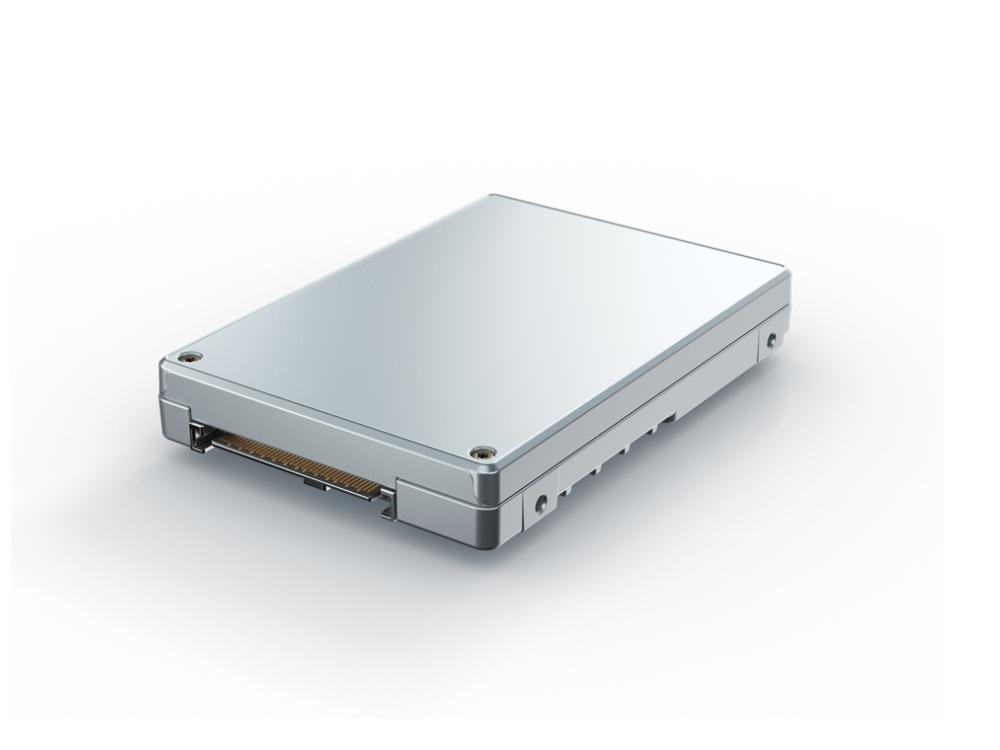
SSDPF2NV307TZN1 (D5-P5316) is a high-density 30.72TB QLC NVMe SSD built for read-centric hyperscale storage, delivering up to 7,000/3,600 MB/s with 800K random-read IOPS while sustaining 45.7 PBW in a single PCIe Gen4 x4 slot. Compared with the previous-generation SSDPE2NV307T8, it advances to a PCIe Gen4.0 x4 interface and Intel 144-layer 3D QLC NAND, giving architects higher rack-level capacity density and faster host throughput for content repositories, data lakes, and large-scale object storage tiers.
With an endurance rating of 45,700 TBW, the SSDPF2NV307TZN1 can sustain approximately 45.7 petabytes of total writes, which is far beyond the needs of typical OS, boot, and mainstream enterprise read-centric workloads. In practical terms, for applications such as a system drive, virtualization boot volume, or general-purpose data serving, this level of endurance supports long-term operation with substantial write headroom and low wear concerns. For enterprise reliability, built-in power loss protection (PLP) helps preserve in-flight data and metadata during an unexpected power interruption, reducing the risk of corruption and improving service continuity. Its UBER of 1.0E-17 indicates an extremely low uncorrectable bit error rate, giving buyers added confidence in data integrity for business-critical storage environments.
1. The PCIe Gen4 x4 interface with NVMe support gives this drive the bandwidth and low-overhead command path needed to keep virtualized databases and scale-out application nodes fed without becoming a storage bottleneck.
2. Its top-tier sequential read performance shortens large dataset loading, backup recovery, and analytics scan times, helping servers reach useful work faster after every restart or job launch.
3. The strong random read capability is ideal for read-heavy enterprise workloads such as search, metadata services, and high-concurrency VM farms where fast access to small blocks directly improves user responsiveness.
4. Built on Intel’s dense 3D QLC NAND with a light write-endurance profile, this SSD is best suited for cost-efficient, read-centric deployments like content repositories, AI data lakes, and warm-tier cloud storage.
5. The very low typical latency helps reduce tail-response delays, which is especially valuable for transaction services and real-time applications that depend on consistent storage behavior under load.
For MPN SSDPF2NV307TZN1, the nearest lower capacity in the same family is 15.36TB, and the nearest higher capacity is 61.44TB. At 30.72TB, this SSD sits at the series sweet spot. Compared with the 15.36TB model, it gives materially more headroom for data growth, denser node design, and longer refresh cycles without changing the expected enterprise-class sequential and random performance profile. Compared with the 61.44TB option, it delivers a more balanced $/GB, lower acquisition cost, and easier deployment economics while still enabling high consolidation. It is especially well suited for mid-scale virtualization clusters, large read-heavy databases, and software-defined storage nodes serving roughly 200 to 300 mixed business workloads.
Q: Is SSDPF2NV307TZN1 suitable for a write-heavy database server?
A: SSDPF2NV307TZN1 is better suited for read-intensive or mixed workloads. With 0.41 DWPD and QLC NAND, it is not the ideal choice for consistently write-heavy database environments.
Q: How many full drive writes per day can it actually endure over its warranty period?
A: This model is rated for 0.41 drive writes per day, meaning it can sustain about 41% of its full 30.72TB capacity in writes daily over the warranty period.
Q: Does it include power loss protection (PLP) and why is that critical?
A: Yes, it includes power loss protection. PLP helps preserve in-flight data and metadata during sudden outages, which is critical for maintaining data integrity and system reliability.
Q: What RAID level is recommended for this SSD?
A: RAID recommendation depends on the workload. RAID 1 or RAID 10 is preferred for performance and redundancy, while RAID 5 or RAID 6 may suit higher-capacity, read-focused deployments.