











 Secure payments
Standard refund policy
Trade Assurance
Secure payments
Standard refund policy
Trade Assurance
| Brand | Intel |
|---|---|
| Model | 760p Series |
| Capacity | 256GB |
| Usage Class | Consumer / Client |
| Host Interface | PCIe Gen 3.0 x4, NVMe |
|---|---|
| Total Interface Bandwidth | 8 Gb/s |
| Form Factor | M.2 22 x 80mm |
|---|
| NAND Flash | Intel 64-layer 3D TLC |
|---|---|
| Drive Writes Per Day | 0.3 |
| Total Bytes Written | 144 TBW |
| Sequential Read | 3210 MB/s |
|---|---|
| Sequential Write | 1315 MB/s |
| Random Read IOPS | 205000 |
| Random Write IOPS | 265000 |
| Average Latency | 40 μs |
| Mean Time Between Failures | 1.6 Million Hours |
|---|---|
| Uncorrectable Bit Error Rate | 1.0×10⁻¹⁷ |
| Power Loss Protection | No |
| MPN | SSDPEKKF256G7 |
|---|
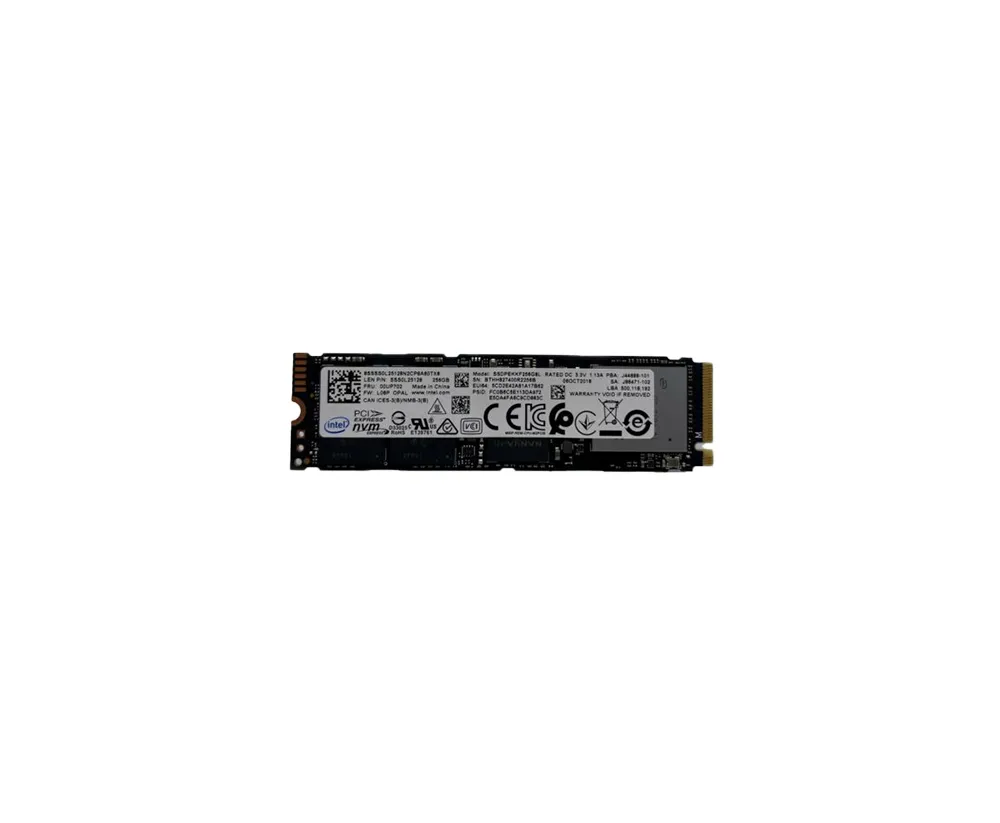
Compared with the previous-generation SSDPEKKF256G7, the Intel 760p Series SSDPEKKF256G8L moves to Intel 64-layer 3D TLC on a PCIe 3.0 x4 NVMe platform, delivering up to 3210 MB/s read, 1315 MB/s write, and 205K/265K random read/write IOPS for a clear step up in client NVMe responsiveness. Its distinctive value is pairing that performance with practical endurance at 144 TBW and 0.3 DWPD in a 256GB M.2 form factor, making it a strong fit for boot drives, developer workstations, and read-intensive edge systems that need better bandwidth and lower latency than earlier-generation PCIe SSDs.
With an endurance rating of 144 TBW, the SSDPEKKF256G8L is well suited for read-intensive and typical system-drive workloads, such as OS boot, application hosting, and general business PC or server boot use. In practical terms, that equals about 39 GB of writes per day over 10 years, so under normal operating patterns it can serve reliably as a system disk for many years without endurance concerns. For enterprise reliability, the drive’s UBER of 1.0E-15 indicates a very low probability of unrecoverable read errors, supporting dependable data access in professional environments, while the 1.6 million-hour MTBF reflects strong overall hardware reliability. This model does not include power-loss protection, so it is best deployed in boot, read-focused, or UPS-protected systems rather than write-critical caching applications where in-flight data must be preserved during sudden power interruption.
1. The PCIe Gen3 x4 NVMe architecture gives this drive enough host bandwidth to eliminate SATA-era bottlenecks, making it well suited for virtualized servers, boot acceleration, and high-speed application startup.
2. Its strong sequential read capability speeds up large file movement and dataset ingestion, reducing backup restore windows and analytics job startup time.
3. The high random read performance supports dense OLTP, VDI, and metadata-heavy workloads by serving many small requests in parallel with less queue buildup.
4. The endurance profile is optimized for read-centric enterprise deployments, delivering cost-efficient reliability for content delivery, warm data tiers, and scale-out read-heavy clusters rather than constant heavy rewriting.
5. Built on Intel 64-layer 3D TLC NAND and paired with very low typical latency, it offers a practical balance of capacity, consistency, and fast response for cloud services that need predictable QoS at scale.
In the SSDPEKKF series, the 128GB model is the next step down from the 256GB SSDPEKKF256G8L, while the 512GB model is the next step up. With broadly similar enterprise-class sequential throughput and random IOPS across these capacities, the 256GB version sits at the sweet spot of the lineup. Compared with 128GB, it gives much better headroom for OS, logs, swap, and application growth. Compared with 512GB, it delivers a stronger cost-to-performance balance, making it ideal for small virtualization clusters, edge servers, or around 40 to 60 lightweight cloud instances.
Q: Is SSDPEKKF256G8L suitable for a write-heavy database server?
A: SSDPEKKF256G8L is not ideal for write-heavy database servers. With 0.3 DWPD, 144 TBW, and 64-layer 3D TLC NAND, it is better suited for read-intensive or mixed, lighter-write workloads.
Q: How many full drive writes per day can it actually endure over its warranty period?
A: This model is rated at 0.3 DWPD, meaning it can sustain about 0.3 full drive writes per day during its warranty period. For 256GB capacity, that equals roughly 76.8GB written daily.
Q: Does it include power loss protection (PLP) and why is that critical?
A: No, this SSD does not include power loss protection. PLP is critical in enterprise environments because it helps prevent in-flight data loss and reduces metadata corruption during sudden power failure.
Q: What RAID level is recommended for this SSD?
A: For this SSD, RAID 1 or RAID 10 is generally recommended, depending on capacity needs. These levels provide redundancy and solid performance, especially since the drive lacks built-in power loss protection.