











 Secure payments
Standard refund policy
Trade Assurance
Secure payments
Standard refund policy
Trade Assurance
| Brand | Intel |
|---|---|
| Model | SSD 320 Series |
| Capacity | 600 GB |
| Usage Class | Consumer/Client |
| Host Interface | SATA 3Gb/s |
|---|---|
| Total Interface Bandwidth | 3 Gb/s |
| Form Factor | 2.5 inch 7mm |
|---|
| NAND Flash | 25nm MLC |
|---|---|
| Drive Writes Per Day | 0.1 |
| Total Bytes Written | 60 TBW |
| Sequential Read | 270 MB/s |
|---|---|
| Sequential Write | 220 MB/s |
| Random Read IOPS | 39500 |
| Random Write IOPS | 23000 |
| Average Latency | 75 μs |
| Mean Time Between Failures | 1.2 Million Hours |
|---|---|
| Uncorrectable Bit Error Rate | 1.0×10⁻¹⁷ |
| Power Loss Protection | Yes |
| MPN | SSDSA2BW600G301 |
|---|
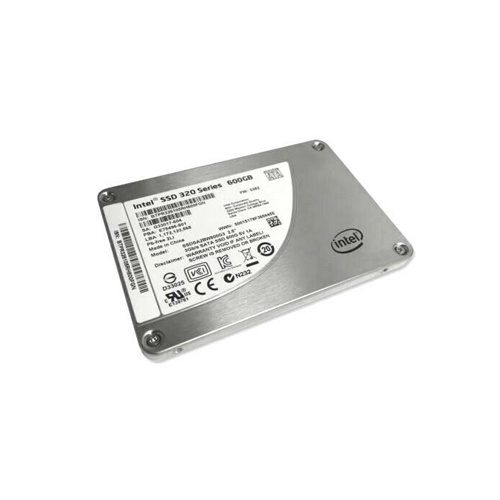
Compared with the earlier SSDSA2BW600G301, the SSDSA2BW600G3 serves as a later refresh of Intel’s 600 GB 320 Series, giving system builders a cleaner sustainment path for legacy SATA 3Gb/s deployments while retaining the proven 25nm MLC architecture and enterprise-familiar behavior. Its 270/220 MB/s throughput and 39,500/23,000 IOPS profile make it a particularly strong choice for read-centric boot volumes, virtualization host OS disks, and metadata-heavy edge workloads where higher-capacity, MLC-based reliability is more valuable than headline sequential speed.
With an endurance rating of 60 TBW and 0.1 DWPD, the SSDSA2BW600G3 is well suited for light to moderate daily write workloads typical of OS drives, office PCs, POS terminals, thin clients, and embedded systems. In practical terms, this level of endurance is generally sufficient for long-term system-disk use, allowing many typical business devices to operate for years—often close to a 10-year usage horizon under low-write conditions—without endurance concern. For reliability, the drive includes Power Loss Protection (PLP), which helps protect in-flight data and reduce the risk of corruption if power is suddenly interrupted. Its UBER specification of 1.0E-16, together with a 1.2 million hour MTBF, indicates strong data integrity and dependable operational stability, giving procurement teams added confidence for business deployment.
1. The SATA 3Gb/s interface paired with 270 MB/s sequential read performance makes this SSD a solid choice for boot volumes, static content delivery, and legacy enterprise platforms where compatibility is more important than maximum throughput.
2. Its 39,500 IOPS random read capability helps accelerate metadata lookups, index access, and virtual machine boot storms in read-centric server environments.
3. With a 0.1 DWPD endurance rating, the drive is best aligned with mostly read-heavy enterprise use cases such as OS images, reference data, and infrequently updated application tiers rather than write-intensive logging or database workloads.
4. Built on 25nm MLC NAND, it offers better cell reliability and data retention than consumer-grade flash, supporting stable operation in long-life enterprise deployments.
5. A typical latency of 75 µs enables consistently fast response to small read requests, helping reduce application wait time and improve overall system responsiveness under steady workloads.
Lower capacity reference: 300 GB Higher capacity reference: 800 GB (closest higher-capacity enterprise reference; 600 GB is effectively the top point within the Intel 320 family itself) At 600 GB, this model sits in the sweet spot of the lineup. Compared with the 300 GB version, it gives much better headroom for OS images, logs, patch growth, and overprovisioning without changing the familiar enterprise SATA performance profile. Compared with an 800 GB-class option, it usually lands at a more efficient price point while delivering essentially the same day-to-day throughput and IOPS. It is best suited for medium-scale deployments, such as hosting boot and application volumes for about 35 to 50 general-purpose virtual servers.
Q: Is SSDSA2BW600G3 suitable for a write-heavy database server?
A: Not ideal for write-heavy database workloads. Its 0.1 DWPD and 60 TBW indicate light write endurance, making it better suited for read-intensive applications or mixed workloads with low daily writes.
Q: How many full drive writes per day can it actually endure over its warranty period?
A: The drive is rated for 0.1 DWPD, meaning about one-tenth of its 600 GB capacity per day. In practice, that is roughly 60 GB of host writes daily during warranty coverage.
Q: Does it include power loss protection (PLP) and why is that critical?
A: Yes, it includes power loss protection. PLP helps preserve in-flight data and critical metadata during unexpected outages, reducing the risk of corruption, failed writes, and file system inconsistency.
Q: What RAID level is recommended for this SSD?
A: RAID 1 or RAID 10 is generally recommended for this SSD, especially in business systems. These levels provide redundancy and good read performance while avoiding the heavier parity-write overhead of RAID 5/6.