

 Secure payments
Standard refund policy
Trade Assurance
Secure payments
Standard refund policy
Trade Assurance
| Brand | Intel |
|---|---|
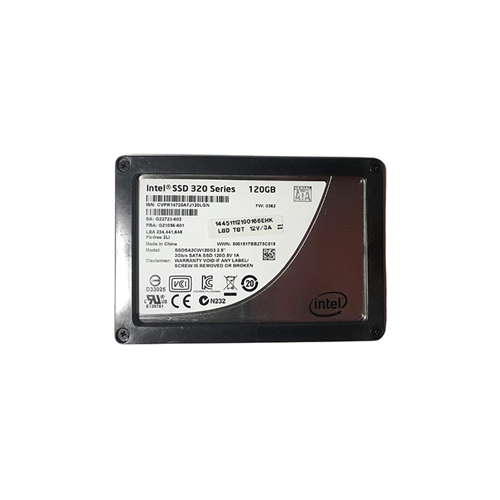
| Model | SSD 320 Series |
| Capacity | 120 GB |
| Usage Class | Consumer/Client |
| Host Interface | SATA 3Gb/s |
|---|---|
| Total Interface Bandwidth | 3 Gb/s |
| Form Factor | 2.5 inch 7mm |
|---|
| NAND Flash | 25nm MLC |
|---|---|
| Drive Writes Per Day | 0.1 |
| Total Bytes Written | 15 TBW |
| Sequential Read | 270 MB/s |
|---|---|
| Sequential Write | 130 MB/s |
| Random Read IOPS | 38000 |
| Random Write IOPS | 14000 |
| Average Latency | 75 μs |
| Mean Time Between Failures | 1.2 Million Hours |
|---|---|
| Uncorrectable Bit Error Rate | 1.0×10⁻¹⁷ |
| Power Loss Protection | Yes |
| MPN | SSDSA2CW120G301 |
|---|
Compared with the earlier SSDSA2CW120G301 revision, the SSDSA2CW120G3 is the later 120GB SSD 320 Series ordering SKU, giving engineers a cleaner lifecycle and qualification path while preserving the platform’s proven 25nm MLC reliability profile. For SATA 3Gb/s infrastructure, it delivers a well-balanced 270/130 MB/s and 38K/14K IOPS performance point that stands out versus typical entry SATA SSDs by favoring predictable random-read responsiveness and MLC-based endurance over lowest-cost TLC designs.
With an endurance rating of 15 TBW, the SSDSA2CW120G3 can sustain about 15,000 GB of total host writes over its service life, which is more than sufficient for light, read-focused workloads such as OS boot, office PCs, POS terminals, and embedded system drives. In practical terms, that is roughly 4 GB of writes per day for 10 years, so for a typical system disk with modest daily write activity, procurement teams can expect stable long-term use with ample endurance margin. For reliability, built-in power loss protection (PLP) helps preserve in-flight data and reduce the risk of corruption if power is suddenly interrupted, which is especially valuable for systems that must shut down safely and recover cleanly. Its UBER of 1.0E-16 means an extremely low probability of uncorrectable bit errors during reads, and together with the 1.2 million-hour MTBF, it supports dependable operation in business and industrial environments.
1. The legacy SATA interface enables a low-risk, drop-in upgrade for existing enterprise servers and storage arrays without requiring a platform redesign.
2. Its sequential read performance helps accelerate system boot, file retrieval, and large-block data access in read-focused business workloads.
3. The random read capability keeps virtual desktops, metadata-heavy applications, and transactional lookup workloads responsive under concurrent access.
4. The low endurance profile makes this drive best suited for read-dominant roles such as OS boot, content delivery, and reference-data storage rather than write-heavy database logging.
5. Mature planar MLC flash combined with microsecond-class latency delivers predictable response behavior and a practical balance of reliability and cost for mainstream enterprise use.
Lower capacity reference: 80 GB Higher capacity reference: 160 GB In the SSDSA2CW G3 family, the 120 GB model sits at a practical sweet spot. Compared with the 80 GB version, it gives noticeably more headroom for OS images, application binaries, logs, and overprovisioning, reducing capacity pressure in always-on enterprise use. Compared with the 160 GB option, it delivers a stronger cost-to-usable-space balance while maintaining broadly similar sequential and random I/O behavior typical of the series. It is especially well suited for small to midsize virtualization clusters, such as hosting boot volumes for about 40 to 60 infrastructure-focused virtual machines.
Q: Is SSDSA2CW120G3 suitable for a write-heavy database server?
A: No. With 0.1 DWPD and 15 TBW endurance, SSDSA2CW120G3 is better suited for read-focused or light-write workloads rather than write-heavy database servers with intensive daily write activity.
Q: How many full drive writes per day can it actually endure over its warranty period?
A: This model is rated for 0.1 DWPD, meaning about one-tenth of a full 120 GB drive write per day, or roughly 12 GB daily, within its endurance specification.
Q: Does it include power loss protection (PLP) and why is that critical?
A: Yes, it includes power loss protection. PLP helps preserve in-flight data and metadata during sudden power failure, reducing corruption risk and improving reliability in business-critical storage environments.
Q: What RAID level is recommended for this SSD?
A: RAID 1 or RAID 10 is generally recommended. These levels provide redundancy and, in RAID 10, better write performance, while avoiding the heavier write penalty common with RAID 5 or RAID 6.