











 Secure payments
Standard refund policy
Trade Assurance
Secure payments
Standard refund policy
Trade Assurance
| Brand | Intel |
|---|---|
| Model | X25-M Mainstream |
| Capacity | 160 GB |
| Usage Class | Consumer/Client |
| Host Interface | SATA 3Gb/s |
|---|---|
| Total Interface Bandwidth | 3 Gb/s |
| Form Factor | 2.5 inch 7mm |
|---|
| NAND Flash | 34nm MLC |
|---|---|
| Drive Writes Per Day | 0.05 |
| Total Bytes Written | 15 TBW |
| Sequential Read | 250 MB/s |
|---|---|
| Sequential Write | 100 MB/s |
| Random Read IOPS | 35000 |
| Random Write IOPS | 8600 |
| Average Latency | 65 μs |
| Mean Time Between Failures | 1.2 Million Hours |
|---|---|
| Uncorrectable Bit Error Rate | 1.0×10⁻¹⁷ |
| Power Loss Protection | No |
| MPN | SSDSA2M160G2 |
|---|
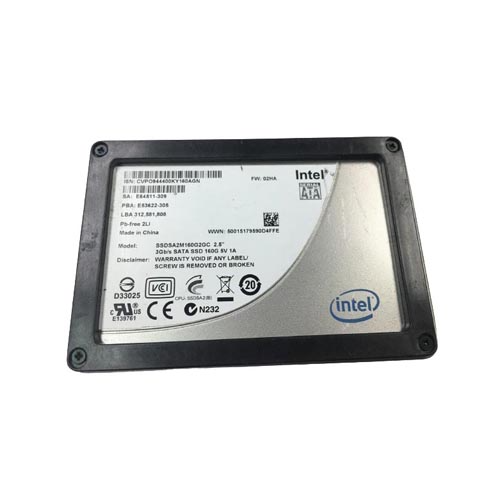
The SSDSA2M160G2GC stands out as the later GC-enabled revision of Intel’s X25-M Mainstream 160GB, pairing 250/100 MB/s sequential performance with 35,000/8,600 IOPS to deliver notably steadier long-term responsiveness on SATA 3Gb/s client systems. Compared with the SSDSA2M160G2, this update’s key generational advantage is improved sustained write consistency through onboard garbage-collection behavior, making it the better choice for read-heavy desktops and notebooks that need predictable performance from 34nm MLC flash.
With an endurance rating of 15 TBW and 0.05 DWPD, the SSDSA2M160G2GC is well suited for light-duty, read-focused use such as OS boot, office PCs, thin clients, and embedded system drives. In typical system-disk workloads where daily writes are relatively low, this level of endurance can comfortably support many years of stable operation, including long-term deployment in standard business environments. The drive is specified with an UBER of 1.0E-16 and an MTBF of 1.2 million hours, indicating a solid reliability baseline for routine commercial and industrial applications. It does not include power-loss protection, so it is best matched to use cases where sudden power interruption is uncommon or where the host system already provides power safeguarding, while the low bit error rate helps support dependable data integrity during normal operation.
1. The SATA 3Gb/s interface paired with 250 MB/s sequential read performance makes this drive a practical fit for legacy enterprise platforms that need faster boot, log replay, and bulk data retrieval without a backplane upgrade.
2. With 35,000 random read IOPS, the SSD can sustain responsive access to heavily indexed databases, virtual machine images, and read-centric application workloads under concurrency.
3. A typical latency of 65 µs helps reduce storage wait time in transactional environments, supporting quicker query response and smoother QoS for latency-sensitive services.
4. Rated at 0.05 DWPD, this model is best aligned with mostly read-intensive enterprise use cases such as OS boot media, reference datasets, and archival content that see limited daily rewrites.
5. Built on 34nm MLC NAND, the drive balances better cell reliability and data retention than consumer-grade flash, making it suitable for dependable operation in long-life business systems.
Lower-capacity reference: 80 GB Higher-capacity reference: 320 GB At 160 GB, this SSD sits in the sweet spot of the family. Compared with the 80 GB version, it gives much better headroom for OS growth, logs, patches, swap, and overprovisioning, reducing the risk of early capacity pressure. Compared with the 320 GB option, it preserves broadly similar enterprise SATA performance while avoiding the higher acquisition cost and less efficient dollar allocation for lighter workloads. In practice, 160 GB is ideal for small to mid-size virtualization clusters, such as hosting boot volumes for about 30 to 50 infrastructure-focused virtual machines.
Q: Is SSDSA2M160G2GC suitable for a write-heavy database server?
A: No. With only 0.05 DWPD and 15 TBW, this 160 GB 34nm MLC SATA SSD is better suited for light-read or mixed workloads, not write-intensive database server environments.
Q: How many full drive writes per day can it actually endure over its warranty period?
A: It is rated for 0.05 drive writes per day, meaning about 8 GB of writes daily on a 160 GB drive over the warranty period. This endurance is considered relatively low.
Q: Does it include power loss protection (PLP) and why is that critical?
A: No, it does not include power loss protection. PLP is critical because it helps prevent in-flight data loss and metadata corruption during unexpected power failure, especially in server or RAID use.
Q: What RAID level is recommended for this SSD?
A: For most business applications, RAID 1 or RAID 10 is recommended to improve redundancy and maintain performance. Avoid parity-heavy RAID levels in write-intensive scenarios due to this SSD’s limited endurance.