











 Secure payments
Standard refund policy
Trade Assurance
Secure payments
Standard refund policy
Trade Assurance
| Brand | Intel |
|---|---|
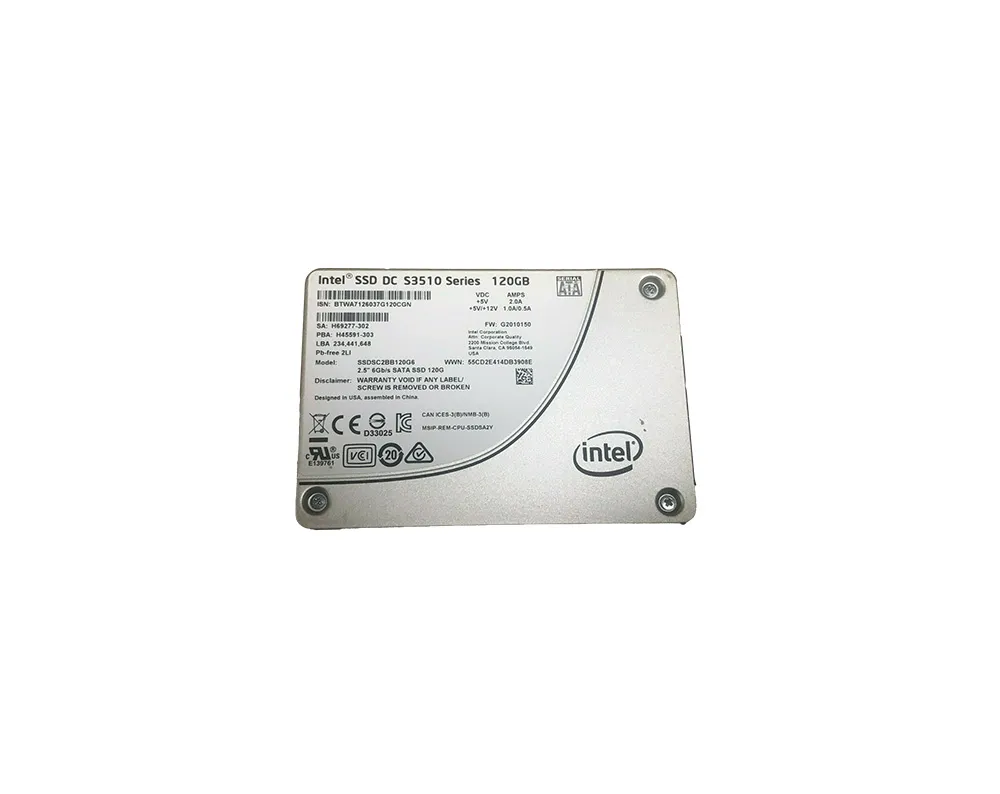
| Model | DC S3510 |
| Capacity | 120 GB |
| Usage Class | Enterprise/Read-Intensive |
| Host Interface | SATA 6Gb/s |
|---|---|
| Total Interface Bandwidth | 6 Gb/s |
| Form Factor | 2.5 inch 7mm |
|---|
| NAND Flash | 16nm MLC |
|---|---|
| Drive Writes Per Day | 0.3 |
| Total Bytes Written | 70 TBW |
| Sequential Read | 475 MB/s |
|---|---|
| Sequential Write | 135 MB/s |
| Random Read IOPS | 46500 |
| Random Write IOPS | 8500 |
| Average Latency | 55 μs |
| Mean Time Between Failures | 2 Million Hours |
|---|---|
| Uncorrectable Bit Error Rate | 1.0×10⁻¹⁷ |
| Power Loss Protection | Yes |
| MPN | SSDSC2BB120G601 |
|---|
Compared with the earlier SSDSC2BB120G601 ordering variant, the SSDSC2BB120G6 is the cleaner lifecycle refresh of the DC S3510, giving enterprises a more current qualification target while preserving the platform’s proven 16nm MLC reliability, 70 TBW endurance, and SATA 6Gb/s compatibility. For 120GB server boot volumes, hypervisor images, and read-centric edge nodes, it stands out versus typical same-capacity SATA SSDs by prioritizing enterprise-grade consistency and endurance over headline write speed, with up to 46,500/8,500 random read/write IOPS and 0.3 DWPD for predictable 24x7 operation.
With an endurance rating of 70 TBW and 0.3 DWPD, the SSDSC2BB120G6 can comfortably handle typical operating system, boot, office, and light application workloads over many years of normal use. In practical terms, for a 120GB SSD used primarily as a system drive, this endurance level is generally sufficient for around 10 years of everyday business usage without concern about write wear. For enterprise reliability, the drive includes Power Loss Protection (PLP), which helps protect in-flight data and maintain metadata integrity if power is suddenly interrupted. Its 1.0E-17 UBER and 2 million-hour MTBF indicate a very low probability of unrecoverable read errors and strong long-term operational reliability, giving buyers added confidence for business deployment.
1. The SATA 6Gb/s interface enables simple drop-in deployment across legacy enterprise storage platforms, making it a cost-efficient upgrade for expanding capacity without changing existing server backplanes.
2. With sequential read performance of 475 MB/s, this drive accelerates large-file access such as OS image delivery, backup restores, and read-heavy content distribution workloads.
3. Its random read capability of 46,500 IOPS supports responsive performance in virtualized environments, boot storms, and metadata-intensive database queries where fast small-block access matters most.
4. Rated for 0.3 DWPD, the endurance profile is best suited to read-centric enterprise applications like web hosting, content repositories, and reference datasets with relatively light daily write pressure.
5. Built with 16nm MLC NAND and a typical latency of 55 µs, the drive combines stronger cell reliability than TLC-based alternatives with consistently low access delay for steady application responsiveness.
Within the same Intel enterprise SSD family as SSDSC2BB120G6, the nearest lower capacity reference is 80 GB, and the nearest higher capacity reference is 160 GB. Both are designed for broadly similar enterprise SATA performance, with comparable sequential read/write behavior and random IOPS in typical mixed server workloads. At 120 GB, this model sits in the sweet spot of the series. Compared with 80 GB, it gives noticeably better headroom for OS images, logs, and patch growth. Compared with 160 GB, it preserves most of the practical performance profile while keeping acquisition cost tighter. It is best suited for small-to-mid virtualization clusters, such as boot and utility storage for around 35 to 50 lightweight application instances.
Q: Is SSDSC2BB120G6 suitable for a write-heavy database server?
A: SSDSC2BB120G6 is generally not ideal for write-heavy database workloads. With 0.3 DWPD and 70 TBW, it is better suited for read-intensive, boot, cache, or light mixed-use server applications.
Q: How many full drive writes per day can it actually endure over its warranty period?
A: This model is rated for 0.3 drive writes per day, meaning it can handle about 36 GB of writes daily on a 120 GB drive over its supported warranty endurance period.
Q: Does it include power loss protection (PLP) and why is that critical?
A: Yes, it includes power loss protection. PLP helps preserve in-flight data and metadata during sudden outages, reducing corruption risk and improving reliability in enterprise or transactional environments.
Q: What RAID level is recommended for this SSD?
A: For most server deployments, RAID 1 or RAID 10 is recommended to balance redundancy and performance. RAID 5 is possible, but parity writes may increase endurance consumption on this SSD.