











 Secure payments
Standard refund policy
Trade Assurance
Secure payments
Standard refund policy
Trade Assurance
| Brand | Intel |
|---|---|
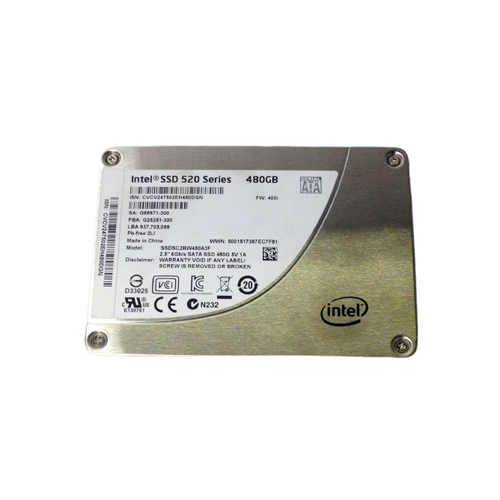
| Model | SSD 520 Series |
| Capacity | 480 GB |
| Usage Class | Consumer/Client |
| Host Interface | SATA 6Gb/s |
|---|---|
| Total Interface Bandwidth | 6 Gb/s |
| Form Factor | 2.5 inch 7mm |
|---|
| NAND Flash | 25nm MLC |
|---|---|
| Drive Writes Per Day | 0.1 |
| Total Bytes Written | 36 TBW |
| Sequential Read | 550 MB/s |
|---|---|
| Sequential Write | 520 MB/s |
| Random Read IOPS | 50000 |
| Random Write IOPS | 60000 |
| Average Latency | 80 μs |
| Mean Time Between Failures | 1.2 Million Hours |
|---|---|
| Uncorrectable Bit Error Rate | 1.0×10⁻¹⁷ |
| Power Loss Protection | No |
| MPN | SSDSC2BW480A3 |
|---|
Compared with the SSDSC2BW480A3, the SSDSC2BW480A3F is the later-revision 480 GB SSD 520 Series SKU, preserving top-end SATA 6Gb/s performance at 550/520 MB/s and 50,000/60,000 IOPS while providing a cleaner refresh path for validated legacy platforms. Its 25nm MLC NAND gives it a more predictable latency and write behavior than many same-class TLC SATA drives, making this MPN especially well suited to read-centric boot, application, and edge-cache tiers where consistent responsiveness is the priority.
With an endurance rating of 36 TBW and 0.1 DWPD, the SSDSC2BW480A3F is well suited for read-focused and light-write workloads such as OS boot drives, office PCs, thin clients, and embedded system storage. In typical system-disk usage, where daily writes are relatively low, this level of endurance can comfortably support many years of service, making it a practical and dependable choice for long-life deployment. From a reliability perspective, the drive is rated at 1.2 million hours MTBF and an UBER of 1.0E-16, meaning the probability of unrecoverable bit errors is very low and aligned with solid commercial SSD quality expectations. It does not include power-loss protection, so it is best used in systems with stable power or upstream power safeguards, but for standard client and read-centric applications it still provides reliable operation backed by a 1-year warranty.
1. The SATA interface enables a straightforward drop-in upgrade for legacy enterprise servers and storage arrays, reducing deployment friction without requiring platform changes.
2. Its strong sequential read capability speeds up boot images, database backups, and large-file retrieval, helping read-heavy systems return data faster to users and applications.
3. The random read performance supports responsive VM density, metadata lookups, and transaction-heavy read workloads, improving consistency under concurrent access.
4. The low endurance rating makes this drive best suited for read-centric roles such as boot, reference-data, and content-delivery tiers rather than write-intensive logging or cache workloads.
5. Built on MLC NAND and paired with low typical latency, it offers more predictable enterprise responsiveness and better long-term reliability than consumer-oriented flash in steady read-focused operation.
For the Intel SSDSC2BW480A3F 480 GB enterprise SSD, the closest same-series reference points are 240 GB as the next lower capacity and 960 GB as the next higher capacity. Since sequential throughput and random IOPS are broadly similar across these mainstream enterprise capacities, 480 GB is the practical sweet spot. Compared with 240 GB, it offers much better headroom for OS, logs, swap, and application growth. Compared with 960 GB, it keeps acquisition cost lower while preserving nearly the same everyday performance profile, making it ideal for mid-sized virtualization clusters or compact database nodes.
Q: Is SSDSC2BW480A3F suitable for a write-heavy database server?
A: No. With only 0.1 DWPD and 36 TBW, this 480GB SATA SSD is better suited for read-centric or light mixed workloads, not write-heavy database server environments.
Q: How many full drive writes per day can it actually endure over its warranty period?
A: It is rated for 0.1 DWPD, meaning about 48GB of writes per day on a 480GB drive over the warranty period, assuming operation stays within the specified endurance limits.
Q: Does it include power loss protection (PLP) and why is that critical?
A: No, it does not include PLP. This matters because sudden power failure may leave in-flight data or metadata uncommitted, increasing the risk of corruption in business-critical systems.
Q: What RAID level is recommended for this SSD?
A: RAID 1 or RAID 10 is generally recommended for better redundancy and stable performance. For write-sensitive deployments, avoid RAID levels that add heavy parity-write overhead.