











 Secure payments
Standard refund policy
Trade Assurance
Secure payments
Standard refund policy
Trade Assurance
| Brand | Intel |
|---|---|
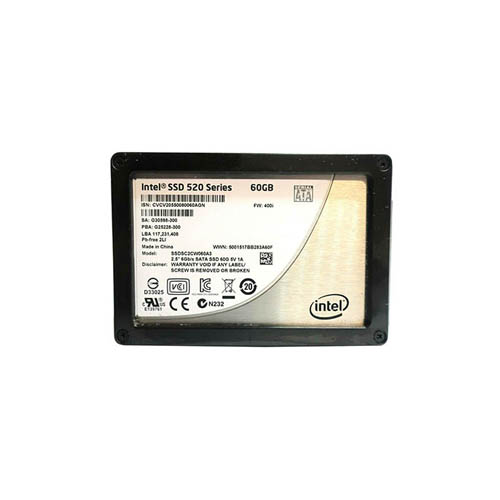
| Model | 520 Series (Cherryville) |
| Capacity | 60 GB |
| Usage Class | Consumer |
| Host Interface | SATA 6Gb/s |
|---|---|
| Total Interface Bandwidth | 6 Gb/s |
| Form Factor | 2.5 inch 9.5mm |
|---|
| NAND Flash | 25nm MLC |
|---|---|
| Drive Writes Per Day | 0.4 |
| Total Bytes Written | 36 TBW |
| Sequential Read | 550 MB/s |
|---|---|
| Sequential Write | 475 MB/s |
| Random Read IOPS | 15000 |
| Random Write IOPS | 80000 |
| Average Latency | 80 μs |
| Mean Time Between Failures | 1.2 Million Hours |
|---|---|
| Uncorrectable Bit Error Rate | 1.0×10⁻¹⁷ |
| Power Loss Protection | No |
| MPN | SSDSC2CW060A |
|---|
Compared with the earlier SSDSC2CW060A, the SSDSC2CW060A3 delivers a more refined 520 Series implementation that better capitalizes on the SATA 6Gb/s interface, reaching up to 550/475 MB/s and an especially strong 80,000 random write IOPS profile for a 60 GB class SSD. Its 25nm MLC NAND, 36 TBW endurance, and 0.4 DWPD rating make it a stronger choice for OS boot, metadata, and read-heavy edge workloads where low-latency write bursts and long-term reliability matter more than raw capacity.
With an endurance rating of 36 TBW and 0.4 DWPD, the SSDSC2CW060A3 is well suited for read-intensive and light-write workloads such as OS boot, embedded control, or appliance system-drive use. In practical terms, a typical 10 GB/day system-disk workload would reach 36 TB in about 10 years, giving buyers confidence for long-term deployment in stable operating environments. Its UBER of 1.0E-16 means the statistical rate of unrecoverable bit errors is very low, supporting dependable data reads in normal enterprise use. This model does not include power-loss protection, so it is best positioned for applications where sudden power interruption is controlled by system-level safeguards such as a UPS, orderly shutdown, or host-side data protection.
1. The SATA enterprise interface enables straightforward drop-in deployment across legacy server and storage platforms, while its bus-saturating sequential read speed helps accelerate boot storms, image distribution, and large-file retrieval.
2. Its random read capability is well suited to read-heavy enterprise workloads such as OS boot volumes, metadata lookups, and light database access, helping sustain responsive performance under parallel user demand.
3. The rated endurance is best aligned with mixed-to-read-dominant duty cycles, giving data centers a cost-efficient option for content serving, caching tiers, and infrastructure workloads with limited daily overwrite pressure.
4. Built on MLC NAND, the drive offers a stronger balance of performance consistency, write resilience, and data retention than consumer-oriented flash, making it a dependable fit for always-on business environments.
5. The low typical latency supports faster transaction acknowledgment and tighter application response times, which is valuable for virtualized servers and latency-sensitive enterprise services.
For the Intel SSD series that includes MPN SSDSC2CW060A3 (60 GB), the nearest reference capacities are: Lower capacity: 40 GB Higher capacity: 80 GB At 60 GB, this model sits in the sweet spot of the series. Compared with the 40 GB version, it offers more headroom for OS images, logs, patches, and overprovisioning, reducing space pressure in always-on enterprise use. Compared with the 80 GB version, it keeps acquisition cost tighter while delivering essentially the same sequential throughput and enterprise-class random IOPS profile. This makes 60 GB a balanced choice for small boot pools, edge servers, or roughly 20 to 30 light-duty virtual desktop system volumes.
Q: Is SSDSC2CW060A3 suitable for a write-heavy database server?
A: SSDSC2CW060A3 is not ideal for a write-heavy database server. With 0.4 DWPD, 36 TBW, and no PLP, it is better suited for light-duty boot, cache, or read-focused workloads.
Q: How many full drive writes per day can it actually endure over its warranty period?
A: This model is rated for 0.4 drive writes per day. For a 60 GB SSD, that equals about 24 GB of writes daily on average across the supported warranty period.
Q: Does it include power loss protection (PLP) and why is that critical?
A: No, this SSD does not include power loss protection. PLP is critical in server environments because it helps prevent in-flight data loss and reduces metadata corruption during unexpected power outages.
Q: What RAID level is recommended for this SSD?
A: For general server use, RAID 1 is typically recommended to improve redundancy and availability. For higher read performance, RAID 10 may be considered, but write-intensive applications need more durable SSDs.