











 Secure payments
Standard refund policy
Trade Assurance
Secure payments
Standard refund policy
Trade Assurance
| Brand | Samsung |
|---|---|
| Model | T9 |
| Capacity | 2 TB |
| Usage Class | Portable / Consumer |
| Host Interface | USB 3.2 Gen 2x2 |
|---|---|
| Total Interface Bandwidth | 20 Gb/s |
| Form Factor | Portable |
|---|
| NAND Flash | Samsung V-NAND 3-bit TLC |
|---|---|
| Drive Writes Per Day | 0.3 |
| Total Bytes Written | 1200 TBW |
| Sequential Read | 2000 MB/s |
|---|---|
| Sequential Write | 2000 MB/s |
| Random Read IOPS | 110000 |
| Random Write IOPS | 110000 |
| Average Latency | 80 μs |
| Mean Time Between Failures | 1.5 Million Hours |
|---|---|
| Uncorrectable Bit Error Rate | 1.0×10⁻¹⁷ |
| Power Loss Protection | No |
| MPN | MU-PC2T0T/AM |
|---|
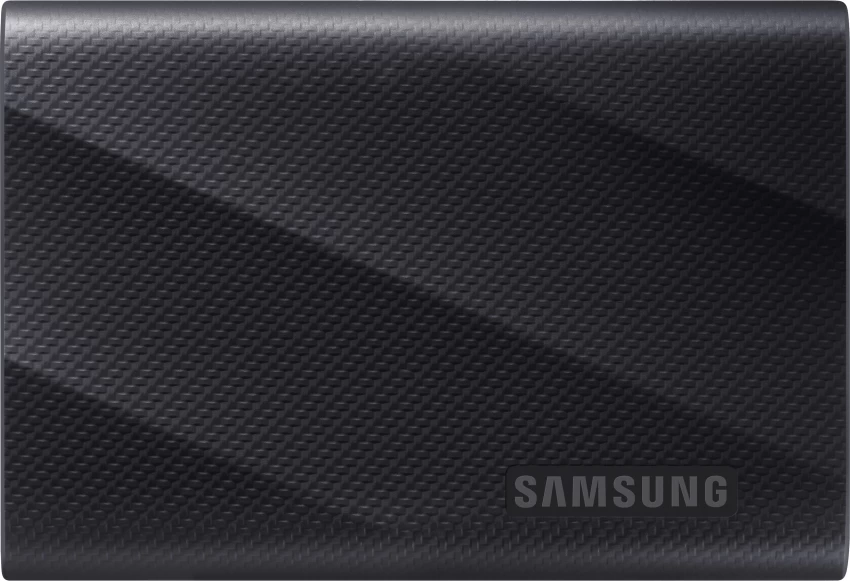
Compared with MU-PC2T0T/AM, the MU-PG2T0B/AM T9 upgrades to USB 3.2 Gen 2x2 and doubles peak sequential performance to 2000/2000 MB/s, materially cutting transfer time for large media sets, project archives, and backup windows. Its 2 TB Samsung V-NAND 3-bit TLC design, 1200 TBW endurance, and 110,000/110,000 random IOPS also give engineers a stronger balance of sustained reliability and small-block responsiveness than the prior generation for mobile scratch, field ingest, and prosumer content workflows.
With an endurance rating of 1200 TBW, the MU-PG2T0B/AM can sustain approximately 1.2 petabytes of total writes, which is far above the write volume of typical OS, office, and general business workloads. In practical terms, for use as a system or boot drive under normal daily operation, this level of endurance provides long service life with ample write headroom and low concern about wear-related replacement. From a reliability perspective, the specified UBER of 1.0E-15 means the drive is designed for a very low unrecoverable bit error rate, supporting dependable data reads in everyday enterprise and commercial environments. This model does not include power loss protection (PLP), so while it remains a solid choice for standard systems, deployments handling write-critical transactions should use proper shutdown control or UPS support to reduce risk during unexpected power interruption.
1. The USB 3.2 Gen 2x2 interface, paired with high sequential bandwidth, enables near-instant movement of large media assets, backups, and analytics datasets between workstations and edge systems.
2. Strong random-read performance keeps small-block data highly responsive, making the drive well suited for metadata-heavy workloads, content indexing, and fast application launches.
3. Its endurance profile fits read-centric enterprise use cases such as reference data repositories, project archives, and external working sets that are updated regularly but not rewritten aggressively.
4. Samsung V-NAND 3-bit TLC balances capacity, cost efficiency, and stable performance, making it a practical choice for professional storage fleets that need predictable flash behavior at scale.
5. Low typical latency helps reduce per-request wait time, improving user responsiveness in transaction-heavy workflows and shortening data access delays for time-sensitive applications.
Lower capacity reference: 1 TB Higher capacity reference: 4 TB At 2 TB, the MU-PG2T0B/AM sits at the sweet spot of the series. Compared with the 1 TB model, it offers much better capacity headroom for OS images, application data, snapshots, and short-term growth without triggering an early upgrade. Compared with the 4 TB version, it preserves a more efficient cost profile while delivering essentially the same class of sequential read/write performance and random IOPS. In practical deployment, 2 TB is ideal for small to mid-sized production environments, such as supporting about 40 to 60 virtual desktop images or several mixed business workloads.
Q: Is MU-PG2T0B/AM suitable for a write-heavy database server?
A: Generally, no. With 0.3 DWPD, TLC NAND, no PLP, and a USB 3.2 Gen 2x2 interface, it is better suited for portable storage, backups, and read-heavy workloads.
Q: How many full drive writes per day can it actually endure over its warranty period?
A: It is rated for 0.3 drive writes per day. For a 2 TB model, that equals about 0.6 TB of writes daily on average across the warranty period.
Q: Does it include power loss protection (PLP) and why is that critical?
A: No, it does not include PLP. This matters because sudden power loss can interrupt in-flight writes, increasing the risk of data corruption or incomplete transactions in critical applications.
Q: What RAID level is recommended for this SSD?
A: For data protection, RAID 1 is the safer choice. RAID 0 may improve throughput but adds risk. For business-critical environments, enterprise SSDs with PLP are strongly recommended.