











 Secure payments
Standard refund policy
Trade Assurance
Secure payments
Standard refund policy
Trade Assurance
| Brand | Samsung |
|---|---|
| Model | T9 |
| Capacity | 4 TB |
| Usage Class | Portable / Consumer |
| Host Interface | USB 3.2 Gen 2x2 |
|---|---|
| Total Interface Bandwidth | 20 Gb/s |
| Form Factor | Portable |
|---|
| NAND Flash | Samsung V-NAND 3-bit TLC |
|---|---|
| Drive Writes Per Day | 0.3 |
| Total Bytes Written | 2400 TBW |
| Sequential Read | 2000 MB/s |
|---|---|
| Sequential Write | 2000 MB/s |
| Random Read IOPS | 110000 |
| Random Write IOPS | 110000 |
| Average Latency | 80 μs |
| Mean Time Between Failures | 1.5 Million Hours |
|---|---|
| Uncorrectable Bit Error Rate | 1.0×10⁻¹⁷ |
| Power Loss Protection | No |
| MPN | MU-PE2T0S/AM |
|---|
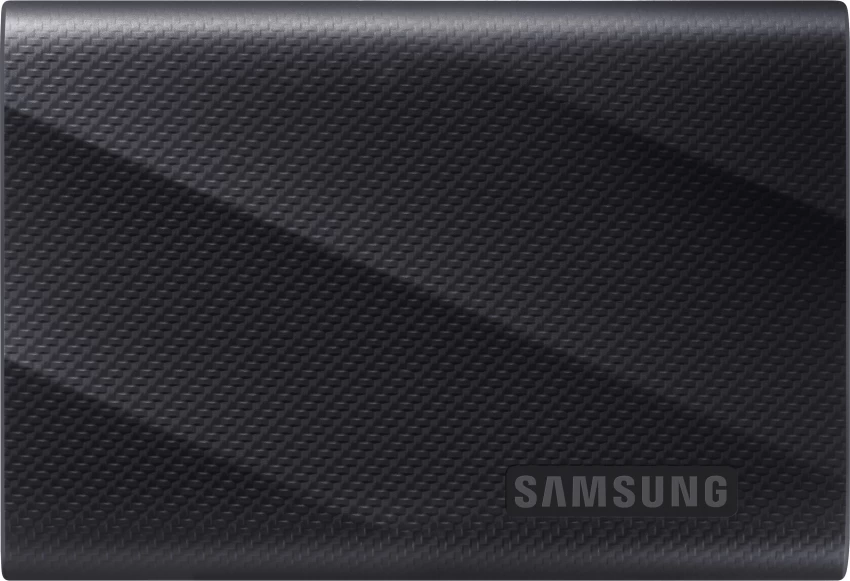
Compared with the previous-generation MU-PE2T0S/AM, the MU-PG4T0B/AM T9 steps up to a USB 3.2 Gen 2x2 interface and delivers up to 2000/2000 MB/s plus 110,000/110,000 IOPS, giving engineers a clear generational gain in both sequential transfer performance and small-block responsiveness. Its 4 TB capacity, Samsung V-NAND 3-bit TLC, and 2400 TBW endurance make it a stronger choice for high-volume 4K/8K media offload, portable scratch storage, and repetitive project shuttling where both speed consistency and write durability matter.
With an endurance rating of 2400 TBW, the MU-PG4T0B/AM can handle approximately 1.2 TB of host writes per day for more than five years, which is comfortably above the write volume of typical OS, boot, office, and read-centric application workloads. In practical terms, when used as a system or application drive under normal commercial or enterprise usage, endurance is very unlikely to be the limiting factor for many years of service. The specified UBER of 1.0E-15 means the drive is designed for a very low rate of unrecoverable read errors, supporting dependable data integrity in everyday operation, while the 1.5 million hour MTBF further reflects solid long-term reliability expectations. This model does not include power loss protection (PLP), so for environments where sudden power interruption is a concern, it is best deployed with a stable power path such as a UPS or in applications where software-level journaling and backup mechanisms are already in place.
1. The USB 3.2 Gen 2x2 interface enables near-internal-class external storage performance, making the drive well suited for fast dataset transfer, edge capture, and portable enterprise backup workflows.
2. With 2000 MB/s sequential read speed, the SSD can accelerate large-file access such as media assets, VM images, and analytics datasets, reducing wait time for bulk ingestion and restore operations.
3. Its 110,000 K IOPS random read capability supports highly responsive small-block access, which benefits metadata-heavy workloads, content indexing, and distributed cache retrieval.
4. Built on Samsung V-NAND 3-bit TLC and rated at 0.3 DWPD, the drive balances flash density and cost efficiency for read-centric enterprise usage such as content repositories, mobile workstations, and secondary data tiers.
5. A typical latency of 80 µs helps minimize access delays for transaction-sensitive applications, improving user responsiveness in bursty workloads and time-critical file operations.
Lower-capacity reference: 2 TB Higher-capacity reference: No higher-capacity SKU is available in the same MU-PG series; 4 TB is the top capacity in this lineup. At 4 TB, the MU-PG4T0B/AM sits at the sweet spot of the series. Compared with the 2 TB model, it gives much more headroom for dataset growth, longer retention, and denser consolidation without changing the expected sequential throughput or random IOPS profile. At the same time, because there is no larger in-series option, 4 TB effectively represents the best balance this family offers between usable capacity, acquisition cost, and stable performance. It is especially well suited for edge analytics nodes, media cache tiers, or backup staging for 40 to 60 branch-office workloads.
Q: Is MU-PG4T0B/AM suitable for a write-heavy database server?
A: We would not recommend MU-PG4T0B/AM for a write-heavy database server. Its 0.3 DWPD endurance, TLC NAND, USB interface, and lack of PLP make it better suited for portable storage.
Q: How many full drive writes per day can it actually endure over its warranty period?
A: This model is rated for 0.3 DWPD, which equals about 1.2 TB of writes per day on a 4 TB drive. Total endurance is rated at 2400 TBW over warranty.
Q: Does it include power loss protection (PLP) and why is that critical?
A: No, MU-PG4T0B/AM does not include power loss protection. PLP is critical in server or database environments because it helps prevent in-flight data and metadata corruption during unexpected power failure.
Q: What RAID level is recommended for this SSD?
A: If RAID is required, RAID 1 or RAID 10 is generally preferred for better redundancy and performance. However, this model is not ideal for mission-critical RAID due to USB connectivity and no PLP.