











 Secure payments
Standard refund policy
Trade Assurance
Secure payments
Standard refund policy
Trade Assurance
| Brand | Samsung |
|---|---|
| Model | 860 EVO |
| Capacity | 500 GB |
| Usage Class | Client / Consumer |
| Host Interface | SATA 6.0 Gbps |
|---|---|
| Total Interface Bandwidth | 6 Gb/s |
| Form Factor | 2.5" |
|---|
| NAND Flash | Samsung V-NAND 3-bit TLC |
|---|---|
| Drive Writes Per Day | 0.33 |
| Total Bytes Written | 300 TBW |
| Sequential Read | 550 MB/s |
|---|---|
| Sequential Write | 520 MB/s |
| Random Read IOPS | 98000 |
| Random Write IOPS | 90000 |
| Average Latency | 50 μs |
| Mean Time Between Failures | 1.5 Million Hours |
|---|---|
| Uncorrectable Bit Error Rate | 1.0×10⁻¹⁷ |
| Power Loss Protection | No |
| MPN | MZ7GE960HMHP-000AZ |
|---|
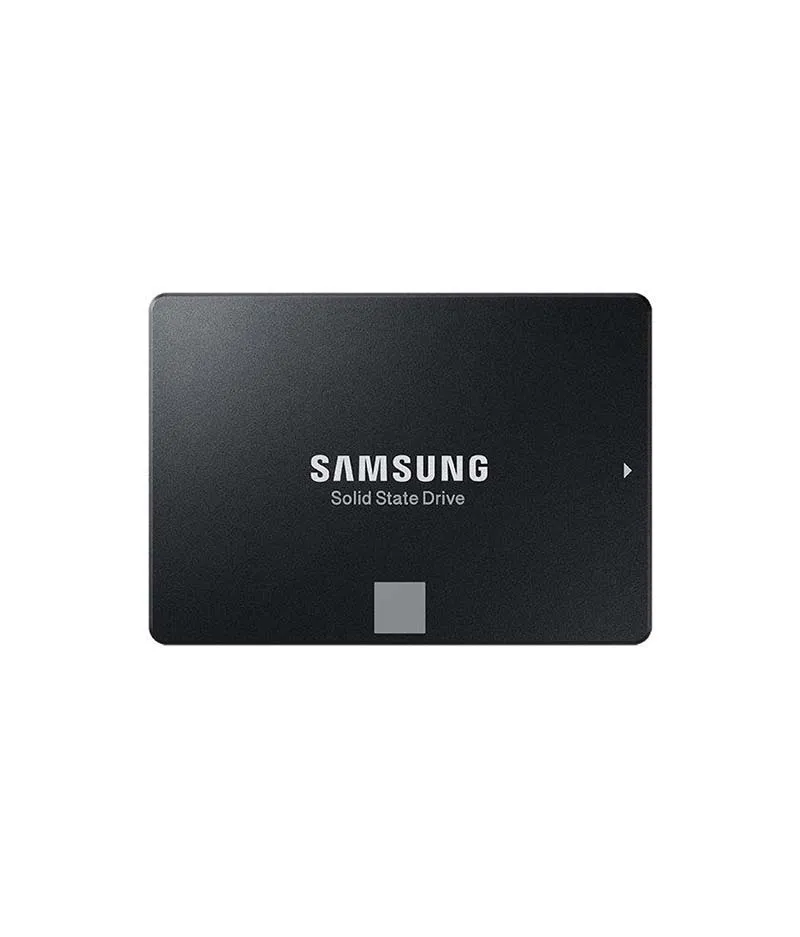
Compared with the older MZ7GE960HMHP-000AZ, the Samsung 860 EVO 500GB (MZ-76E500BW) brings a newer V-NAND 3-bit TLC architecture and a near-SATA-limit performance profile of 550/520 MB/s with up to 98,000/90,000 IOPS, giving client systems noticeably stronger responsiveness under mixed boot, application, and multitasking workloads. Its 300 TBW endurance rating at 0.33 DWPD also makes it a more balanced long-life SATA choice for mainstream workstations and notebook upgrades, where consistent performance and write durability matter more than peak PCIe-class bandwidth.
With an endurance rating of 300 TBW and 0.33 DWPD, this SSD can support writing about 82 GB per day for 10 years, which is more than sufficient for typical OS, office, and general business workloads. In practical terms, for use as a system drive or in read-heavy client environments, this level of endurance provides long service life with comfortable margin under normal daily operation. Its specified UBER of 1.0E-15 means the drive is designed for a very low rate of unrecoverable bit errors, supporting dependable data reads in everyday business use. This model does not include power-loss protection (PLP), so while it remains a reliable choice for standard desktop and notebook applications, environments with frequent sudden power interruption or critical in-flight write protection requirements should consider a PLP-equipped SSD.
1. The SATA interface makes this drive a low-risk drop-in upgrade for existing enterprise servers and storage arrays, accelerating modernization without changing backplanes, cabling, or controller infrastructure.
2. Its sustained sequential throughput helps backup, imaging, log export, and content distribution jobs finish faster, improving batch-window efficiency in bandwidth-bound environments.
3. Strong random-read capability enables quicker access to small, scattered data blocks, which benefits virtualized workloads, metadata-heavy applications, and read-centric databases under concurrency.
4. This endurance profile is best aligned with read-dominant enterprise use cases such as boot volumes, reference datasets, and content-serving tiers where predictable reliability matters more than heavy daily overwrite tolerance.
5. Samsung V-NAND TLC combined with very low typical latency delivers a balanced mix of flash density, cost efficiency, and responsive QoS for latency-sensitive business applications.
Lower capacity reference: 250 GB Higher capacity reference: 1 TB In this series, the 500 GB model is the sweet spot for mainstream business deployments. Compared with the 250 GB version, it gives much better headroom for OS images, application growth, logs, and overprovisioning, reducing the risk of early capacity pressure. Compared with the 1 TB option, it preserves nearly the same everyday sequential and random performance while keeping acquisition cost and per-node spend under tighter control. It is best suited for small to mid-sized virtualization clusters, such as hosting boot and application volumes for about 30 to 50 office workload VMs.
Q: Is MZ-76E500BW suitable for a write-heavy database server?
A: MZ-76E500BW is generally not recommended for write-heavy database servers. Its 0.33 DWPD, 300 TBW endurance, TLC NAND, and lack of PLP make it better suited for client or read-focused workloads.
Q: How many full drive writes per day can it actually endure over its warranty period?
A: This model is rated at 0.33 DWPD, meaning about one-third of its 500 GB capacity can be written daily over the warranty period. That equals roughly 165 GB of writes per day.
Q: Does it include power loss protection (PLP) and why is that critical?
A: No, this SSD does not include power loss protection. PLP is critical in server environments because it helps prevent in-flight data loss and reduces metadata or filesystem corruption during sudden outages.
Q: What RAID level is recommended for this SSD?
A: For this SSD, RAID 1 is commonly recommended for basic redundancy, while RAID 10 is better for higher performance and fault tolerance. Avoid parity-heavy RAID for sustained write-intensive workloads.