











 Secure payments
Standard refund policy
Trade Assurance
Secure payments
Standard refund policy
Trade Assurance
| Brand | Samsung |
|---|---|
| Model | 870 QVO |
| Capacity | 4 TB |
| Usage Class | Client / Consumer |
| Host Interface | SATA 6Gb/s |
|---|---|
| Total Interface Bandwidth | 6 Gb/s |
| Form Factor | 2.5 |
|---|
| NAND Flash | Samsung V-NAND 4bit QLC |
|---|---|
| Drive Writes Per Day | 0.3 |
| Total Bytes Written | 1440 TBW |
| Sequential Read | 560 MB/s |
|---|---|
| Sequential Write | 530 MB/s |
| Random Read IOPS | 98000 |
| Random Write IOPS | 88000 |
| Average Latency | 35 μs |
| Mean Time Between Failures | 1.5 Million Hours |
|---|---|
| Uncorrectable Bit Error Rate | 1.0×10⁻¹⁷ |
| Power Loss Protection | No |
| MPN | MZ-76Q4T0 |
|---|
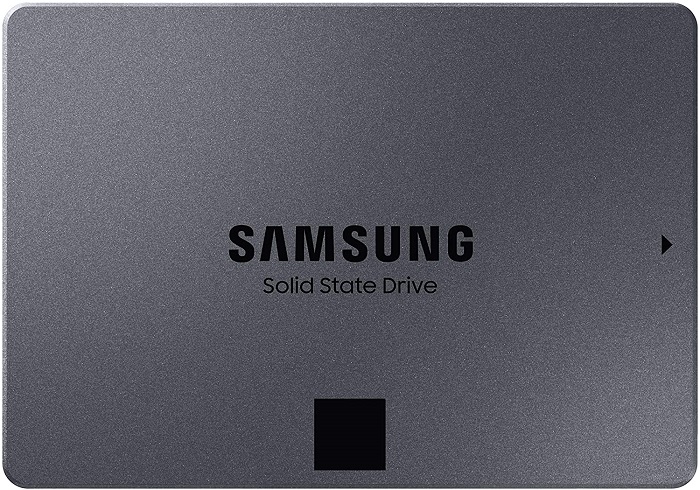
The Samsung 870 QVO 4TB (MZ-77Q4T0BW) delivers a rare combination of SATA-saturating 560/530 MB/s throughput, 98,000/88,000 IOPS, and 1440 TBW endurance in a 4-bit QLC design, making it a high-density, cost-efficient choice for read-heavy workstations, game libraries, and bulk content storage. Compared with the previous-generation MZ-76Q4T0, it offers a more mature 4TB QLC implementation with stronger random-read performance and more consistent real-world responsiveness, giving engineers a cleaner drop-in upgrade when capacity per bay matters more than moving to NVMe.
With an endurance rating of 1440 TBW, this 4TB SSD is designed to handle very substantial write volume over its service life, equivalent to writing about 394 GB per day for 10 years. In typical procurement use cases such as OS drives, office PCs, edge systems, or read-heavy business applications, that level of endurance provides a very comfortable margin and should support long-term deployment with confidence. Its UBER of 1.0E-15 means the drive is specified for no more than one unrecoverable bit error per 10^15 bits read, which aligns with reliable operation for mainstream business workloads when paired with normal backup and data-protection practices. This model does not include power-loss protection (PLP), so while it is well suited for client and read-focused enterprise scenarios, applications sensitive to unexpected power interruption should use a UPS or system-level safeguards to protect in-flight data.
1. Its SATA interface delivers near-link-limit sequential bandwidth while preserving broad compatibility with existing enterprise servers and storage arrays, enabling fast upgrades without a platform change.
2. Strong random-read capability keeps VDI pools, boot storms, and metadata-heavy applications responsive even when many users or virtual machines hit the drive at once.
3. This endurance class is optimized for read-centric enterprise workloads such as content delivery, reporting databases, and warm-tier cloud storage, where write volume is moderate and cost efficiency is critical.
4. Samsung’s V-NAND QLC design prioritizes flash density and lower cost per terabyte, making it well suited for large-scale deployments storing massive datasets that are accessed far more often than they are rewritten.
5. Very low typical latency helps cut response-time jitter for transactional reads, improving application snappiness and speeding up small-block lookup operations in real business workloads.
Lower capacity reference: 2 TB Higher capacity reference: 8 TB Typical same-series performance reference 2 TB: Up to 560 MB/s read, 530 MB/s write, up to 98K/88K random read/write IOPS 4 TB: Up to 560 MB/s read, 530 MB/s write, up to 98K/88K random read/write IOPS 8 TB: Up to 560 MB/s read, 530 MB/s write, up to 98K/88K random read/write IOPS At 4 TB, this drive sits at the sweet spot of the family. Compared with the 2 TB model, it gives much better headroom for OS images, logs, snapshots, and steady data growth, reducing the need for early expansion. Compared with the 8 TB option, it delivers nearly the same practical SATA performance while keeping acquisition cost and capacity overprovisioning under better control. It is best suited for mid-scale deployments, such as shared boot storage for about 60 to 80 virtual desktops or edge servers running mixed application and cache workloads.
Q: Is MZ-77Q4T0BW suitable for a write-heavy database server?
A: No. With 0.3 DWPD, 1440 TBW, and QLC NAND, MZ-77Q4T0BW is better suited for read-centric or mixed workloads rather than write-heavy database server environments.
Q: How many full drive writes per day can it actually endure over its warranty period?
A: It is rated for 0.3 drive writes per day. For a 4 TB SSD, that equals about 1.2 TB of writes daily across the warranty period.
Q: Does it include power loss protection (PLP) and why is that critical?
A: No, it does not include PLP. This matters because PLP helps protect in-flight data and metadata during sudden power failures, which is especially important in enterprise storage environments.
Q: What RAID level is recommended for this SSD?
A: RAID 1 or RAID 10 is generally recommended for better redundancy and performance balance. RAID 5/6 may increase write amplification, which is less ideal for QLC-based SSDs.