











 Secure payments
Standard refund policy
Trade Assurance
Secure payments
Standard refund policy
Trade Assurance
| Brand | Samsung |
|---|---|
| Model | 870 QVO |
| Capacity | 8 TB |
| Usage Class | Consumer/Storage-Intensive |
| Host Interface | SATA 3.0 6Gb/s |
|---|---|
| Total Interface Bandwidth | 6 Gb/s |
| Form Factor | 2.5 inch 7mm |
|---|
| NAND Flash | Samsung V5 (9xL) QLC |
|---|---|
| Drive Writes Per Day | 0.1 |
| Total Bytes Written | 2880 TBW |
| Sequential Read | 560 MB/s |
|---|---|
| Sequential Write | 530 MB/s |
| Random Read IOPS | 98000 |
| Random Write IOPS | 88000 |
| Average Latency | 100 μs |
| Mean Time Between Failures | 1.5 Million Hours |
|---|---|
| Uncorrectable Bit Error Rate | 1.0×10⁻¹⁷ |
| Power Loss Protection | No |
| MPN | MZ-76Q4T0BW |
|---|
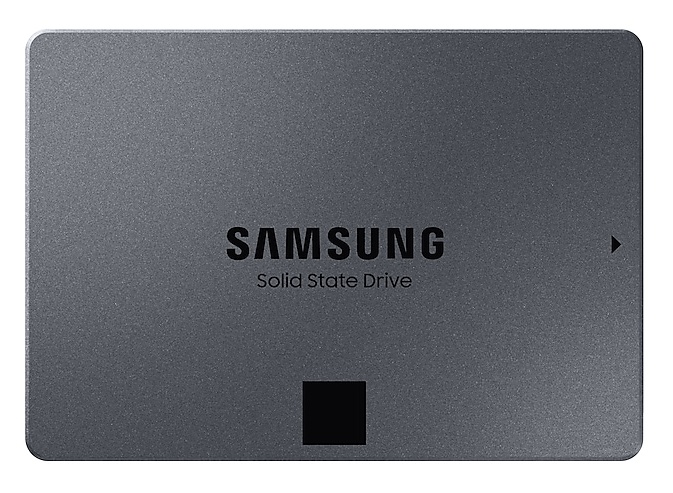
Compared with the previous-generation MZ-76Q4T0BW, the MZ-77Q8T0 doubles capacity to 8 TB while sustaining near-SATA-limit performance at 560/530 MB/s and up to 98,000/88,000 IOPS, delivering a clear density upgrade without sacrificing responsiveness. Built on Samsung V5 (9xL) QLC NAND with 2880 TBW endurance, the 870 QVO is a strong choice for high-capacity, read-centric storage tiers such as media libraries, backup repositories, and large desktop datasets where maximizing usable SATA capacity per drive is the priority.
With an endurance rating of 2,880 TBW, the MZ-77Q8T0 can sustain writing about 2.88 petabytes of data over its warranted life, which is more than sufficient for typical OS, application, and general data storage workloads. In practical terms, under common client or light business usage patterns, this level of endurance supports many years of dependable service and can comfortably handle use as a system drive and bulk storage drive. From a reliability standpoint, the specified UBER of 1.0E-17 indicates a very low uncorrectable bit error rate, helping ensure strong data integrity during normal read operations, while the 1.5 million hour MTBF reflects solid expected long-term operational stability. This model does not include power-loss protection, so it is best deployed in environments with stable power or upstream UPS protection where enterprise-style in-flight write safeguarding is not a requirement.
1. The SATA 3.0 interface, paired with near-bus-limit sequential read performance, makes this drive an easy drop-in upgrade for existing enterprise servers and storage arrays that need faster boot, restore, and bulk-read operations without changing backplane infrastructure.
2. Its strong random read capability is well suited to read-heavy virtual desktops, web serving, and metadata-intensive databases, helping more users and queries be served in parallel with fewer storage bottlenecks.
3. The low DWPD rating positions this SSD for read-centric enterprise workloads such as content repositories, backup staging, analytics copies, and warm archival tiers where capacity efficiency matters more than frequent full-drive rewrites.
4. Samsung V5 QLC NAND enables very high flash density at lower cost per terabyte, making it attractive for scale-out storage environments that need large usable capacity for mostly-read data sets.
5. With typical latency in the low-microsecond class, the drive supports more predictable application response times for latency-sensitive reads, improving user experience in front-end services and shared storage pools.
Lower-capacity reference: 4 TB Higher-capacity reference: No larger model is available in the same 870 QVO series; the nearest upward Samsung SATA reference is 15.36 TB in the PM893 family, which is a different series. At 8 TB, the MZ-77Q8T0 sits in the sweet spot of the lineup. Compared with the 4 TB version, it gives much better headroom for VM images, shared datasets, and snapshot growth, reducing the need for early expansion. Versus moving up to a larger 15.36 TB class drive in another Samsung SATA family, 8 TB usually delivers the best balance of acquisition cost, usable capacity, and familiar SATA-level performance. It is especially well suited for mid-sized virtualization clusters, such as hosting boot and application volumes for about 40 to 60 business workloads.
Q: Is MZ-77Q8T0 suitable for a write-heavy database server?
A: No. The MZ-77Q8T0 uses QLC NAND and is rated at only 0.1 DWPD, so it is better suited for read-centric or mixed-light workloads, not sustained write-heavy database servers.
Q: How many full drive writes per day can it actually endure over its warranty period?
A: It is rated for 0.1 DWPD, meaning about 0.8 TB of writes per day on an 8 TB drive during the warranty period, consistent with the 2880 TBW endurance specification.
Q: Does it include power loss protection (PLP) and why is that critical?
A: No, it does not include PLP. Power loss protection is critical in server environments because it helps prevent in-flight data loss and metadata corruption during unexpected power interruptions.
Q: What RAID level is recommended for this SSD?
A: RAID 1 or RAID 10 is generally recommended for this SSD, depending on capacity needs. These levels improve redundancy and performance, while helping reduce operational risk in business environments.