











 Secure payments
Standard refund policy
Trade Assurance
Secure payments
Standard refund policy
Trade Assurance
| Brand | Samsung |
|---|---|
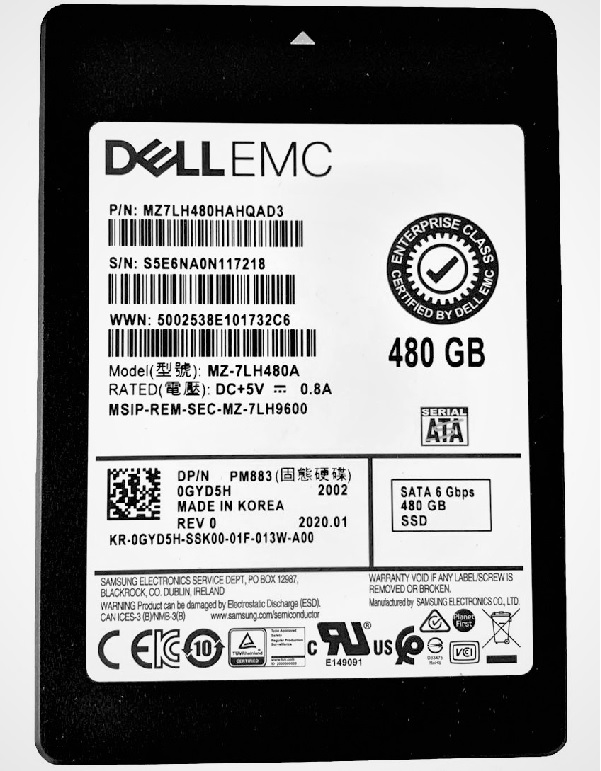
| Model | PM883 |
| Capacity | 480 GB |
| Usage Class | Read Intensive |
| Host Interface | SATA 6Gb/s |
|---|---|
| Total Interface Bandwidth | 6 Gb/s |
| Form Factor | 2.5 |
|---|
| NAND Flash | Samsung V-NAND 3D TLC |
|---|---|
| Drive Writes Per Day | 1.3 |
| Total Bytes Written | 683 TBW |
| Sequential Read | 550 MB/s |
|---|---|
| Sequential Write | 520 MB/s |
| Random Read IOPS | 98000 |
| Random Write IOPS | 14000 |
| Average Latency | 40 μs |
| Mean Time Between Failures | 2 Million Hours |
|---|---|
| Uncorrectable Bit Error Rate | 1.0×10⁻¹⁷ |
| Power Loss Protection | Yes |
| MPN | MZ-7LM480E |
|---|
Compared with the MZ-7LM480E, the MZ-7LH480A PM883 moves to a newer Samsung V-NAND 3D TLC platform that delivers a stronger value-endurance balance at 683 TBW and 1.3 DWPD, while sustaining near-saturation SATA 6Gb/s performance at 550/520 MB/s. Its distinctive advantage in the 480 GB class is enterprise-grade read-centric efficiency—ideal for server boot volumes, virtualization hosts, and content-serving nodes that need high random read responsiveness up to 98,000 IOPS without stepping up to higher-cost NVMe tiers.
With an endurance rating of 683 TBW and 1.3 DWPD, the MZ-7LH480A is designed to handle sustained daily write activity far beyond typical client or light server boot-drive usage. In practical terms, under common OS, application, logging, and routine business workloads, it can serve reliably as a system drive for many years, making it a low-risk choice for long-term deployment. For enterprise reliability, the built-in power loss protection (PLP) helps preserve data in flight and reduces the risk of corruption if power is interrupted unexpectedly. Its UBER of 1.0E-17, together with a 2 million hour MTBF, indicates a very low rate of unrecoverable bit errors and strong overall dependability, which helps procurement teams feel confident in data integrity and operational stability.
1. The SATA 6Gb/s interface ensures drop-in compatibility with mainstream enterprise servers and storage arrays, making large-scale upgrades simple without changing the existing backplane or controller design.
2. Sequential read performance of 550 MB/s helps accelerate full-dataset scans, VM boot storms, and backup restore operations in read-heavy enterprise environments.
3. Up to 98,000 random-read IOPS, paired with a typical latency of 40 µs, enables faster response for database indexing, VDI logins, and other latency-sensitive transactional workloads.
4. Rated for 1.3 DWPD, this drive provides the write endurance needed for mixed-use enterprise applications that generate steady daily writes without forcing overprovisioned capacity planning.
5. Samsung V-NAND 3D TLC combines high density with enterprise-focused consistency, delivering a strong balance of capacity efficiency, predictable performance, and long-term reliability in production deployments.
Reference capacities in the same series: Lower capacity: 240 GB Higher capacity: 960 GB Typical performance positioning for the series: Sequential read/write: about 550/520 MB/s across 240 GB, 480 GB, and 960 GB Random read/write: broadly similar enterprise-class SATA behavior, roughly up to 98K/28K IOPS depending on workload and firmware Capacity positioning analysis: In the PM883 family, 480 GB is the sweet-spot capacity. Compared with the 240 GB version, it gives much better headroom for OS growth, patches, logs, and application buffers, reducing the risk of early capacity pressure. Compared with the 960 GB model, it preserves nearly the same practical SATA performance while keeping acquisition cost and per-node storage allocation under tighter control. This makes 480 GB especially well suited for mid-scale virtualization clusters, such as hosting boot and utility volumes for around 40 to 60 general-purpose virtual machines.
Q: Is MZ-7LH480A suitable for a write-heavy database server?
A: Yes. With 1.3 DWPD, 683 TBW, low 40 µs typical latency, and enterprise Samsung V-NAND 3D TLC, the MZ-7LH480A is suitable for moderately write-heavy database workloads.
Q: How many full drive writes per day can it actually endure over its warranty period?
A: It is rated for 1.3 full drive writes per day. For a 480 GB SSD, that equals about 624 GB of writes daily across its supported warranty endurance period.
Q: Does it include power loss protection (PLP) and why is that critical?
A: Yes, it includes power loss protection. PLP helps preserve in-flight data and metadata during unexpected outages, which is critical for maintaining data integrity and reducing corruption risks.
Q: What RAID level is recommended for this SSD?
A: RAID 10 is generally recommended for database and transactional workloads, as it balances performance, redundancy, and rebuild reliability. RAID 1 is also suitable for smaller capacity-focused deployments.