











 Secure payments
Standard refund policy
Trade Assurance
Secure payments
Standard refund policy
Trade Assurance
| Brand | Samsung |
|---|---|
| Model | PM851 |
| Capacity | 256GB |
| Usage Class | Client |
| Host Interface | SATA 6Gb/s |
|---|---|
| Total Interface Bandwidth | 6 Gb/s |
| Form Factor | 2.5 |
|---|
| NAND Flash | Samsung 1xnm TLC |
|---|---|
| Drive Writes Per Day | 0.3 |
| Total Bytes Written | 75 TBW |
| Sequential Read | 540 MB/s |
|---|---|
| Sequential Write | 270 MB/s |
| Random Read IOPS | 95000 |
| Random Write IOPS | 36000 |
| Average Latency | 100 μs |
| Mean Time Between Failures | 1.5 Million Hours |
|---|---|
| Uncorrectable Bit Error Rate | 1.0×10⁻¹⁷ |
| Power Loss Protection | No |
| MPN | MZ-7TE250 |
|---|
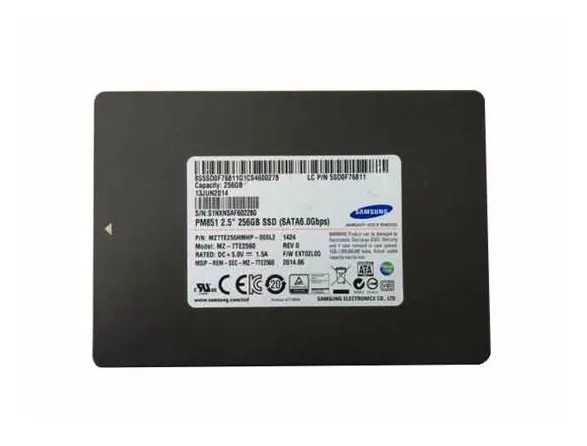
Compared with the earlier MZ-7TE250, the MZ-7TE2560 raises usable capacity to 256GB while sustaining strong SATA 6Gb/s client performance at up to 540/270 MB/s and 95,000/36,000 IOPS, giving OEM notebooks and desktops a cleaner balance of responsiveness and BOM efficiency. Built on Samsung 1xnm TLC with a 75 TBW endurance rating, this PM851 variant is a practical upgrade for mainstream boot-drive and productivity workloads where consistent read-heavy performance matters more than higher-cost enterprise write endurance.
With an endurance rating of 75 TBW, the MZ-7TE2560 can sustain about 20 GB of writes per day for 10 years, or roughly 68–77 GB per day over a typical 3-year to 5-year deployment, which is more than sufficient for OS boot, office applications, and general read-heavy client workloads. In practical terms, for use as a system drive or light-duty business SSD, this endurance level provides comfortable headroom under normal daily usage. Its specified UBER of 1.0E-15 means the drive is designed for a very low unrecoverable bit error rate, supporting dependable data reads in everyday business operation, while the 1.5 million hour MTBF further indicates solid long-term hardware reliability. This model does not include power-loss protection (PLP), so while it is a reliable choice for standard desktop or embedded use, systems that face frequent unexpected power interruptions or require protection for in-flight write data should pair it with stable power design or UPS support.
1. The SATA interface with near line-rate sequential throughput makes this drive an easy drop-in upgrade for legacy enterprise servers and storage arrays that need faster boot, scan, and bulk-read performance without changing platform architecture.
2. Its strong random-read capability helps VDI, OLTP, and metadata-heavy workloads respond faster under concurrency, improving user experience when many small requests hit the drive at once.
3. The moderate write-endurance profile is well suited to read-centric enterprise roles such as boot drives, content repositories, reference datasets, and analytics tiers with limited daily overwrite pressure.
4. Samsung’s fine-geometry TLC NAND balances cost efficiency and usable capacity, giving data centers a practical way to scale flash deployment for mainstream read-heavy applications.
5. The very low typical latency supports quicker application response and more predictable QoS, which is especially valuable for transactional systems and latency-sensitive virtualized environments.
For the MZ-7TE2560 256GB model, the nearest lower-capacity reference in the same family is 128GB, and the nearest higher-capacity reference is 512GB. Both adjacent capacities typically stay in the same enterprise SATA performance class, with broadly similar sequential read/write behavior and random IOPS in normal deployments. The 256GB version sits at the sweet spot of the series. Compared with 128GB, it provides much better headroom for OS growth, logs, patching, and overprovisioning, reducing capacity pressure in always-on workloads. Compared with 512GB, it usually delivers the best balance of acquisition cost, usable space, and stable enterprise performance. It is especially well suited for boot, middleware, and light database volumes in a small to mid-size virtualization cluster, such as supporting 30 to 50 business application instances.
Q: Is MZ-7TE2560 suitable for a write-heavy database server?
A: No. The MZ-7TE2560 is better suited for read-focused or mixed workloads. With 0.3 DWPD, 75 TBW, TLC NAND, and no PLP, it is not ideal for write-heavy database servers.
Q: How many full drive writes per day can it actually endure over its warranty period?
A: It is rated at 0.3 drive writes per day. For a 256GB SSD, that equals about 76.8GB of writes daily on average across the warranty period, within endurance specifications.
Q: Does it include power loss protection (PLP) and why is that critical?
A: No, it does not include power loss protection. PLP is critical because it helps protect in-flight data and metadata during sudden outages, reducing corruption risk in transactional or enterprise workloads.
Q: What RAID level is recommended for this SSD?
A: For most business deployments, RAID 1 or RAID 10 is recommended to improve redundancy and read performance. RAID 5 may work, but parity writes can accelerate wear on this SSD.