











 Secure payments
Standard refund policy
Trade Assurance
Secure payments
Standard refund policy
Trade Assurance
| Brand | Samsung |
|---|---|
| Model | 970 EVO PLUS |
| Capacity | 250 GB |
| Usage Class | Client |
| Host Interface | PCIe Gen3 x4 |
|---|---|
| Total Interface Bandwidth | 32 Gb/s |
| Form Factor | M.2 (2280) |
|---|
| NAND Flash | Samsung V-NAND 3D TLC |
|---|---|
| Drive Writes Per Day | 0.33 |
| Total Bytes Written | 150 TBW |
| Sequential Read | 3500 MB/s |
|---|---|
| Sequential Write | 2300 MB/s |
| Random Read IOPS | 250000 |
| Random Write IOPS | 530000 |
| Average Latency | 100 μs |
| Mean Time Between Failures | 1.5 Million Hours |
|---|---|
| Uncorrectable Bit Error Rate | 1.0×10⁻¹⁷ |
| Power Loss Protection | No |
| MPN | MZ-V7E250BW |
|---|
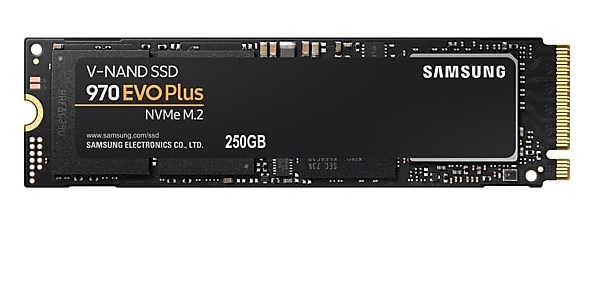
Compared with the previous-generation MZ-V7E250BW, the Samsung 970 EVO PLUS 250GB boosts sequential write speed from 1,500 MB/s to 2,300 MB/s and random write performance from 500,000 to 530,000 IOPS, while sustaining 3,500 MB/s reads on the same PCIe Gen3 x4 interface. With Samsung V-NAND 3D TLC and a 150 TBW endurance rating, this MPN delivers distinctly better small-capacity NVMe performance for OS, application, and workstation scratch-drive deployments without sacrificing the endurance profile of its predecessor.
With an endurance rating of 150 TBW and 0.33 DWPD, the MZ-V7S250BW can comfortably handle typical OS, office, and general business workloads, where daily writes are usually far below its rated limit. In practical terms, for use as a boot or system drive, this level of endurance is generally sufficient for many years of normal operation and can support long-term deployment under light to moderate write activity. From a reliability perspective, the specified UBER of 1.0E-16 means the drive is designed for a very low rate of unrecoverable bit errors, helping support stable data reads in everyday use, while the 1.5 million-hour MTBF indicates solid expected operational reliability. This model does not include power-loss protection (PLP), so while it is well suited for client and non-write-critical environments, systems requiring guaranteed in-flight data protection during sudden power interruption should use a model with PLP.
1. The PCIe Gen3 x4 interface provides enough host bandwidth to keep virtualized application stacks and edge database nodes responsive without creating a storage-side bottleneck.
2. Its sequential read performance accelerates large-file access, helping analytics platforms, image repositories, and backup validation jobs complete much faster.
3. Strong random read capability makes it well suited for metadata-heavy workloads such as VDI boot storms, web services, and high-concurrency OLTP queries.
4. With Samsung V-NAND 3D TLC paired with a light write-per-day endurance profile, this drive fits read-centric enterprise deployments where capacity, efficiency, and predictable service life matter more than sustained heavy rewriting.
5. The low typical latency improves transaction consistency and shortens response times for latency-sensitive workloads such as caching tiers and real-time application delivery.
Lower-capacity reference: N/A — 250 GB is the smallest official capacity in the MZ-V7S series. Higher-capacity reference: 500 GB Capacity positioning analysis: In the MZ-V7S lineup, 250 GB is the practical sweet spot for entry deployment. Since there is no smaller official SKU, it already avoids the tight space constraints typically seen with sub-250 GB system drives, leaving more headroom for OS images, patching, logs, and application growth. Compared with the 500 GB model, it preserves nearly the same everyday sequential and random performance characteristics while keeping acquisition cost lower. This makes it especially well suited for small VDI pools, edge servers, or about 30 to 40 lightweight virtual machine boot volumes.
Q: Is MZ-V7S250BW suitable for a write-heavy database server?
A: Not ideally. With 0.33 DWPD, 150 TBW, Samsung V-NAND 3D TLC, and no PLP, MZ-V7S250BW is better suited for client, boot, or read-focused workloads than write-heavy database servers.
Q: How many full drive writes per day can it actually endure over its warranty period?
A: It is rated for 0.33 drive writes per day, meaning about one-third of its 250 GB capacity can be written daily on average across the warranty period.
Q: Does it include power loss protection (PLP) and why is that critical?
A: No, it does not include PLP. This matters because sudden power failure may leave in-flight writes uncommitted, increasing risks of data loss, corruption, or metadata inconsistency in critical systems.
Q: What RAID level is recommended for this SSD?
A: For general reliability, RAID 1 is commonly recommended for small deployments. For higher performance with redundancy, RAID 10 is preferable. Avoid RAID 0 if data protection is important.