











 Secure payments
Standard refund policy
Trade Assurance
Secure payments
Standard refund policy
Trade Assurance
| Brand | Samsung |
|---|---|
| Model | 980 |
| Capacity | 500 GB |
| Usage Class | Client / Consumer |
| Host Interface | PCIe 3.0 x4 |
|---|---|
| Total Interface Bandwidth | 8 Gb/s |
| Form Factor | M.2 (2280) |
|---|
| NAND Flash | Samsung V-NAND 3-bit TLC |
|---|---|
| Drive Writes Per Day | 0.33 |
| Total Bytes Written | 300 TBW |
| Sequential Read | 3100 MB/s |
|---|---|
| Sequential Write | 2600 MB/s |
| Random Read IOPS | 400000 |
| Random Write IOPS | 470000 |
| Average Latency | 60 μs |
| Mean Time Between Failures | 1.5 Million Hours |
|---|---|
| Uncorrectable Bit Error Rate | 1.0×10⁻¹⁷ |
| Power Loss Protection | No |
| MPN | MZ7LM480HCHP |
|---|
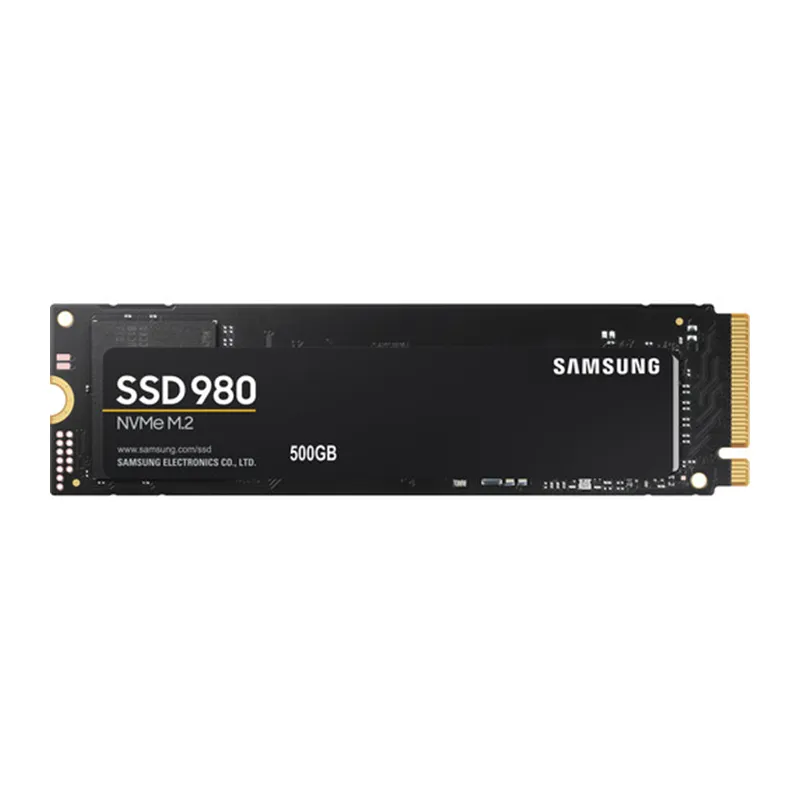
Compared with the earlier MZ7LM480HCHP, the Samsung 980 MZ-V8V500B/AM delivers a clear generational step-up by moving to PCIe 3.0 x4 NVMe with Samsung V-NAND 3-bit TLC, reaching up to 3100/2600 MB/s and 400,000/470,000 IOPS for substantially faster boot, application-load, and scratch-disk performance. With 500 GB capacity and 300 TBW endurance at 0.33 DWPD, this MPN is a strong engineering choice for client workstations and mainstream laptops that need a balanced mix of sustained responsiveness, proven TLC reliability, and efficient upgrade cost.
With an endurance rating of 300 TBW and 0.33 DWPD, the MZ-V8V500B/AM is well suited for typical client and light commercial workloads, including use as an OS boot drive, office PC, or general-purpose workstation SSD. In practical terms, most users would be unlikely to approach this write limit under normal daily operation, making it a dependable choice for long-term routine use. From a reliability standpoint, the specified UBER of 1.0E-15 and MTBF of 1.5 million hours indicate a solid level of data integrity and expected operational stability for standard deployment environments. This model does not include power-loss protection (PLP), so while it is appropriate for systems with normal shutdown control or UPS support, it is not intended for write-critical applications where in-flight data must be protected during sudden power interruption.
1. The PCIe 3.0 x4 NVMe interface, paired with strong sequential read bandwidth, enables much faster boot, imaging, and large dataset ingestion in virtualization and analytics environments.
2. With up to 3100 MB/s sequential read performance, the drive helps cut wait time for large file transfers, backup restores, and content delivery workloads.
3. Its 400,000 random read IOPS capability supports dense VM farms and read-heavy databases by sustaining responsive access under highly concurrent small-block workloads.
4. Rated at 0.33 DWPD, this SSD is best aligned with read-centric enterprise deployments where predictable operating cost and adequate endurance matter more than heavy daily overwrite demands.
5. Samsung V-NAND 3-bit TLC with a typical 60 µs latency provides a practical balance of flash density, cost efficiency, and fast response time for business applications that need consistent everyday performance.
Lower capacity reference: 250 GB Higher capacity reference: 1 TB In this SSD family, the 500 GB model sits at the practical sweet spot. Compared with the 250 GB version, it gives much better headroom for OS images, application stacks, logs, and short-term data growth, reducing the risk of early capacity pressure. Compared with the 1 TB model, it usually delivers the best balance between acquisition cost and usable performance, since sequential throughput and random IOPS remain broadly similar across capacities. It is well suited for small-to-mid virtualization clusters, such as hosting boot and utility volumes for about 30 to 50 light business VMs.
Q: Is MZ-V8V500B/AM suitable for a write-heavy database server?
A: No. With 0.33 DWPD, 300 TBW, TLC NAND, and no power loss protection, this model is better suited for client or light mixed workloads than write-heavy database server environments.
Q: How many full drive writes per day can it actually endure over its warranty period?
A: Its endurance rating is 0.33 DWPD, meaning about one-third of the 500 GB capacity can be written daily on average over the warranty period, equivalent to roughly 165 GB per day.
Q: Does it include power loss protection (PLP) and why is that critical?
A: No, it does not include PLP. This matters because PLP helps protect in-flight data and metadata during sudden power failure, which is especially important for transactional and enterprise storage workloads.
Q: What RAID level is recommended for this SSD?
A: For general reliability, RAID 1 is commonly recommended for small deployments, while RAID 10 is preferred for better performance and redundancy. Avoid parity-heavy RAID if write consistency is critical.