

 Secure payments
Standard refund policy
Trade Assurance
Secure payments
Standard refund policy
Trade Assurance
| Brand | Samsung |
|---|---|
| Model | 990 EVO Plus |
| Capacity | 1 TB |
| Usage Class | Client / Consumer |
| Host Interface | PCIe 4.0 x4 / PCIe 5.0 x2 |
|---|---|
| Total Interface Bandwidth | 16 Gb/s |
| Form Factor | M.2 2280 |
|---|
| NAND Flash | Samsung V-NAND 3-bit TLC |
|---|---|
| Drive Writes Per Day | 0.33 |
| Total Bytes Written | 600 TBW |
| Sequential Read | 7150 MB/s |
|---|---|
| Sequential Write | 6300 MB/s |
| Random Read IOPS | 850000 |
| Random Write IOPS | 135000 |
| Average Latency | 50 μs |
| Mean Time Between Failures | 1.5 Million Hours |
|---|---|
| Uncorrectable Bit Error Rate | 1.0×10⁻¹⁷ |
| Power Loss Protection | No |
| MPN | MZ-V9S2T0BW |
|---|
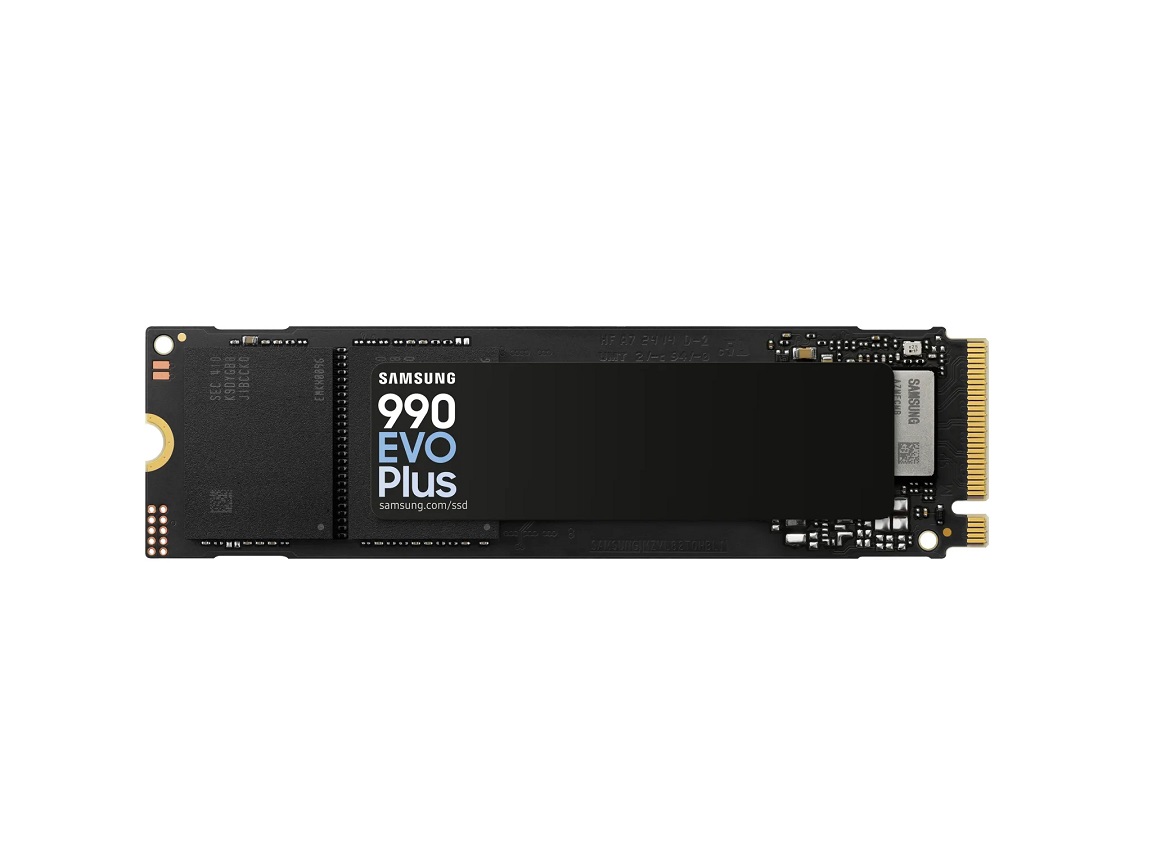
The Samsung 990 EVO Plus 1TB (MZ-V9S1T0BW) stands out in the mainstream NVMe tier by combining dual-interface flexibility—PCIe 4.0 x4 today and PCIe 5.0 x2 platform compatibility for next-generation hosts—with up to 7,150/6,300 MB/s sequential performance on proven Samsung V-NAND 3-bit TLC, making it a strong fit for high-throughput boot, application, and content-creation client workloads. Compared with MZ-V9S2T0BW, this 1TB SKU delivers the same 990 EVO Plus architecture and performance class in a lower-capacity, lower-cost deployment point, while still sustaining 600 TBW endurance and up to 850K random-read IOPS for more efficient fleet standardization where 2TB is unnecessary.
With an endurance rating of 600 TBW and 0.33 DWPD, this 1TB SSD can sustain about 164 GB of writes per day for five years, which is well above the write volume of a typical office PC, laptop, or OS/application drive. In practical terms, for normal business workloads such as boot, productivity software, web use, and moderate file updates, it can serve reliably as a system drive for many years without endurance being a concern. From a reliability perspective, the specified UBER of 1.0E-15 and MTBF of 1.5 million hours indicate a mature, dependable design suitable for standard commercial deployments and everyday data access. This model does not include power-loss protection (PLP), so while it is a solid choice for client and non-transactional workloads, environments with critical in-flight write protection requirements should pair it with stable power/UPS coverage or consider a drive with PLP.
1. The PCIe 4.0 x4 / PCIe 5.0 x2 interface gives this drive broad platform compatibility while providing enough bandwidth to keep virtualization hosts, edge nodes, and compact servers from being bottlenecked by storage links.
2. Its 7150 MB/s sequential read performance accelerates large dataset ingestion, image backup restores, and analytics job startup, reducing wait time for bandwidth-heavy enterprise workflows.
3. With 850,000 K IOPS random read capability, the drive can sustain highly concurrent small-block access patterns common in VDI, metadata-heavy applications, and read-centric database tiers.
4. The 0.33 DWPD endurance profile is best suited to read-dominant enterprise deployments where capacity efficiency and predictable service life matter more than intensive daily overwrite workloads.
5. Samsung V-NAND 3-bit TLC, paired with a typical latency of 50 µs, delivers a practical balance of flash density, cost efficiency, and consistently fast response for latency-sensitive application reads.
For the Samsung MZ-V9S1T0BW 1 TB model, the nearest lower capacity in the same series is 500 GB, and the next higher capacity is 2 TB. Across this family, sequential read/write performance and random IOPS are broadly comparable, with capacity mainly affecting endurance, spare area, and price efficiency rather than day-to-day responsiveness. The 1 TB version sits at the sweet spot of the lineup. Compared with the 500 GB model, it offers much better headroom for OS images, application stacks, logs, and growth over time. Compared with the 2 TB option, it preserves nearly the same practical performance while keeping acquisition cost and fleet standardization more manageable. It is especially well suited for mid-scale deployments, such as hosting boot and application volumes for about 40 to 60 general-purpose virtual desktops or a compact edge virtualization cluster.
Q: Is MZ-V9S1T0BW suitable for a write-heavy database server?
A: Generally no. With 0.33 DWPD, 600 TBW, TLC NAND, and no PLP, MZ-V9S1T0BW is better suited for client, read-focused, or mixed-use workloads than write-heavy database server environments.
Q: How many full drive writes per day can it actually endure over its warranty period?
A: This model is rated for 0.33 DWPD, meaning about one-third of its 1 TB capacity can be written daily on average over the warranty period, aligning with the 600 TBW endurance rating.
Q: Does it include power loss protection (PLP) and why is that critical?
A: No, it does not include power loss protection. PLP is critical in server or database use because it helps prevent in-flight data loss and metadata corruption during unexpected power interruptions.
Q: What RAID level is recommended for this SSD?
A: For most business deployments, RAID 1 or RAID 10 is recommended to improve redundancy and performance. RAID 5 may be less ideal due to parity write overhead and endurance considerations.