











 Secure payments
Standard refund policy
Trade Assurance
Secure payments
Standard refund policy
Trade Assurance
| Brand | Samsung |
|---|---|
| Model | 9100 PRO Series |
| Capacity | 4TB |
| Usage Class | Consumer / Client |
| Host Interface | PCIe Gen 4.0 x4, NVMe |
|---|---|
| Total Interface Bandwidth | 16 Gb/s |
| Form Factor | M.2 22 x 80mm |
|---|
| NAND Flash | Samsung V-NAND TLC |
|---|---|
| Drive Writes Per Day | 0.3 |
| Total Bytes Written | 2400 TBW |
| Sequential Read | 7450 MB/s |
|---|---|
| Sequential Write | 6900 MB/s |
| Random Read IOPS | 1200000 |
| Random Write IOPS | 1550000 |
| Average Latency | 50 μs |
| Mean Time Between Failures | 1.5 Million Hours |
|---|---|
| Uncorrectable Bit Error Rate | 1.0×10⁻¹⁷ |
| Power Loss Protection | No |
| MPN | MZ-V8P2T0B/AM |
|---|
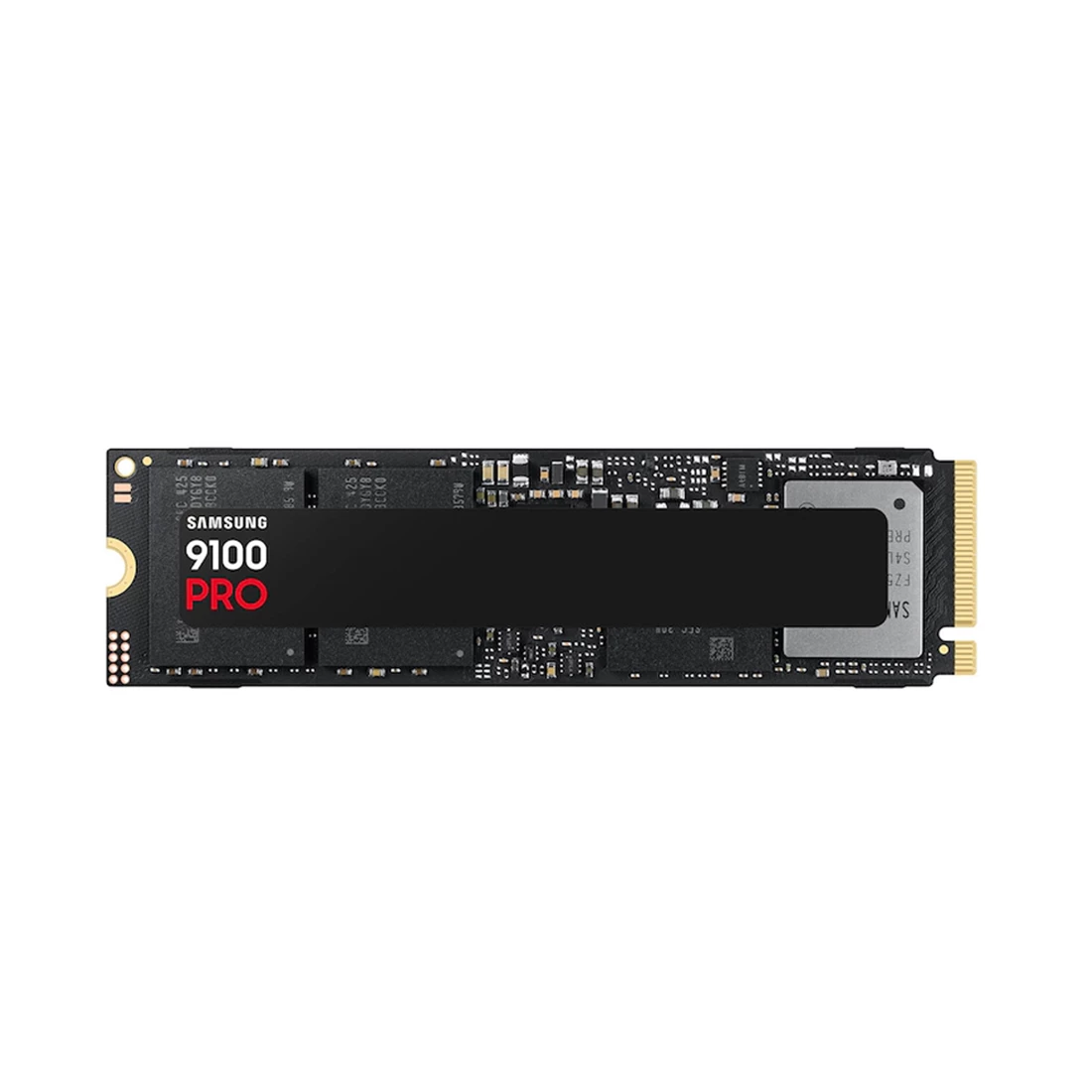
The Samsung 9100 PRO Series 4TB (MZ-VAP4T0B/AM) stands out by combining a high-density 4TB M.2 footprint with up to 7,450/6,900 MB/s sequential throughput, 1,200,000/1,550,000 IOPS, and 2,400 TBW on Samsung V-NAND TLC—an excellent fit for large project datasets, heavy scratch-disk usage, and sustained workstation-class content pipelines. Compared with the previous-generation MZ-V8P2T0B/AM, it delivers a clear generational upgrade by doubling per-slot capacity to 4TB while raising the performance ceiling for both sequential and random workloads, allowing more data locality and higher productivity without adding another drive.
With an endurance rating of 2400 TBW and 0.3 DWPD, this 4 TB SSD is designed to handle about 1.2 TB of writes per day across its warranty life, which is far above the write volume of most OS, office, and general business workloads. In practical terms, for use as a system drive or for typical read-heavy client and workstation applications, this level of endurance provides long-term, worry-free operation and ample write headroom over many years. Its UBER specification of 1.0E-15 means the drive is designed for a very low rate of unrecoverable bit errors, supporting dependable data reads in normal operation. This model does not include power loss protection (PLP), so while it remains suitable for standard desktop and workstation environments, applications with frequent unexpected power interruptions or write-critical transactional workloads should use system-level power safeguards such as a UPS.
1. The PCIe Gen4 x4 NVMe interface gives this drive the parallel bandwidth needed to keep virtualization hosts, analytics nodes, and GPU servers fed without the storage bus becoming the bottleneck.
2. Its top-tier sequential read performance accelerates large block workloads such as database backup recovery, media streaming, and AI model loading, helping servers reach usable state much faster.
3. The very high random read capability is especially valuable for latency-sensitive applications like OLTP databases, VDI boot storms, and heavily consolidated cloud environments where many small requests arrive at once.
4. The modest endurance rating makes it a strong fit for read-centric enterprise deployments such as content repositories, scale-out storage tiers, and data lakes rather than write-intensive logging or caching layers.
5. Samsung V-NAND TLC paired with extremely low typical latency delivers a balanced mix of capacity efficiency, consistent responsiveness, and enterprise-grade reliability for mainstream data center workloads.
Lower capacity reference: 3.84TB Higher capacity reference: 7.68TB At 4TB, this SSD sits in the sweet spot of the series. Compared with the 3.84TB model, it gives IT teams more headroom for OS images, logs, snapshots, and steady data growth without changing the familiar enterprise-level performance profile. Compared with the 7.68TB option, it usually delivers the best balance between acquisition cost, usable capacity, power efficiency, and deployment flexibility. This makes it especially well suited for mid-scale virtualization clusters, such as hosting boot and application volumes for about 60 to 90 mixed-workload virtual machines.
Q: Is MZ-VAP4T0B/AM suitable for a write-heavy database server?
A: Not ideally. With 0.3 DWPD and 2400 TBW, this 4TB TLC NVMe SSD is better for read-intensive or mixed workloads than sustained write-heavy database server environments.
Q: How many full drive writes per day can it actually endure over its warranty period?
A: It is rated for 0.3 full drive writes per day. For a 4TB drive, that equals about 1.2TB of writes daily across the warranty period.
Q: Does it include power loss protection (PLP) and why is that critical?
A: No, it does not include PLP. This matters because PLP helps protect in-flight data and metadata during sudden power failure, which is important for enterprise database integrity.
Q: What RAID level is recommended for this SSD?
A: RAID 1 or RAID 10 is typically recommended for performance and redundancy. For capacity-focused deployments, RAID 5 or 6 may work, but write overhead should be considered.