











 Secure payments
Standard refund policy
Trade Assurance
Secure payments
Standard refund policy
Trade Assurance
| Brand | Samsung |
|---|---|
| Model | PM9A1 |
| Capacity | 2 TB |
| Usage Class | Client/OEM High-Performance |
| Host Interface | PCIe 4.0 x4, NVMe 1.3 |
|---|---|
| Total Interface Bandwidth | 64 Gb/s |
| Form Factor | M.2 (2280) |
|---|
| NAND Flash | Samsung V6 (128L) TLC |
|---|---|
| Drive Writes Per Day | 0.3 |
| Total Bytes Written | 1200 TBW |
| Sequential Read | 7000 MB/s |
|---|---|
| Sequential Write | 5200 MB/s |
| Random Read IOPS | 1000000 |
| Random Write IOPS | 850000 |
| Average Latency | 80 μs |
| Mean Time Between Failures | 1.5 Million Hours |
|---|---|
| Uncorrectable Bit Error Rate | 1.0×10⁻¹⁷ |
| Power Loss Protection | No |
| MPN | MZ-VLB2T0B |
|---|
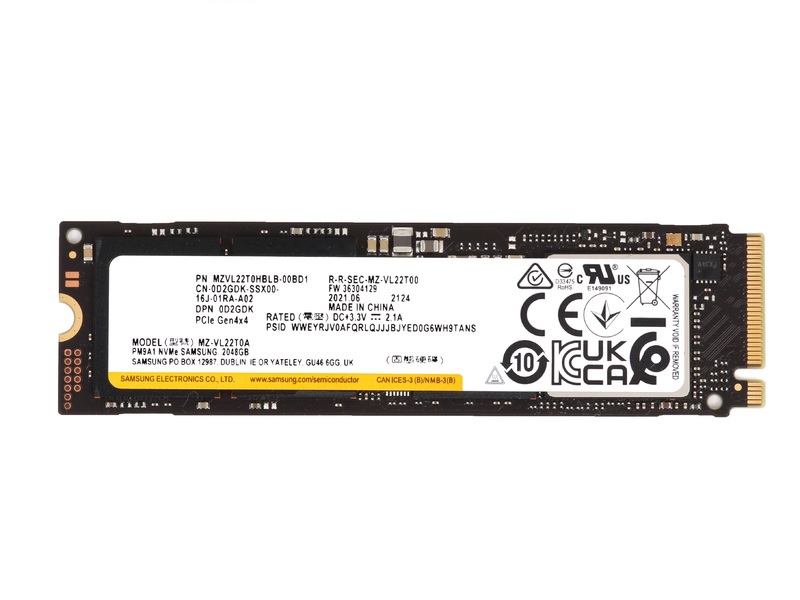
Compared with the MZ-VLB2T0B predecessor, the Samsung PM9A1 MZ-VL22T0A makes a clear generational jump to PCIe 4.0 x4, delivering up to 7000/5200 MB/s and 1,000,000/850,000 IOPS—roughly doubling the bandwidth class of Samsung’s earlier PCIe 3.0 OEM 2 TB drive. With Samsung V6 128-layer TLC and 1200 TBW at 0.3 DWPD, this MPN is especially well suited to high-end workstation boot, code-build, and content-creation scratch workloads that need near-flagship speed without giving up client-grade endurance.
With an endurance rating of 1200 TBW, this 2 TB SSD can sustain about 330 GB of writes per day for 10 years, which is far beyond the write volume of most OS, office, and general business workloads. In practical terms, for use as a system drive or standard business application drive, this endurance level provides a strong margin for long-term, worry-free operation. An UBER of 1.0E-17 indicates an extremely low probability of unrecoverable bit errors, supporting high data integrity in normal enterprise and commercial use, while the 1.5 million-hour MTBF further reflects solid long-term reliability expectations. This model does not include power-loss protection, so for environments with frequent sudden power interruptions it should be paired with proper shutdown controls or UPS support, but in stable power conditions it remains a dependable choice for routine business deployment.
1. The PCIe 4.0 x4 interface with NVMe 1.3 unlocks host-side bandwidth and parallel queue efficiency that keep virtualization clusters and analytics nodes from being bottlenecked by storage.
2. With sequential read performance up to 7000 MB/s, the drive accelerates large-block workloads such as database snapshots, VM image loading, and data lake ingestion.
3. Its 1,000,000 K random read IOPS capability is built for heavily concurrent enterprise applications, sustaining fast response under mixed access patterns from OLTP, metadata, and containerized services.
4. Rated at 0.3 DWPD, it is best aligned with read-centric enterprise deployments where predictable longevity matters more than intensive daily overwrite activity.
5. Samsung V6 128-layer TLC NAND, combined with a typical latency of 80 µs, delivers a strong balance of density, cost efficiency, and consistently quick access for scale-out servers and cloud storage tiers.
Lower capacity reference: 1 TB Higher capacity reference: 4 TB Across this series, the 1 TB and 4 TB options typically deliver broadly similar sequential read/write throughput and random IOPS to the 2 TB model, which is common for enterprise SSD product stacks. Capacity positioning analysis: The 2 TB model sits at the sweet spot of the family. Compared with the 1 TB version, it gives materially better headroom for OS images, application growth, logs, and snapshot retention, reducing early capacity pressure. Compared with the 4 TB option, it preserves most of the same enterprise-class performance while keeping acquisition cost and per-node storage spend under tighter control. It is best suited for mid-scale deployments, such as a 3-node virtualization cluster hosting around 60 to 80 mixed application and infrastructure virtual machines.
Q: Is MZ-VL22T0A suitable for a write-heavy database server?
A: Not ideally. With 0.3 DWPD, TLC NAND, and no PLP, MZ-VL22T0A is better for read-centric or mixed workloads than sustained write-heavy database server environments.
Q: How many full drive writes per day can it actually endure over its warranty period?
A: It is rated for 0.3 drive writes per day. For a 2 TB SSD, that equals about 0.6 TB of writes daily within its specified endurance limits.
Q: Does it include power loss protection (PLP) and why is that critical?
A: No, it does not include PLP. This matters because PLP helps protect in-flight data and metadata during sudden power loss, reducing corruption risk in enterprise workloads.
Q: What RAID level is recommended for this SSD?
A: RAID 1 or RAID 10 is generally recommended, depending on capacity and performance needs. These levels provide redundancy and are safer choices, especially since the drive lacks PLP.