











 Secure payments
Standard refund policy
Trade Assurance
Secure payments
Standard refund policy
Trade Assurance
| Brand | Samsung |
|---|---|
| Model | PM853T |
| Capacity | 240 GB |
| Usage Class | Read Intensive |
| Host Interface | SATA 6Gb/s |
|---|---|
| Total Interface Bandwidth | 6 Gb/s |
| Form Factor | 2.5 |
|---|
| NAND Flash | Samsung 2D Planar TLC |
|---|---|
| Drive Writes Per Day | 0.3 |
| Total Bytes Written | 165 TBW |
| Sequential Read | 530 MB/s |
|---|---|
| Sequential Write | 270 MB/s |
| Random Read IOPS | 87000 |
| Random Write IOPS | 15000 |
| Average Latency | 120 μs |
| Mean Time Between Failures | 2 Million Hours |
|---|---|
| Uncorrectable Bit Error Rate | 1.0×10⁻¹⁷ |
| Power Loss Protection | Yes |
| MPN | MZ7TE240HMHP-00003 |
|---|
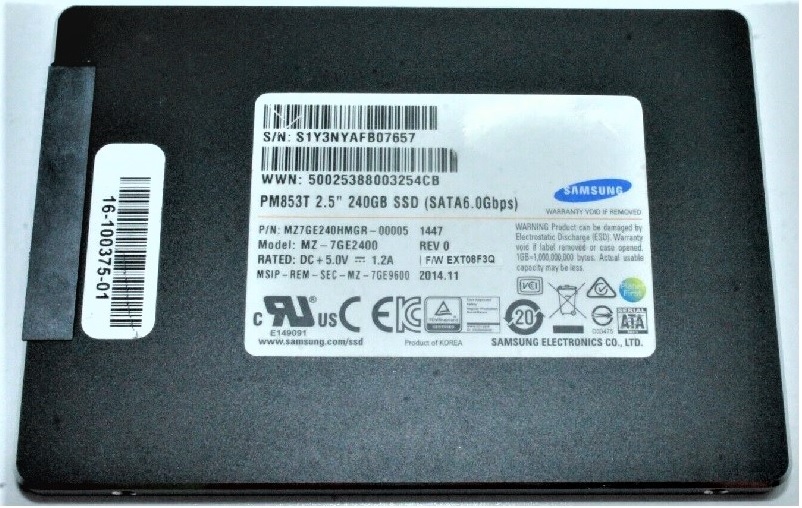
Compared with the previous-generation MZ7TE240HMHP-00003, the Samsung PM853T (MZ7GE240HMGR) delivers a more cost-efficient enterprise SATA design by pairing Samsung 2D Planar TLC with 165 TBW endurance, while still sustaining 530 MB/s sequential read performance and up to 87,000 random read IOPS. At 240 GB with 0.3 DWPD, it is a strong fit for read-centric boot, cache, and server OS volumes where consistent SATA 6Gb/s performance and lower $/GB matter more than write-heavy endurance.
With an endurance rating of 165 TBW and 0.3 DWPD, the MZ7GE240HMGR is well suited for typical read-focused enterprise and client workloads, including OS boot, application hosting, and general-purpose system drive use. In practical terms, this means that under normal daily write levels, it can serve reliably as a system disk for many years, giving buyers confidence in long-term deployment stability. For enterprise reliability, the drive includes Power Loss Protection (PLP), which helps preserve in-flight data and metadata during an unexpected power outage, reducing the risk of corruption and improving system recovery integrity. Its UBER of 1.0E-17 indicates an extremely low uncorrectable bit error rate, supporting high data integrity, while the 2 million-hour MTBF further reinforces dependable operation in professional environments.
1. The SATA interface pairs broad server and storage-array compatibility with near bus-limit sequential read performance, making it a practical drop-in upgrade for faster boot, backup, and bulk data access in legacy enterprise platforms.
2. Strong random read capability helps accelerate metadata lookups, VDI boot storms, and read-heavy database queries, improving responsiveness when many small requests hit the drive at once.
3. Its light endurance profile is best aligned with read-centric enterprise workloads such as content delivery, reference datasets, and OS or application boot volumes rather than intensive write logging or cache-tier use.
4. Samsung’s planar TLC NAND balances cost efficiency and usable capacity, giving organizations an economical option for scaling read-focused storage without paying for higher-endurance flash unnecessarily.
5. Low typical read latency supports faster transaction acknowledgment and more predictable application response times, which is especially valuable in virtualized environments and latency-sensitive business services.
In the MZ7GE series, the nearest lower-capacity option is 120 GB, while the next higher-capacity option is 480 GB. The 240 GB model sits at the practical sweet spot: it offers noticeably more headroom than 120 GB for OS growth, logs, patches, and swap activity, while avoiding the higher acquisition cost of 480 GB when the workload does not need extra capacity. Since sequential throughput and random IOPS are broadly similar across these capacities, 240 GB is the most balanced choice for compact enterprise deployments, such as a 12- to 20-node edge virtualization cluster.
Q: Is MZ7GE240HMGR suitable for a write-heavy database server?
A: Not ideally. With 0.3 DWPD and 165 TBW, the MZ7GE240HMGR is better suited for read-intensive or mixed workloads rather than sustained write-heavy database server environments.
Q: How many full drive writes per day can it actually endure over its warranty period?
A: This model is rated for 0.3 drive writes per day, meaning it can handle about 30% of its 240 GB capacity in writes daily over warranty conditions.
Q: Does it include power loss protection (PLP) and why is that critical?
A: Yes, it includes power loss protection. PLP helps preserve in-flight data and mapping tables during sudden outages, reducing corruption risk and improving reliability in business systems.
Q: What RAID level is recommended for this SSD?
A: RAID 1 or RAID 10 is generally recommended, depending on capacity and performance needs. These levels provide redundancy and help improve availability for enterprise or critical workloads.